


Harry Shum's office may be one of the best places to witness the next stage of China's rise as an economic powerhouse.
Set in the heart of the Haidian District in Beijing, with its canyons of universities, laboratories and high-technology ventures, his office occupies a corner of Microsoft Research Asia, the software giant's ambitious effort to tap scientific brainpower in China.

PHOTO: NY TIMES
Shum oversees 170 scientists who huddle around computers in gray cubicles to brainstorm and tinker with ideas that may one day drive Microsoft's technological empire to even greater heights.
"Microsoft began to realize we can't find all the talented people in the US," Shum said. Pointing outside, he added: "Nowhere in this universe has a higher concentration of IQ power."
Microsoft is not the only multinational company to use China as a base for research and development. In recent years hundreds of them have set up laboratories here, and Chinese officials claim the number is growing by 200 a year.
The laboratories vary in size and ambition, but as they multiply and expand they may help China grow from mostly a user and copier of advanced technologies developed elsewhere into a powerful incubator of its own, industry executives and experts say. And the shift may eventually reshape applied research, jobs and policies in the US and other developed countries.
But it is far from certain that China will reap the full rewards of this flowering. Planting and nurturing corporate labs is a delicate business, and in China they are buffeted by concerns about protecting patents, retaining and training researchers, and managing the distances -- physical and cultural -- between here and headquarters.
Inexpensive scientists
When Microsoft opened its Beijing laboratory in late 1998, it was among the first multinationals to establish a large research center in China. It hoped investing in research here would help pry open the door to two dazzling prizes: China's large reservoir of skilled but inexpensive scientists, and its consumers, still relatively poor but growing richer and eager for new technology.
After considering several sites in Asia, Microsoft settled on the Haidian District, home to some 40 universities, 138 scientific institutes and many of China's 810,000 research scientists and engineers.
"China was really the No.1 target from the beginning," Richard Rashid, the senior vice president of Microsoft Research, said in a telephone interview from corporate headquarters in Redmond, Washington. "We felt there was a tremendously deep pool of talent there."
"There are a lot of really good scientists and engineers coming from Chinese universities," said Maximilian von Zedtwitz, who teaches management at Qinghua University here. "Their first choice is to go abroad, but their second choice is to work in China for foreign companies."
When the Microsoft laboratory first announced openings for 50 positions, it was deluged with tens of thousands of applications, said Zhang Ya-Qin, the former managing director of the laboratory who is now a company vice president in charge of Microsoft's mobile technology.
The expansion of foreign laboratories in China is bound to spark further debate, similar to the controversy over offshoring of technology services, about the implications of the increasing globalization of corporate research.
Executives at Microsoft and other companies argue that their Chinese laboratories are not taking jobs away from the US or elsewhere. "There's an internationalization of research going on," Rashid said. "That's a good thing. The more smart people, the more innovation, and the more benefits for companies like Microsoft."
Advanced research
The starting point for this research boom is China's growing importance and sophistication as a market for technology, especially telecommunications and the Internet, industry executives said.
Recently, Oracle opened a laboratory in Beijing to tailor its Linux operating software to suit its Asian customers, and companies like Motorola, Siemens, IBM and Intel are going even further, running full-scale labs that work on their companies' most advanced products.
Although experts say that China's growth as an international research base will continue, many also said that growth could be slowed or ultimately endangered by the growing pains and legal uncertainties.
The most immediate threat is China's laxity in safeguarding intellectual property rights, which makes it too easy for innovations and industrial secrets to leak out, only to reappear in a Chinese competitor's product catalogue. Multinationals' growing resentment of theft of patents and trade secrets is leading some to threaten to quit China for India, Von Zedtwitz said.
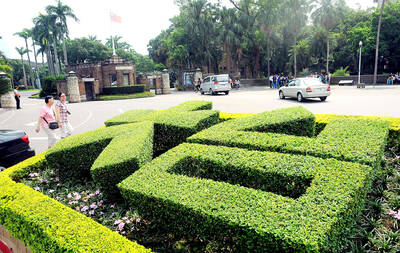
Taiwan has experienced its most significant improvement in the QS World University Rankings by Subject, data provided on Sunday by international higher education analyst Quacquarelli Symonds (QS) showed. Compared with last year’s edition of the rankings, which measure academic excellence and influence, Taiwanese universities made great improvements in the H Index metric, which evaluates research productivity and its impact, with a notable 30 percent increase overall, QS said. Taiwanese universities also made notable progress in the Citations per Paper metric, which measures the impact of research, achieving a 13 percent increase. Taiwanese universities gained 10 percent in Academic Reputation, but declined 18 percent
RETHINK? The defense ministry and Navy Command Headquarters could take over the indigenous submarine project and change its production timeline, a source said Admiral Huang Shu-kuang’s (黃曙光) resignation as head of the Indigenous Submarine Program and as a member of the National Security Council could affect the production of submarines, a source said yesterday. Huang in a statement last night said he had decided to resign due to national security concerns while expressing the hope that it would put a stop to political wrangling that only undermines the advancement of the nation’s defense capabilities. Taiwan People’s Party Legislator Vivian Huang (黃珊珊) yesterday said that the admiral, her older brother, felt it was time for him to step down and that he had completed what he
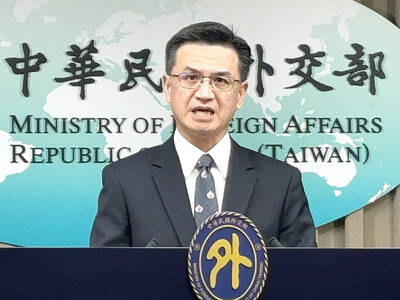
BULLY TACTICS: Beijing has continued its incursions into Taiwan’s airspace even as Xi Jinping talked about Taiwan being part of the Chinese family and nation China should stop its coercion of Taiwan and respect mainstream public opinion in Taiwan about sovereignty if its expression of goodwill is genuine, the Ministry of Foreign Affairs (MOFA) said yesterday. Ministry spokesman Jeff Liu (劉永健) made the comment in response to media queries about a meeting between former president Ma Ying-jeou (馬英九) and Chinese President Xi Jinping (習近平) the previous day. Ma voiced support for the so-called “1992 consensus,” while Xi said that although the two sides of the Taiwan Strait have “different systems,” this does not change the fact that they are “part of the same country,” and that “external

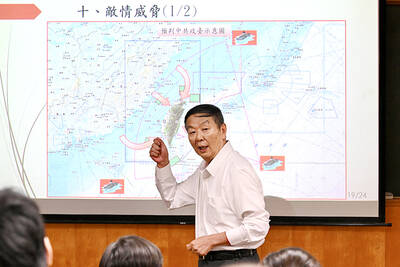
UNDER DISCUSSION: The combatant command would integrate fast attack boat and anti-ship missile groups to defend waters closest to the coastline, a source said The military could establish a new combatant command as early as 2026, which would be tasked with defending Taiwan’s territorial waters 24 nautical miles (44.4km) from the nation’s coastline, a source familiar with the matter said yesterday. The new command, which would fall under the Naval Command Headquarters, would be led by a vice admiral and integrate existing fast attack boat and anti-ship missile groups, along with the Naval Maritime Surveillance and Reconnaissance Command, said the source, who asked to remain anonymous. It could be launched by 2026, but details are being discussed and no final timetable has been announced, the source


 RSS
RSS