


United Parcel Service Inc chief executive Michael Eskew said China is using unfair barriers to block foreign competition and has failed to do enough to combat product piracy since joining the WTO.
"China is creating many new discriminative rules, after scrapping regulations that are directly against the WTO treaties," Eskew, also chairman of the Washington-based US-China Business Council, said in a speech to a trade fair in Xiamen.
"Foreign companies are seriously disadvantaged when competing with state companies," he said.
The US is pressing China for wider access to its domestic market and tougher action against illegal copying of US movies, software and films to help close a record US$124 billion trade gap.
China seized 2 million fake compact discs in the first half in its biggest piracy crackdown yet, the government said on Monday.
"On piracy issues, our attitude is clear and our action is resolute," Chinese Vice Premier Wu Yi (
China has asked foreign companies to adopt the nation's own technological and scientific standards in information technology, agriculture and other industries, Eskew said.
The government has also imposed high capital requirements or strict license application procedures to shut out competition, he said.
United Parcel, FedEx Corp and other companies have protested plans by China to bring in a revised postal law that the companies say is designed to protect the country's postal monopoly.
State-owned China Post has its own affiliated express delivery service, EMS.
"As far as we know, the draft law is not made to create a level playing ground, and does not encourage free competition," Eskew said. "China cannot attract foreign investment properly without a fully competitive logistics industry."
On piracy, the central government's attempts to crack down have been ineffective because local government enforcement has been too weak, according to Eskew.
"We will continue to work with the Chinese government and companies to make sure this problem will be solved effectively," he said.
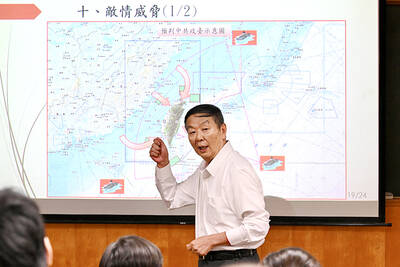
RETHINK? The defense ministry and Navy Command Headquarters could take over the indigenous submarine project and change its production timeline, a source said Admiral Huang Shu-kuang’s (黃曙光) resignation as head of the Indigenous Submarine Program and as a member of the National Security Council could affect the production of submarines, a source said yesterday. Huang in a statement last night said he had decided to resign due to national security concerns while expressing the hope that it would put a stop to political wrangling that only undermines the advancement of the nation’s defense capabilities. Taiwan People’s Party Legislator Vivian Huang (黃珊珊) yesterday said that the admiral, her older brother, felt it was time for him to step down and that he had completed what he
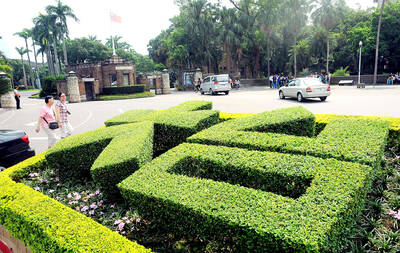
Taiwan has experienced its most significant improvement in the QS World University Rankings by Subject, data provided on Sunday by international higher education analyst Quacquarelli Symonds (QS) showed. Compared with last year’s edition of the rankings, which measure academic excellence and influence, Taiwanese universities made great improvements in the H Index metric, which evaluates research productivity and its impact, with a notable 30 percent increase overall, QS said. Taiwanese universities also made notable progress in the Citations per Paper metric, which measures the impact of research, achieving a 13 percent increase. Taiwanese universities gained 10 percent in Academic Reputation, but declined 18 percent
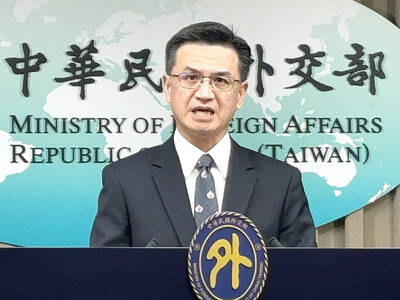
BULLY TACTICS: Beijing has continued its incursions into Taiwan’s airspace even as Xi Jinping talked about Taiwan being part of the Chinese family and nation China should stop its coercion of Taiwan and respect mainstream public opinion in Taiwan about sovereignty if its expression of goodwill is genuine, the Ministry of Foreign Affairs (MOFA) said yesterday. Ministry spokesman Jeff Liu (劉永健) made the comment in response to media queries about a meeting between former president Ma Ying-jeou (馬英九) and Chinese President Xi Jinping (習近平) the previous day. Ma voiced support for the so-called “1992 consensus,” while Xi said that although the two sides of the Taiwan Strait have “different systems,” this does not change the fact that they are “part of the same country,” and that “external

UNDER DISCUSSION: The combatant command would integrate fast attack boat and anti-ship missile groups to defend waters closest to the coastline, a source said The military could establish a new combatant command as early as 2026, which would be tasked with defending Taiwan’s territorial waters 24 nautical miles (44.4km) from the nation’s coastline, a source familiar with the matter said yesterday. The new command, which would fall under the Naval Command Headquarters, would be led by a vice admiral and integrate existing fast attack boat and anti-ship missile groups, along with the Naval Maritime Surveillance and Reconnaissance Command, said the source, who asked to remain anonymous. It could be launched by 2026, but details are being discussed and no final timetable has been announced, the source


 RSS
RSS