


OPEC president Purnomo Yus-giantoro blamed a "political premium" of US$10-US$15 a barrel for soaring oil prices yesterday, saying the oil cartel is exceeding its supply quotas but the market is not responding.
Purnomo said OPEC was concerned about the high oil prices but exceptional circumstances restricted its room to maneuvre on the issue.
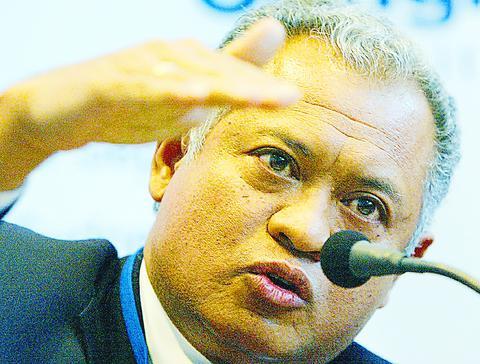
PHOTO: AP
"According to our view based on the fundamentals -- supply and demand values -- the price should not be as high as what we see today," he told reporters at the 19th World Energy Congress in Sydney.
"What we see is a political premium between 10-15 dollars per barrel," he said.
Purnomo, who is also Indonesia's energy minister, expects prices to fall from current levels of more than US$40 by the end of the year, based on contracts exchanged on oil futures markets.
In Asian trade yesterday, oil prices continued to weaken as concerns over the possible impact of Hurricane Frances on the southern US states which are home to major oil production and refinery facilities faded.
In early afternoon deals, New York's reference contract, light sweet crude for October delivery was at US$43.22 a barrel, down slightly from the US$43.31 close on Tuesday.
Purnomo also said the OPEC was likely to change its target band of US$22 to US$28 dollars a barrel at a meeting in Vienna on Sept. 15.
He refused to comment on where the revised band might be set but said it would reflect the impact of inflation and depreciation of the US dollar since the current target band was set in 2000.
Meanwhile, IMF Managing Director Rodrigo de Rato said he doesn't expect oil prices, which rose to a record last month, to fall back soon to a range of between $25 to $28 a barrel.
"There are some important structural changes that will keep the price in a certain range," de Rato said in an interview with Bloomberg while traveling from Johannesburg to Ouagadougou, the capital of Burkina Faso.
"Certainly the price that was set in most budgets of $25 to $28 per barrel is gone, so countries are going to revise that," he said.
"Supply is not rigid, but there is very little flexibility," de Rato said.
"Oil-consuming countries need to rethink their policies. There is a structural change in the energy situation because there is much stronger demand in most countries," he said.
Demand for the fuel is rising in countries ranging from South Africa to the UK and the US, he said.
"The central bank in South Africa sees that South Africa is consuming more oil," de Rato said. "The UK is for the first time a net importer and the US is using more oil."
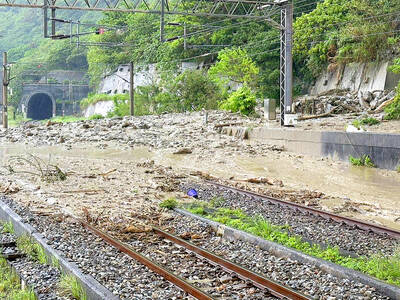
ROLLER-COASTER RIDE: More than five earthquakes ranging from magnitude 4.4 to 5.5 on the Richter scale shook eastern Taiwan in rapid succession yesterday afternoon Back-to-back weather fronts are forecast to hit Taiwan this week, resulting in rain across the nation in the coming days, the Central Weather Administration said yesterday, as it also warned residents in mountainous regions to be wary of landslides and rockfalls. As the first front approached, sporadic rainfall began in central and northern parts of Taiwan yesterday, the agency said, adding that rain is forecast to intensify in those regions today, while brief showers would also affect other parts of the nation. A second weather system is forecast to arrive on Thursday, bringing additional rain to the whole nation until Sunday, it

CONDITIONAL: The PRC imposes secret requirements that the funding it provides cannot be spent in states with diplomatic relations with Taiwan, Emma Reilly said China has been bribing UN officials to obtain “special benefits” and to block funding from countries that have diplomatic ties with Taiwan, a former UN employee told the British House of Commons on Tuesday. At a House of Commons Foreign Affairs Committee hearing into “international relations within the multilateral system,” former Office of the UN High Commissioner for Human Rights (OHCHR) employee Emma Reilly said in a written statement that “Beijing paid bribes to the two successive Presidents of the [UN] General Assembly” during the two-year negotiation of the Sustainable Development Goals. Another way China exercises influence within the UN Secretariat is
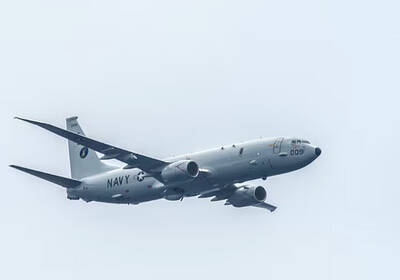
CHINA REACTS: The patrol and reconnaissance plane ‘transited the Taiwan Strait in international airspace,’ the 7th Fleet said, while Taipei said it saw nothing unusual The US 7th Fleet yesterday said that a US Navy P-8A Poseidon flew through the Taiwan Strait, a day after US and Chinese defense heads held their first talks since November 2022 in an effort to reduce regional tensions. The patrol and reconnaissance plane “transited the Taiwan Strait in international airspace,” the 7th Fleet said in a news release. “By operating within the Taiwan Strait in accordance with international law, the United States upholds the navigational rights and freedoms of all nations.” In a separate statement, the Ministry of National Defense said that it monitored nearby waters and airspace as the aircraft

Taiwan’s first drag queen to compete on the internationally acclaimed RuPaul’s Drag Race, Nymphia Wind (妮妃雅), was on Friday crowned the “Next Drag Superstar.” Dressed in a sparkling banana dress, Nymphia Wind swept onto the stage for the final, and stole the show. “Taiwan this is for you,” she said right after show host RuPaul announced her as the winner. “To those who feel like they don’t belong, just remember to live fearlessly and to live their truth,” she said on stage. One of the frontrunners for the past 15 episodes, the 28-year-old breezed through to the final after weeks of showcasing her unique


 RSS
RSS