


A series of stinging defeats for the US at the World Trade Organization may encourage US protectionism in a country where the administration is reluctant to impose the rules of international law on its lawmakers, analysts say.
The WTO last week authorized eight trading powers, including the EU and Japan, to slap sanctions on Washington for failing to abolish a provision in its anti-dumping laws that has already been found to fall foul of global trade rules.
The eight plaintiffs say punitive sanctions of more than US$150 million a year are in order over the offending legislation, which allows US industries to be paid anti-dumping duties levied on foreign competitors.
This latest putdown for Washington follows other US defeats in recent months over steel, cotton and tax breaks for US exporters, with sanctions in some cases running into billions of dollars.
"There is a risk that these defeats at the WTO entail a resurgence of American protectionism," said Jean-Pierre Lehmann, director of the Evian Group, a center specializing in trade matters.
"There is quite a nationalist and unilateralist atmosphere in the United States at the moment" in the administration of US President George W. Bush.
"Coupled with the enormous trade deficit that they are going through, that may have repercussions," he said.
A former Canadian trade negotiator at the Geneva-based WTO, John Weekes, who is now an advisor to a Geneva law firm, said the issue could well surface next year in the US Congress.
Next year, Congress will debate extending the law giving the president special powers for negotiating trade agreements, known as "fast-track" authority.
"The famous [former senator Robert] Dole Amendment to examine if the United States must, or not, stay in the WTO will be discussed," Weekes added.
Since its creation in 1995, the WTO's dispute settlement body has had the power to punish member states who flout the rules, unlike the WTO's predecessor, the GATT.
The US is in the same boat as all other members in having to adhere to the body's rules and cannot exert its influence as it can at other multilateral forums.
Washington respects WTO rulings if its trade rules can be changed by an administrative decision, Weekes pointed out.
But, in the case of the offending anti-dumping law, known as the Byrd Amendment after its sponsor Senator Robert Byrd of West Virginia and adopted by Congress in 2000 -- against the will of the administration -- the White House failed to convince lawmakers to abolish the provision.
Under the law, the US government distributes anti-dumping and anti-subsidies duties to the US companies that allege dumping, or the selling abroad at less than the market price on the domestic market.
"American parliamentarians do not worry about knowing if a proposed law is compatible or not with the rules of the WTO," Lehmann said.
And non-respect of WTO decisions may undermine its credibility, encouraging other big trading powers to ignore its rulings. "It's a dangerous game, it's playing with fire," Lehmann added.
But it is precisely this risk that could convince the US to respect the WTO, said Fabian Delcros, professor of WTO law at the Institute of Political Studies in Paris.
"The United States has a fundamental interest in remaining in the WTO since China entered at the end of 2001," he said, underscoring the growing importance of the Chinese market for US trade.
"That guarantees for the United States that China will apply the minimal basis of rules which allow a market economy to function."

ROLLER-COASTER RIDE: More than five earthquakes ranging from magnitude 4.4 to 5.5 on the Richter scale shook eastern Taiwan in rapid succession yesterday afternoon Back-to-back weather fronts are forecast to hit Taiwan this week, resulting in rain across the nation in the coming days, the Central Weather Administration said yesterday, as it also warned residents in mountainous regions to be wary of landslides and rockfalls. As the first front approached, sporadic rainfall began in central and northern parts of Taiwan yesterday, the agency said, adding that rain is forecast to intensify in those regions today, while brief showers would also affect other parts of the nation. A second weather system is forecast to arrive on Thursday, bringing additional rain to the whole nation until Sunday, it

CONDITIONAL: The PRC imposes secret requirements that the funding it provides cannot be spent in states with diplomatic relations with Taiwan, Emma Reilly said China has been bribing UN officials to obtain “special benefits” and to block funding from countries that have diplomatic ties with Taiwan, a former UN employee told the British House of Commons on Tuesday. At a House of Commons Foreign Affairs Committee hearing into “international relations within the multilateral system,” former Office of the UN High Commissioner for Human Rights (OHCHR) employee Emma Reilly said in a written statement that “Beijing paid bribes to the two successive Presidents of the [UN] General Assembly” during the two-year negotiation of the Sustainable Development Goals. Another way China exercises influence within the UN Secretariat is
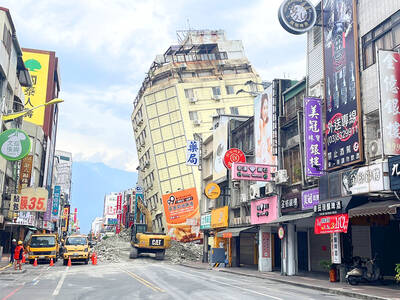
LANDSLIDES POSSIBLE: The agency advised the public to avoid visiting mountainous regions due to more expected aftershocks and rainfall from a series of weather fronts A series of earthquakes over the past few days were likely aftershocks of the April 3 earthquake in Hualien County, with further aftershocks to be expected for up to a year, the Central Weather Administration (CWA) said yesterday. Based on the nation’s experience after the quake on Sept. 21, 1999, more aftershocks are possible over the next six months to a year, the agency said. A total of 103 earthquakes of magnitude 4 on the local magnitude scale or higher hit Hualien County from 5:08pm on Monday to 10:27am yesterday, with 27 of them exceeding magnitude 5. They included two, of magnitude
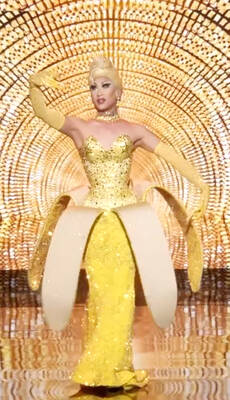
Taiwan’s first drag queen to compete on the internationally acclaimed RuPaul’s Drag Race, Nymphia Wind (妮妃雅), was on Friday crowned the “Next Drag Superstar.” Dressed in a sparkling banana dress, Nymphia Wind swept onto the stage for the final, and stole the show. “Taiwan this is for you,” she said right after show host RuPaul announced her as the winner. “To those who feel like they don’t belong, just remember to live fearlessly and to live their truth,” she said on stage. One of the frontrunners for the past 15 episodes, the 28-year-old breezed through to the final after weeks of showcasing her unique


 RSS
RSS