


OPEC spent years in the role of oil market stabilizer but its hands are tied as prices crest near all-time highs and its meeting next month is only likely to underscore the cartel's loss of clout, analysts say.
"They really can't do anything, they're producing effectively close to 100 percent capacity," said Bruce Evers, analyst at Investec Securities in London, referring to the OPEC meeting scheduled on Sept. 15 at the cartel's Vienna headquarters.
"I think all you will get is Saudi Arabia saying `we have plenty of spare capacity and we will be able to meet customers' demand,'" he said.
That tactic by the oil kingpin, he pointed out, has been tried already in recent weeks without much effect on the surge in oil prices, which almost hit US$50 a barrel in New York last week.
Oil prices moved up slightly in Asian trading Wednesday, but remained below US$46 a barrel with concerns about supply receding for now, dealers said.
New York's main contract, light sweet crude for October delivery, was US$0.14 higher at US$45.35 per barrel at 11:45am, from Tuesday's close of US$45.21 a barrel in New York.
It touched a morning high of US$45.45.
Evers questioned the willingness of Saudi Arabia to really implement emergency measures, technically risky for wells because they could subsequently prevent the recovery of a significant share of the oil underneath.
Meanwhile, Purnomo Yusgiantoro, the president of the 11-state Organization of Petroleum Exporting Countries, has conjured up the image of a powerful cartel response to the crisis.
"We hope for a significant solution to solve the rising oil prices" next month, he said.
Experts at the French Oil Institute (IFP), a specialized industrial research and development center, said that "in the current circumstances, the capacity of OPEC to rein in the high price of crude is weak."
The cartel's surplus capacities, which formerly conferred its role as the giant producer and market power despite the fact that OPEC produces only about 40 percent of the world's supply, have dwindled.
The surplus fell to about one billion barrels a day in the spring of 2004, from 4.6 million barrels a day in 2002, IFP noted.
As a result, the main regulatory tool at the cartel's disposal, its production quotas, have become virtually useless, and the decisions on their levels, which traditionally had shaped the price, have lost all significance, IFP said.
In fact, the members have systematically produced more than their quotas for months.
The London-based Centre for Global Energy Studies identified another problem: OPEC has underinvested in its production capacities for years, while demand, boosted by the economic recovery and the growth in emerging countries, notably China and India, has reached the boiling point.
"OPEC has refrained from adding to its capacity since 2000, disregarding market signals such as growing demand and rising prices," CGES said.
"They've completely underestimated the demand," said Invsetec's Evers. "Everything that could go wrong has gone wrong."
Evers said the cartel has never known such impotence, and is the prime reason for it.
OPEC, in its monthly report published last week, said its production was more than adequate to meet demand through 2005, but admitted that the currently high level of oil prices is encouraging speculation.
For Evers, OPEC is above all trying to absolve itself from responsibility in the situation by pinning the blame on underinvestment by oil companies.
"I think they realize now they have to invest heavily in additional capacity, but to get a lot of additional capacity, it's going to cost a lot of money and take time," he said.
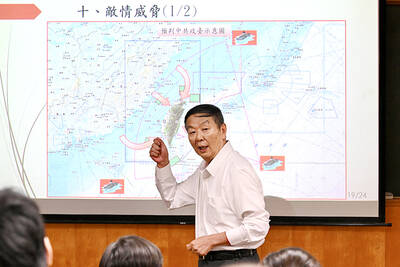
RETHINK? The defense ministry and Navy Command Headquarters could take over the indigenous submarine project and change its production timeline, a source said Admiral Huang Shu-kuang’s (黃曙光) resignation as head of the Indigenous Submarine Program and as a member of the National Security Council could affect the production of submarines, a source said yesterday. Huang in a statement last night said he had decided to resign due to national security concerns while expressing the hope that it would put a stop to political wrangling that only undermines the advancement of the nation’s defense capabilities. Taiwan People’s Party Legislator Vivian Huang (黃珊珊) yesterday said that the admiral, her older brother, felt it was time for him to step down and that he had completed what he

Taiwan has experienced its most significant improvement in the QS World University Rankings by Subject, data provided on Sunday by international higher education analyst Quacquarelli Symonds (QS) showed. Compared with last year’s edition of the rankings, which measure academic excellence and influence, Taiwanese universities made great improvements in the H Index metric, which evaluates research productivity and its impact, with a notable 30 percent increase overall, QS said. Taiwanese universities also made notable progress in the Citations per Paper metric, which measures the impact of research, achieving a 13 percent increase. Taiwanese universities gained 10 percent in Academic Reputation, but declined 18 percent
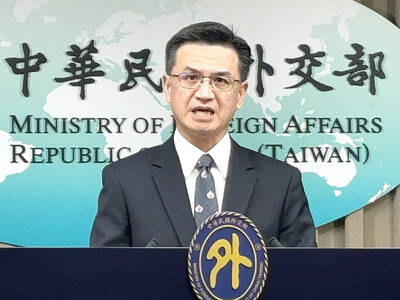
BULLY TACTICS: Beijing has continued its incursions into Taiwan’s airspace even as Xi Jinping talked about Taiwan being part of the Chinese family and nation China should stop its coercion of Taiwan and respect mainstream public opinion in Taiwan about sovereignty if its expression of goodwill is genuine, the Ministry of Foreign Affairs (MOFA) said yesterday. Ministry spokesman Jeff Liu (劉永健) made the comment in response to media queries about a meeting between former president Ma Ying-jeou (馬英九) and Chinese President Xi Jinping (習近平) the previous day. Ma voiced support for the so-called “1992 consensus,” while Xi said that although the two sides of the Taiwan Strait have “different systems,” this does not change the fact that they are “part of the same country,” and that “external
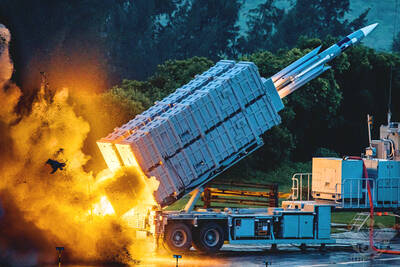
UNDER DISCUSSION: The combatant command would integrate fast attack boat and anti-ship missile groups to defend waters closest to the coastline, a source said The military could establish a new combatant command as early as 2026, which would be tasked with defending Taiwan’s territorial waters 24 nautical miles (44.4km) from the nation’s coastline, a source familiar with the matter said yesterday. The new command, which would fall under the Naval Command Headquarters, would be led by a vice admiral and integrate existing fast attack boat and anti-ship missile groups, along with the Naval Maritime Surveillance and Reconnaissance Command, said the source, who asked to remain anonymous. It could be launched by 2026, but details are being discussed and no final timetable has been announced, the source


 RSS
RSS