


On a day of trading clouded by fears of a potential terrorist attack, John Thain, the chief executive of the New York Stock Exchange, announced on Monday his long awaited plan to increase electronic trading that could diminish the historic role of floor traders.
His proposal, which will allow institutional investors to trade large blocks of stock electronically, is a radical shift for the exchange and its 1,366 members.
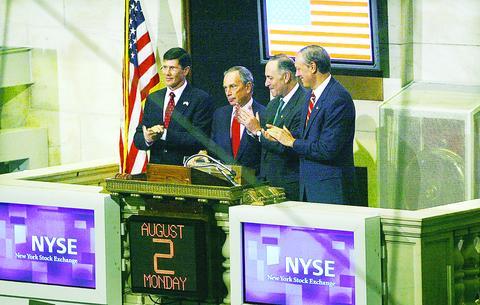
PHOTO: AFP
It is all the more ambitious for being introduced during a time of nervousness in the markets spurred by the onset of rising interest rates, terrorist threats and political uncertainty.
After the weekend news that the exchange and other financial institutions were possible targets of terrorist attacks, New York's leading politicians were at the exchange on Monday morning, from Senator Charles Schumer, a Democrat, who greeted traders as they entered the building in the morning, to Governor George Pataki and Mayor Michael Bloomberg who rang the opening bell.
"We are open for business," Thain said Monday as he stood before the statue of George Washington on the steps of monument hall, with Schumer beside him.
Missing from Thain's clipped, to-the-point remarks was the patriotic oratory that his predeces-sor, Richard Grasso, favored, especially in the aftermath of the Sept. 11 terror attacks.
But for Thain, a former president of Goldman Sachs who directed the firm's aggressive investments in electronic trading, his expertise lies less in promoting the exchange and more in mastering the technological details of his new plan and persuading the Big Board's many constituencies to adopt it.
Defenders of the New York Stock Exchange's two-centuries-old open outcry system, which relies on specialist traders to use their trading acumen and capital to help investors find the best price for a stock, say that now, more than ever, the experience and know-how of the floor trader is needed to ensure price stability.
At a news conference on Monday, however, Thain said the new program, which is called Direct Plus, was designed so that large institutional investors such as Fidelity and American Century would conduct more of their electronic trades with the New York Stock Exchange.
"If we didn't respond to our customer base," Thain said. "They would pull their volume off and trade on the electronic markets."
The stock exchange's market share is currently 80 percent, having dipped to a low of 75 percent in January during the controversy over Grasso's pay.
Institutional investors have long complained that they cannot trade with speed and anonymity at the exchange and, as a result, they have channeled much of their trading to the Big Board's electronic competitors.
A draft of the Direct Plus proposal was sent to the Securities and Exchange Commission, the exchange's main regulator, on Monday for approval.
Thain said he expected the new version of Direct Plus to become operational within six to 12 months.

ROLLER-COASTER RIDE: More than five earthquakes ranging from magnitude 4.4 to 5.5 on the Richter scale shook eastern Taiwan in rapid succession yesterday afternoon Back-to-back weather fronts are forecast to hit Taiwan this week, resulting in rain across the nation in the coming days, the Central Weather Administration said yesterday, as it also warned residents in mountainous regions to be wary of landslides and rockfalls. As the first front approached, sporadic rainfall began in central and northern parts of Taiwan yesterday, the agency said, adding that rain is forecast to intensify in those regions today, while brief showers would also affect other parts of the nation. A second weather system is forecast to arrive on Thursday, bringing additional rain to the whole nation until Sunday, it

CONDITIONAL: The PRC imposes secret requirements that the funding it provides cannot be spent in states with diplomatic relations with Taiwan, Emma Reilly said China has been bribing UN officials to obtain “special benefits” and to block funding from countries that have diplomatic ties with Taiwan, a former UN employee told the British House of Commons on Tuesday. At a House of Commons Foreign Affairs Committee hearing into “international relations within the multilateral system,” former Office of the UN High Commissioner for Human Rights (OHCHR) employee Emma Reilly said in a written statement that “Beijing paid bribes to the two successive Presidents of the [UN] General Assembly” during the two-year negotiation of the Sustainable Development Goals. Another way China exercises influence within the UN Secretariat is

LANDSLIDES POSSIBLE: The agency advised the public to avoid visiting mountainous regions due to more expected aftershocks and rainfall from a series of weather fronts A series of earthquakes over the past few days were likely aftershocks of the April 3 earthquake in Hualien County, with further aftershocks to be expected for up to a year, the Central Weather Administration (CWA) said yesterday. Based on the nation’s experience after the quake on Sept. 21, 1999, more aftershocks are possible over the next six months to a year, the agency said. A total of 103 earthquakes of magnitude 4 on the local magnitude scale or higher hit Hualien County from 5:08pm on Monday to 10:27am yesterday, with 27 of them exceeding magnitude 5. They included two, of magnitude

Taiwan’s first drag queen to compete on the internationally acclaimed RuPaul’s Drag Race, Nymphia Wind (妮妃雅), was on Friday crowned the “Next Drag Superstar.” Dressed in a sparkling banana dress, Nymphia Wind swept onto the stage for the final, and stole the show. “Taiwan this is for you,” she said right after show host RuPaul announced her as the winner. “To those who feel like they don’t belong, just remember to live fearlessly and to live their truth,” she said on stage. One of the frontrunners for the past 15 episodes, the 28-year-old breezed through to the final after weeks of showcasing her unique


 RSS
RSS