


Dell has grown from nothing into a US$41.4 billion company in only 20 years, and its next target is US$60 billion in annual sales. Where is the extra revenue going to come from? Dell is already manufacturing PCs at a phenomenal rate -- almost one per second, more than 84,000 a day -- so the years of explosive PC growth may be coming to an end. Dell is therefore focusing more on its business outside the US, and turning to two new areas: peripherals and services.
Selling peripherals such as printers, scanners and even TV sets is fairly simple. Dell already has the sales and fulfilment infrastructure in place: it can take an order and ship a product.
"As we standardize our approach to overseas markets, there are great opportunities to standardize the service offerings as well," says Neil Hand, director of worldwide enterprise team at Dell in Austin, Texas.
Forget about having US$1,800-a-day consultants climbing all over your offices, re-engineering your business and ordering custom programming. What Dell has in mind is a menu with a price list, like McDonald's.
The services will be straightforward and clearly defined: maybe you want PCs delivered from the factory with your software already installed. Perhaps you want a Microsoft Exchange mail server set up, or a high-performance computing cluster installed. Or you just want someone to take away old PCs, erase the data on the drives, and dispose of them in an environmentally friendly way.
"Our services strategy is very closely tied to our hardware strategy," explains Jeff Kimbell, director of marketing in Europe, responsible for the non-consumer part of Dell's business.
"We're not building a services business in order to become a services company: we're building it to complement and enhance our core hardware business, so customers get a better experience," he said.
Instead of selling services and hoping hardware sales will follow, most of Dell's service offerings ride on the back of hardware sales: do you want installation with that?
This may not appeal to large companies with lots of IT staff -- Dell has a Professional Services group to handle those.
However, small and medium-sized businesses (SMBs) are often short of information technology (IT) skills, and could be interested. They also represent a relatively untapped market.
"They have a good point," says Alan Mac Neela, a vice president of Gartner Research in the UK.
"The SMB market is very poorly served, and has been for a long time. Selling services with hardware -- we call them `product affinity services' -- would be quite interesting, because they have the ability to do that. But one of the issues with SMBs is that you need to sell to an awful lot of them to make a reasonable amount of money, and that's going to be tricky," he said.
Dell reckons that on current sales, it is making US$3 billion a year from services, and Mac Neela thinks that is not to begger than all of Dell -- US$42.6 billion last year.
The big problem with services is that it is people intensive, whereas Dell runs a famously tight ship. Wouldn't a global services offering require an enormous staff?
"Traditionally it would," says Aamir Paul, senior manager of services marketing for Dell in Europe.
"But we said: `Let's not get feet on the street, let's get the right partners. There's a supply chain out there, let's use it to drive standards on behalf of our customers.' It's not outsourcing: customers are still dealing with Dell, with a single point of ownership," Paul said.
Dell says it is taking the same approach as it did when supplying PCs direct -- process definition, standardization, commoditization, inventory and supply chain management, and so on. But instead of supplying a PC, it's supplying a service such as Transfer My PC.
How many SMB customers will actually want to pay for installation, data migration, server consolidation and similar services is another matter.
If they don't have a clear idea of their own costs, they may not find the list prices attractive. But since Dell is not making big investments in staff, offices, equipment and infrastructure, it's probably not too bothered.
"There's a lot of frustration out there today," Kimbell adds. "Our strategy is about making customers happy, because happy customers come back and buy more stuff."

Taiwan has experienced its most significant improvement in the QS World University Rankings by Subject, data provided on Sunday by international higher education analyst Quacquarelli Symonds (QS) showed. Compared with last year’s edition of the rankings, which measure academic excellence and influence, Taiwanese universities made great improvements in the H Index metric, which evaluates research productivity and its impact, with a notable 30 percent increase overall, QS said. Taiwanese universities also made notable progress in the Citations per Paper metric, which measures the impact of research, achieving a 13 percent increase. Taiwanese universities gained 10 percent in Academic Reputation, but declined 18 percent
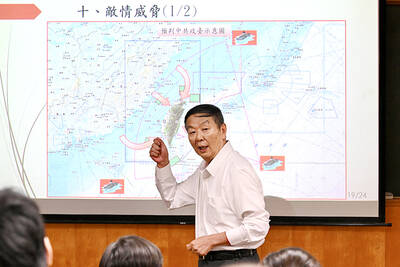
RETHINK? The defense ministry and Navy Command Headquarters could take over the indigenous submarine project and change its production timeline, a source said Admiral Huang Shu-kuang’s (黃曙光) resignation as head of the Indigenous Submarine Program and as a member of the National Security Council could affect the production of submarines, a source said yesterday. Huang in a statement last night said he had decided to resign due to national security concerns while expressing the hope that it would put a stop to political wrangling that only undermines the advancement of the nation’s defense capabilities. Taiwan People’s Party Legislator Vivian Huang (黃珊珊) yesterday said that the admiral, her older brother, felt it was time for him to step down and that he had completed what he
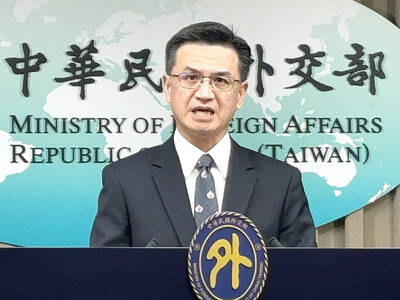
BULLY TACTICS: Beijing has continued its incursions into Taiwan’s airspace even as Xi Jinping talked about Taiwan being part of the Chinese family and nation China should stop its coercion of Taiwan and respect mainstream public opinion in Taiwan about sovereignty if its expression of goodwill is genuine, the Ministry of Foreign Affairs (MOFA) said yesterday. Ministry spokesman Jeff Liu (劉永健) made the comment in response to media queries about a meeting between former president Ma Ying-jeou (馬英九) and Chinese President Xi Jinping (習近平) the previous day. Ma voiced support for the so-called “1992 consensus,” while Xi said that although the two sides of the Taiwan Strait have “different systems,” this does not change the fact that they are “part of the same country,” and that “external
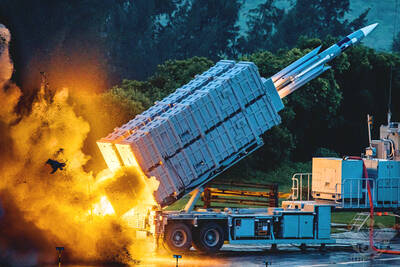
UNDER DISCUSSION: The combatant command would integrate fast attack boat and anti-ship missile groups to defend waters closest to the coastline, a source said The military could establish a new combatant command as early as 2026, which would be tasked with defending Taiwan’s territorial waters 24 nautical miles (44.4km) from the nation’s coastline, a source familiar with the matter said yesterday. The new command, which would fall under the Naval Command Headquarters, would be led by a vice admiral and integrate existing fast attack boat and anti-ship missile groups, along with the Naval Maritime Surveillance and Reconnaissance Command, said the source, who asked to remain anonymous. It could be launched by 2026, but details are being discussed and no final timetable has been announced, the source


 RSS
RSS