


Fuelled by a credit crunch and rumors of a list of banks soon to be closed, fears of a new banking crisis gripped Russia's financial markets last week as analysts hurried to assure there was no cause for panic.
A repeat of the 1998 financial crisis is unlikely, analysts say, because the central bank has plenty of reserves to provide any needed liquidity, and with no sign of retail panic, the tension will likely blow over.
Once the smoke clears, however, many of Russia's myriad of small "boutique" banks may find themselves out of business, they say.
"There is no cause for any banking sector crisis," wrote Moscow's Renaissance Capital investment bank. "If necessary, the central bank can and will step in by injecting liquidity into the inter-bank market."
The trouble started in mid-May, when Russia's central bank pulled the license of Sodbusinessbank, accusing the medium-sized financial institution of money laundering and regulatory violations.
When the bank resisted bankruptcy proceedings, the central bank physically took control of it with the help of police.
After the shutdown, hundreds of irate Sodbusinessbank customers lined up outside its branches, demanding their money -- the first such scenes since the 1998 financial crisis that saw tens of thousands of Russians lose their life savings.
In an uneasy climate, the latest events have sparked furious rumors of which of Russia's estimated 1,300 banks would be next to face the central bank's wrath.
Credittrustbank, which was thought to have the same owners as Sodbusinessbank, immediately fell under suspicion.
Other banks cut off their credit lines to Credittrust, customers closed accounts and today the bank faces bankruptcy.
Following Credittrust's fall, the jitters grew. First, rumors flew that the central bank had a list of banks that would be next to face the ax -- something that its officials strenuously denied.
Rates on the interbank market shot up as many banks stopped lending to each other. "Russian banks are closing credit facilities to each other en mass," UFG wrote.
By Friday, President Vladimir Putin got involved, telling Central Bank chief Sergei Ignatiyev during a Kremlin meeting: "I hope that you do not intend to carry out any mass mopping-up operations of the banking system."
Meanwhile analysts insist that despite the worrying signs, the crisis will dissipate.
For one, they say, there has been no panic among retail investors.
"It is inevitable that a proportion [banks' retail clients] will take out deposits and place them back under the mattress," Renaissance said. But "only a very few major Moscow banks have any crucial dependence on retail funding and we believe that the central bank will support these banks in the event of any retail panic."
Said Christof Ruehl, head of the World Bank's Russia office: "It is conceivable that if people get nervous that panic spreads across different groups of banks, but that seems very unlikely."
Also, the structure of Russia's unreformed banking system is such that it minimizes the effects of the current jitters.
Most of Russia's banks are not the retail-oriented ones that are ubiquitous in the West, but small institutions often servicing a single company. Because they are not active on the interbank market, their closure would not affect sentiment, Ruehl said.
The "system is very strictly tiered, so there are these small banks on the bottom and they don't really deal with the interbank market at all," Ruehl said.
"Then there are some large private sector banks ... who do use the interbank market, but they are sufficiently separated from these small ones for there not to be any mechanical reason" for the spread of sentiment.
Last week's nerves highlight once again the need to reform the nation's banking sector, analysts say.
"Further banking reform ... is shown to be as urgent as ever," UFG said.
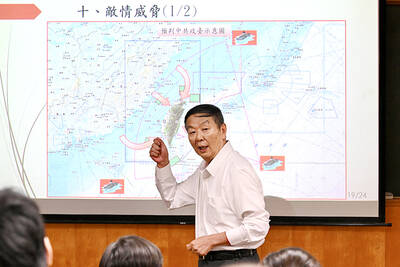
RETHINK? The defense ministry and Navy Command Headquarters could take over the indigenous submarine project and change its production timeline, a source said Admiral Huang Shu-kuang’s (黃曙光) resignation as head of the Indigenous Submarine Program and as a member of the National Security Council could affect the production of submarines, a source said yesterday. Huang in a statement last night said he had decided to resign due to national security concerns while expressing the hope that it would put a stop to political wrangling that only undermines the advancement of the nation’s defense capabilities. Taiwan People’s Party Legislator Vivian Huang (黃珊珊) yesterday said that the admiral, her older brother, felt it was time for him to step down and that he had completed what he

Taiwan has experienced its most significant improvement in the QS World University Rankings by Subject, data provided on Sunday by international higher education analyst Quacquarelli Symonds (QS) showed. Compared with last year’s edition of the rankings, which measure academic excellence and influence, Taiwanese universities made great improvements in the H Index metric, which evaluates research productivity and its impact, with a notable 30 percent increase overall, QS said. Taiwanese universities also made notable progress in the Citations per Paper metric, which measures the impact of research, achieving a 13 percent increase. Taiwanese universities gained 10 percent in Academic Reputation, but declined 18 percent
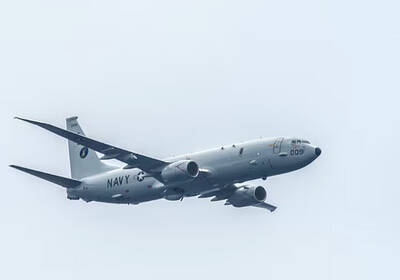
CHINA REACTS: The patrol and reconnaissance plane ‘transited the Taiwan Strait in international airspace,’ the 7th Fleet said, while Taipei said it saw nothing unusual The US 7th Fleet yesterday said that a US Navy P-8A Poseidon flew through the Taiwan Strait, a day after US and Chinese defense heads held their first talks since November 2022 in an effort to reduce regional tensions. The patrol and reconnaissance plane “transited the Taiwan Strait in international airspace,” the 7th Fleet said in a news release. “By operating within the Taiwan Strait in accordance with international law, the United States upholds the navigational rights and freedoms of all nations.” In a separate statement, the Ministry of National Defense said that it monitored nearby waters and airspace as the aircraft
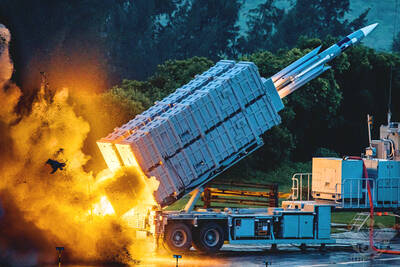
UNDER DISCUSSION: The combatant command would integrate fast attack boat and anti-ship missile groups to defend waters closest to the coastline, a source said The military could establish a new combatant command as early as 2026, which would be tasked with defending Taiwan’s territorial waters 24 nautical miles (44.4km) from the nation’s coastline, a source familiar with the matter said yesterday. The new command, which would fall under the Naval Command Headquarters, would be led by a vice admiral and integrate existing fast attack boat and anti-ship missile groups, along with the Naval Maritime Surveillance and Reconnaissance Command, said the source, who asked to remain anonymous. It could be launched by 2026, but details are being discussed and no final timetable has been announced, the source


 RSS
RSS