


Despite an expected production increase later this week, OPEC may not be able to pump enough oil to bring down prices that have been skyrocketing due to instability in the Middle East and increased world demand.
Analysts said record high oil prices of some US$40 a barrel may be driven by geopolitics and other global factors that are far beyond the reach of the Organization of Petroleum Exporting Countries, an 11-nation cartel that produces about a third of the world's oil and is already producing close to capacity.
OPEC president Purnomo Yusgiantoro said last week he was confident the cartel's ministers would agree to increase OPEC's oil production ceiling in an attempt to curb soaring world prices when they meet in Amsterdam on Friday.
Yusgiantoro said the ministers would discuss Saudi Arabia's proposal to raise output by 1.5 million barrels per day (bpd).
But analysts said OPEC was already overproducing and can do little more to push down prices.
Bruce Evers of Investec Securities said in London that OPEC production of some 2 million bpd over its official quota of 23.5 million bpd should already have lowered prices.
"But it did not happen because of extreme tensions in the Middle East and other producing countries ... and because demand is much stronger than people think," Evers noted.
"More oil in the market doesn't necessarily bring prices down," Deutsche Bank analyst Adam Sieminski said by phone from London. He said the real effect of an OPEC quota increase would be to add half a million bpd to the world market.
"The next move in oil prices depends at least as much on geopolitical factors as on how much oil is in the market," he said, pointing to concerns by oil traders about further stability in the Middle East, where even the world's largest oil producer Saudi Arabia is now threatened by terrorism.
Meanhwile, OPEC member Venezuela is having trouble increasing production "because of underspending" by its government and Nigeria is wracked by ethnic violence, Sieminski said.
In addition, demand for oil has grown despite warmer weather in the northern hemisphere as economies recover in the US and Japan and are booming in China.
"Japanese nuclear power plants are shut down because of problems they had a year ago," Sieminski said, noting that this meant Japan needed more oil.
Another key factor is tight gasoline supplies in the US as the warm weather driving season begins. High US gasoline prices "can help keep crude prices up" but are affected by more than the crude oil supply.
These prices have to do with shortages created by "refinery issues and incredibly complex gasoline rules" from the Environmental Protection Agency, Sieminski said.
He added that he did not think oil prices were sustainable at current high levels in the long-term but that in the short-term they were not likely to come down and could even spike to US$50 a barrel.
Concerns over supply were heightened after gunmen attacked a Saudi oil facility on May 1 at Yanbu port, killing five employees of the Swiss-Swedish engineering group ABB and a Saudi national guard soldier.
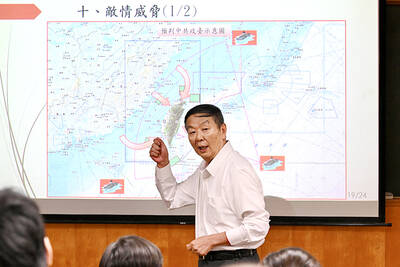
RETHINK? The defense ministry and Navy Command Headquarters could take over the indigenous submarine project and change its production timeline, a source said Admiral Huang Shu-kuang’s (黃曙光) resignation as head of the Indigenous Submarine Program and as a member of the National Security Council could affect the production of submarines, a source said yesterday. Huang in a statement last night said he had decided to resign due to national security concerns while expressing the hope that it would put a stop to political wrangling that only undermines the advancement of the nation’s defense capabilities. Taiwan People’s Party Legislator Vivian Huang (黃珊珊) yesterday said that the admiral, her older brother, felt it was time for him to step down and that he had completed what he

Taiwan has experienced its most significant improvement in the QS World University Rankings by Subject, data provided on Sunday by international higher education analyst Quacquarelli Symonds (QS) showed. Compared with last year’s edition of the rankings, which measure academic excellence and influence, Taiwanese universities made great improvements in the H Index metric, which evaluates research productivity and its impact, with a notable 30 percent increase overall, QS said. Taiwanese universities also made notable progress in the Citations per Paper metric, which measures the impact of research, achieving a 13 percent increase. Taiwanese universities gained 10 percent in Academic Reputation, but declined 18 percent
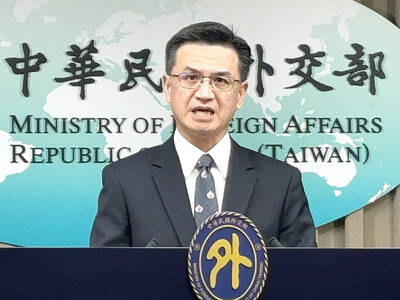
BULLY TACTICS: Beijing has continued its incursions into Taiwan’s airspace even as Xi Jinping talked about Taiwan being part of the Chinese family and nation China should stop its coercion of Taiwan and respect mainstream public opinion in Taiwan about sovereignty if its expression of goodwill is genuine, the Ministry of Foreign Affairs (MOFA) said yesterday. Ministry spokesman Jeff Liu (劉永健) made the comment in response to media queries about a meeting between former president Ma Ying-jeou (馬英九) and Chinese President Xi Jinping (習近平) the previous day. Ma voiced support for the so-called “1992 consensus,” while Xi said that although the two sides of the Taiwan Strait have “different systems,” this does not change the fact that they are “part of the same country,” and that “external
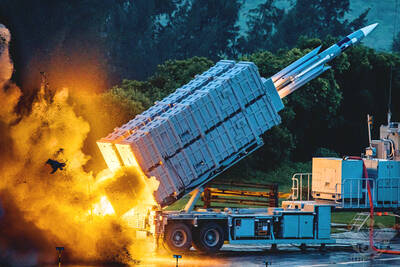
UNDER DISCUSSION: The combatant command would integrate fast attack boat and anti-ship missile groups to defend waters closest to the coastline, a source said The military could establish a new combatant command as early as 2026, which would be tasked with defending Taiwan’s territorial waters 24 nautical miles (44.4km) from the nation’s coastline, a source familiar with the matter said yesterday. The new command, which would fall under the Naval Command Headquarters, would be led by a vice admiral and integrate existing fast attack boat and anti-ship missile groups, along with the Naval Maritime Surveillance and Reconnaissance Command, said the source, who asked to remain anonymous. It could be launched by 2026, but details are being discussed and no final timetable has been announced, the source


 RSS
RSS