


In a rare concession to US trading demands, China is expected to pledge this week to crack down on pirating and counterfeiting of software, DVDs and other forms of intellectual property, according to American trade officials who have been preparing for trade talks here today.
Enforcement of intellectual property rights in China has been an economic priority for the George W. Bush administration during an election year in which the White House wants to show it is getting tough protecting American industry from unfair trading practices.
But the administration's previous strategy of sending senior officials to Beijing to publicly demand those changes failed to move the Chinese. Only by adopting a narrow agenda and carefully choreographing a one-day session at which both sides appear to be making concessions has the administration been able to coax the semblance of a compromise from the Chinese.
Now, after weeks of consultations in Beijing, in preparation for the meeting here today, administration officials expect the Chinese to present a "credible and effective action plan to reduce piracy and counterfeiting," according to Josette Shiner, deputy US trade representative.
The plan is likely to involve more aggressive enforcement by Chinese police officials, who have tended to ignore the brisk retail business in counterfeit software, DVDs and music CDs throughout China.
China is also expected to agree to speed up the full opening of its market to American goods and services -- something that had been scheduled to happen by December but may now take place months sooner.
In some other areas of dispute, though, people who have been involved in the briefings say that China may offer little more than nebulous promises -- a nonspecific commitment to stop using new taxes and new technical standards to block imports from the US, for example, and a stated intention to stop forcing the transfer of American technology to Chinese companies in exchange for doing business in China.
And on some other important areas of disagreement between the two countries -- including China's currency controls and labor practices, the textile industry and subsidies that the US pays to farmers -- the issues will not even be on the agenda.
Democrats are almost certain to seize upon the limitations of today's talks as evidence that the Bush administration is not being firm enough with China.
For China to make any concessions now is as much a reflection of new economic conditions as a serious change of heart. As Chinese leaders contend with an overheated economy and signs of potentially runaway inflation, they want a sure footing for their relationship with the US. If its economic bubble bursts, China will need an open US market if it hopes to have a soft landing.
"The Chinese understand this is not the time for an argument with the US," said Nayan Chanda, Asian academic and director of publications at Yale's Center for the Study of Globalization.
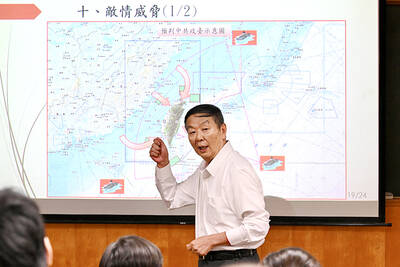
RETHINK? The defense ministry and Navy Command Headquarters could take over the indigenous submarine project and change its production timeline, a source said Admiral Huang Shu-kuang’s (黃曙光) resignation as head of the Indigenous Submarine Program and as a member of the National Security Council could affect the production of submarines, a source said yesterday. Huang in a statement last night said he had decided to resign due to national security concerns while expressing the hope that it would put a stop to political wrangling that only undermines the advancement of the nation’s defense capabilities. Taiwan People’s Party Legislator Vivian Huang (黃珊珊) yesterday said that the admiral, her older brother, felt it was time for him to step down and that he had completed what he
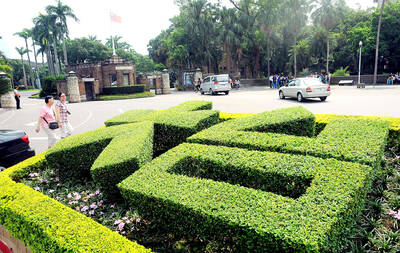
Taiwan has experienced its most significant improvement in the QS World University Rankings by Subject, data provided on Sunday by international higher education analyst Quacquarelli Symonds (QS) showed. Compared with last year’s edition of the rankings, which measure academic excellence and influence, Taiwanese universities made great improvements in the H Index metric, which evaluates research productivity and its impact, with a notable 30 percent increase overall, QS said. Taiwanese universities also made notable progress in the Citations per Paper metric, which measures the impact of research, achieving a 13 percent increase. Taiwanese universities gained 10 percent in Academic Reputation, but declined 18 percent
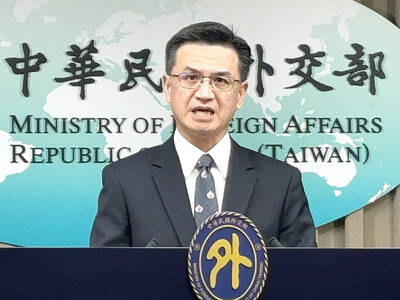
BULLY TACTICS: Beijing has continued its incursions into Taiwan’s airspace even as Xi Jinping talked about Taiwan being part of the Chinese family and nation China should stop its coercion of Taiwan and respect mainstream public opinion in Taiwan about sovereignty if its expression of goodwill is genuine, the Ministry of Foreign Affairs (MOFA) said yesterday. Ministry spokesman Jeff Liu (劉永健) made the comment in response to media queries about a meeting between former president Ma Ying-jeou (馬英九) and Chinese President Xi Jinping (習近平) the previous day. Ma voiced support for the so-called “1992 consensus,” while Xi said that although the two sides of the Taiwan Strait have “different systems,” this does not change the fact that they are “part of the same country,” and that “external

UNDER DISCUSSION: The combatant command would integrate fast attack boat and anti-ship missile groups to defend waters closest to the coastline, a source said The military could establish a new combatant command as early as 2026, which would be tasked with defending Taiwan’s territorial waters 24 nautical miles (44.4km) from the nation’s coastline, a source familiar with the matter said yesterday. The new command, which would fall under the Naval Command Headquarters, would be led by a vice admiral and integrate existing fast attack boat and anti-ship missile groups, along with the Naval Maritime Surveillance and Reconnaissance Command, said the source, who asked to remain anonymous. It could be launched by 2026, but details are being discussed and no final timetable has been announced, the source


 RSS
RSS