


Google Inc hails its new e-mail service as a breakthrough in online communication, but consumer watchdogs are attacking it as a creepy invasion of privacy that threatens to set a troubling precedent.
Although Google's free "Gmail" service isn't even available yet, critics already are pressuring the popular search-engine maker to drop its plans to electronically scan e-mail content so it can distribute relevant ads alongside incoming messages.
Privacy activists worry that Gmail will comb through e-mail more intensively than the filters widely used to weed out potential viruses and spam.
Gmail opponents also want Google to revise a policy that entitles the company to retain copies of people's incoming and outgoing e-mail even after they close their accounts.
The e-mail scanning, which Google says will be handled exclusively by computers, has raised the most alarms, partly because it seeks to capitalize on messages sent by people without Gmail accounts.
Google intends to deliver ads by analyzing what's being discussed. For instance, an e-mail from one friend to another talking about an upcoming trip might include links to hotels or airlines.
Gmail has a "definite creepiness factor," said Ari Schwartz, associate director of the Center for Democracy and Technology.
Mountain View, California-based Google portrays the commercialization of e-mail as a small trade-off for a service that will give each user one gigabyte of storage -- up to 500 times more than other leading free services -- and provide a quicker, cleaner way to search e-mailboxes. Most e-mail messages opened on Gmail won't even contain ads, according to Google.
Nevertheless, critics say the free storage -- roughly the equivalent of 500,000 pages -- isn't worth compromising individual privacy rights.
"Consumers really need to look this gift horse in the mouth because it has rotten teeth and bad breath," said Beth Givens, director of the Privacy Rights Clearinghouse, a watchdog group.
The Gmail backlash has inspired Orwellian comparisons likening Google to Big Brother, a disturbing development for a privately held company committed to making money "without doing evil."
"We are not going over to the dark side," said Wayne Rosing, Google's vice president of engineering. "Consumers can expect us to treat their e-mail as private and with a great deal of respect. I don't think we are doing anything unreasonable."
Gmail apparently doesn't bother everyone. Without providing specifics, Rosing said "hundreds of thousands" of people have registered with Gmail.com since Google announced the service last week. The company is still testing Gmail before offering it to the general public later this year.
But some parts of Gmail could be illegal, said Simon Davies, director of Privacy International, a watchdog group in London.
Google's current Gmail policy advises potential users that "residual copies of e-mail may remain on our systems, even after you have deleted them from your mailbox or after the termination of your account."
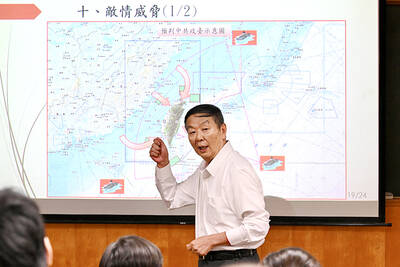
RETHINK? The defense ministry and Navy Command Headquarters could take over the indigenous submarine project and change its production timeline, a source said Admiral Huang Shu-kuang’s (黃曙光) resignation as head of the Indigenous Submarine Program and as a member of the National Security Council could affect the production of submarines, a source said yesterday. Huang in a statement last night said he had decided to resign due to national security concerns while expressing the hope that it would put a stop to political wrangling that only undermines the advancement of the nation’s defense capabilities. Taiwan People’s Party Legislator Vivian Huang (黃珊珊) yesterday said that the admiral, her older brother, felt it was time for him to step down and that he had completed what he

Taiwan has experienced its most significant improvement in the QS World University Rankings by Subject, data provided on Sunday by international higher education analyst Quacquarelli Symonds (QS) showed. Compared with last year’s edition of the rankings, which measure academic excellence and influence, Taiwanese universities made great improvements in the H Index metric, which evaluates research productivity and its impact, with a notable 30 percent increase overall, QS said. Taiwanese universities also made notable progress in the Citations per Paper metric, which measures the impact of research, achieving a 13 percent increase. Taiwanese universities gained 10 percent in Academic Reputation, but declined 18 percent

UNDER DISCUSSION: The combatant command would integrate fast attack boat and anti-ship missile groups to defend waters closest to the coastline, a source said The military could establish a new combatant command as early as 2026, which would be tasked with defending Taiwan’s territorial waters 24 nautical miles (44.4km) from the nation’s coastline, a source familiar with the matter said yesterday. The new command, which would fall under the Naval Command Headquarters, would be led by a vice admiral and integrate existing fast attack boat and anti-ship missile groups, along with the Naval Maritime Surveillance and Reconnaissance Command, said the source, who asked to remain anonymous. It could be launched by 2026, but details are being discussed and no final timetable has been announced, the source

CHINA REACTS: The patrol and reconnaissance plane ‘transited the Taiwan Strait in international airspace,’ the 7th Fleet said, while Taipei said it saw nothing unusual The US 7th Fleet yesterday said that a US Navy P-8A Poseidon flew through the Taiwan Strait, a day after US and Chinese defense heads held their first talks since November 2022 in an effort to reduce regional tensions. The patrol and reconnaissance plane “transited the Taiwan Strait in international airspace,” the 7th Fleet said in a news release. “By operating within the Taiwan Strait in accordance with international law, the United States upholds the navigational rights and freedoms of all nations.” In a separate statement, the Ministry of National Defense said that it monitored nearby waters and airspace as the aircraft


 RSS
RSS