


For more than two years, Nancy Drew would answer calls from Americans asking about their insurance policies and annuities. Most people were put at ease with someone who talked, and thought, like them.
But Nancy was not Nancy. She was Nayanima Basu. Although Nayanima was taking calls from America, she was answering them in her cubicle in Gurgaon, a suburb of Delhi. And when it was day in America, it was night in India.
"The whole experience was completely disorientating. I used to come home in the morning exhausted and was lucky if I saw my husband for an hour before he left for work," says Nayanima, a 23-year-old history graduate, who regularly worked thirteen-hour days that began at 7:30pm.
Call centers have become the factory floor of India. Known as BPO -- business process outsourcing -- the ?1.7 billion industry has grown by 60 percent a year since 2000, and employs nearly a quarter of a million people.
The reason is that India has a large, well-educated, English-speaking workforce whose wages are a fraction of those in America and Britain.
Companies such as General Electric, HSBC and American Express employ thousands in call centers on the subcontinent.
This week, it was announced that half of all calls to Britain's busiest number -- the national rail inquiries service -- would be routed to India by the end of the year.
Multinational firms offer, by Indian standards, good salaries. Graduates command 10,000 rupees (?140) in a month, what a farm worker makes in six.
But in call centers, a half-hour lunch break and two fifteen-minute snack breaks each day are considered a generous benefit.
Call center workers, whose average age is 23, say that even leaving to use the toilet or have a cigarette can seriously affect their recorded performance, which is measured on a minute by minute basis and used to assess their pay.
For a small but increasing number of people, the benefits of working for a call center cannot make up for the disadvantages of long, unsociable hours, monotonous work and abusive conversations.
"Although we were trained to pronounce words like Americans -- you know, rolling your r and emphasising the p in words -- customers would know we were Indian," says Nayanima, who left her job in December and is applying to become a civil servant.
"We were even taken to America for four months to work there so that we knew about malls and the television shows. But you would still get people getting angry with you and start saying, `Indians can't do this job properly, you are stealing our jobs.' The worst was when one grandmother in Texas called me an Indian-educated whore."
Although India's economy and its companies have gained, there are many who are warning that the cost will be borne by a generation of young people traumatized by high-pressure workplaces.
"I have seen more than 100 cases of call center employees coming in with complaints of depression and substance abuse," said Sanjay Chugh, a Delhi-based psychiatrist. "This I consider to be the tip of the iceberg. The shift in the biological clock and the roleplaying nature of the work means many also face an identity crisis and emotional detachment from family and friends."
For some, it is the physical demands that are too great.
"I could not adjust to the sleeping patterns," says Kirti Gulati, a 21-year-old business studies graduate who started working in a call center in Delhi last year.
"I lost about 8kg in two months and my eyes just swelled up with the stress. It was too much, so I left and took a job with Ford selling cars -- which is half the pay, but I feel much better."
Business analysts say that although the working regime in call centers may resemble a factory, there is little chance for employees to form a trade union to campaign for better rights.
"Most levels of employees can, as a matter of right, form a trade union," said Diljeet Titus, a labor lawyer in Delhi. "Those who fall outside the purview of a trade union can form management-level officers' associations. However, companies develop an internal structure and strategies to keep employees from getting into any kind of collective bargaining position."
The attrition rate in the industry is reckoned to be about 30 percent -- that is, nearly a third of the staff leave each year -- and companies have responded by increasing break times, holding parties at work, and reducing the proportion of earnings dependant on performance.
Sanjoy Narayan, the editor of the Indian magazine Business Today, said many firms had simply been too slow to respond to the explosive growth of Indian call centers.
"There is undoubtedly a problem," he said. "The issue is that you have taken a group of very intelligent people and given them fairly menial, repetitive tasks. Companies are only now realising that they need to make the work interesting and offer these guys a career, not just a job for a couple of years."
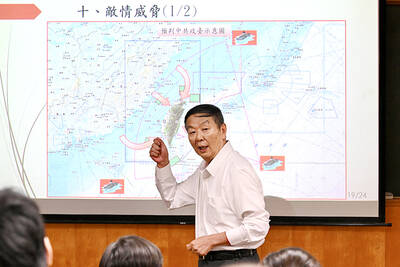
RETHINK? The defense ministry and Navy Command Headquarters could take over the indigenous submarine project and change its production timeline, a source said Admiral Huang Shu-kuang’s (黃曙光) resignation as head of the Indigenous Submarine Program and as a member of the National Security Council could affect the production of submarines, a source said yesterday. Huang in a statement last night said he had decided to resign due to national security concerns while expressing the hope that it would put a stop to political wrangling that only undermines the advancement of the nation’s defense capabilities. Taiwan People’s Party Legislator Vivian Huang (黃珊珊) yesterday said that the admiral, her older brother, felt it was time for him to step down and that he had completed what he

Taiwan has experienced its most significant improvement in the QS World University Rankings by Subject, data provided on Sunday by international higher education analyst Quacquarelli Symonds (QS) showed. Compared with last year’s edition of the rankings, which measure academic excellence and influence, Taiwanese universities made great improvements in the H Index metric, which evaluates research productivity and its impact, with a notable 30 percent increase overall, QS said. Taiwanese universities also made notable progress in the Citations per Paper metric, which measures the impact of research, achieving a 13 percent increase. Taiwanese universities gained 10 percent in Academic Reputation, but declined 18 percent
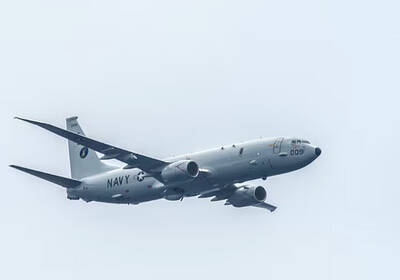
CHINA REACTS: The patrol and reconnaissance plane ‘transited the Taiwan Strait in international airspace,’ the 7th Fleet said, while Taipei said it saw nothing unusual The US 7th Fleet yesterday said that a US Navy P-8A Poseidon flew through the Taiwan Strait, a day after US and Chinese defense heads held their first talks since November 2022 in an effort to reduce regional tensions. The patrol and reconnaissance plane “transited the Taiwan Strait in international airspace,” the 7th Fleet said in a news release. “By operating within the Taiwan Strait in accordance with international law, the United States upholds the navigational rights and freedoms of all nations.” In a separate statement, the Ministry of National Defense said that it monitored nearby waters and airspace as the aircraft

UNDER DISCUSSION: The combatant command would integrate fast attack boat and anti-ship missile groups to defend waters closest to the coastline, a source said The military could establish a new combatant command as early as 2026, which would be tasked with defending Taiwan’s territorial waters 24 nautical miles (44.4km) from the nation’s coastline, a source familiar with the matter said yesterday. The new command, which would fall under the Naval Command Headquarters, would be led by a vice admiral and integrate existing fast attack boat and anti-ship missile groups, along with the Naval Maritime Surveillance and Reconnaissance Command, said the source, who asked to remain anonymous. It could be launched by 2026, but details are being discussed and no final timetable has been announced, the source


 RSS
RSS