


Ryanair, the low-fare Irish carrier, warned on Wednesday that profit in its financial year ending in March could be down as much as 10 percent as its revenue per passenger plummets.
Ryanair said that it expected to post net income of 215 million euros, or US$272 million, at the close of its financial year. The airline had a net profit of 217.3 million euros in the first three quarters, so the profit warning also signaled that the company expects to see a loss -- its first -- in the current quarter.
Ryanair said that it expected revenue per passenger to slide 25 percent to 30 percent in the current quarter over the year-ago period. The constant need to cut ticket prices was responsible, the airline said, now that large state-owned airlines are copying its low-fares strategy.
"We don't have an explanation for the yield decline," Michael O'Leary, chief executive of Ryanair, said in a conference call. "We speculate that there's intense price competition."
The profit warning, the airline's first, prompted some analysts to say that the brash carrier, which is modeled on Southwest Airlines in the US, has reached the end of its rapid expansion. Shares in Ryanair fell 28 percent on the Irish stock exchange, to 4.86 euros (US$6.14), their lowest level since October 2001, and 30 percent, to 4.70 euros, in London.
Ryanair reported its third-quarter results a week ahead of schedule to avoid coinciding with an expected negative ruling from the European Commission on whether the airline accepted illegal subsidies from a state-owned airport at Charleroi, outside Brussels, Belgium.
Newspapers reported on Wed-nesday that the European transportation commissioner, Loyola de Palacio, would rule against Ryanair, forcing it to repay from 3 million to 13 million euros (US$3.8 million to US$16.4 million) in discounted charges, mostly landing fees. The rebuff would undermine Ryanair's strategy of negotiating favorable deals with secondary airports, often state-owned.
Revenue per passenger is falling as Ryanair continues to add capacity and cut fares -- in the last quarter, ticket prices dropped 11 percent from a year ago -- in the face of increased competition. For passengers in an industry where there is little customer loyalty, flying will become even cheaper, analysts say.
O'Leary said that he expected the fall in revenue per passenger to ease, starting in April, and promised that Ryanair would "always offer the lowest fares in all markets."
Ryanair's average ticket price is 39 euros (US$49).
In the quarter that ended in December, Ryanair's after-tax profits rose 10 percent over the period in 2002, to 47.5 million euros (US$60 million), not including a charge of 6.6 million euros for retiring some planes early. Revenue was up 37 percent, to 255 million euros (US$322 million). Passenger numbers jumped 54 percent, to 6.1 million, pushing Ryanair ahead of easyJet as Europe's biggest budget airline.
Figures that robust, and Ryan-air's previously uninterrupted growth in quarterly profit, are unlikely to be repeated in the short term. In a conference call, O'Leary said that Ryanair was facing six months to a year of uncertainty.
"Ultimately this isn't something that could just go away," said Kevin McConnell, head equity analyst at Bloxham Stockbrokers in Dublin. "We're seeing more and more entrants to the low-cost area."
Ryanair remains well positioned to compete against newer entrants, analysts said. EasyJet, its closest rival, has per-passenger costs that are 40 percent to 50 percent higher than Ryanair's, Mattimoe said.
In the conference call, O'Leary tried to forestall any attacks on his aggressive strategy.
"There will be a lot of analysis that says we grew too fast, that 60 percent capacity growth this year was much too much," he said. "To which I would answer, well, we did 55 percent capacity growth last year and we did a 59 percent increase in profits."
Ryanair recently established new hubs outside Rome, and Barcelona, Spain, and half the airline's 146 routes are less than a year old. From May onward, its capacity will grow 20 percent a year instead of 50 percent, O'Leary said.
Even if the profit warning does not signal a weakness in Ryanair's business model or a failure stemming from its rapid expansion, analysts said the airline was likely to face a period of more modest performance until, as it hopes, its new competitors drop out of the market.

RETHINK? The defense ministry and Navy Command Headquarters could take over the indigenous submarine project and change its production timeline, a source said Admiral Huang Shu-kuang’s (黃曙光) resignation as head of the Indigenous Submarine Program and as a member of the National Security Council could affect the production of submarines, a source said yesterday. Huang in a statement last night said he had decided to resign due to national security concerns while expressing the hope that it would put a stop to political wrangling that only undermines the advancement of the nation’s defense capabilities. Taiwan People’s Party Legislator Vivian Huang (黃珊珊) yesterday said that the admiral, her older brother, felt it was time for him to step down and that he had completed what he

Taiwan has experienced its most significant improvement in the QS World University Rankings by Subject, data provided on Sunday by international higher education analyst Quacquarelli Symonds (QS) showed. Compared with last year’s edition of the rankings, which measure academic excellence and influence, Taiwanese universities made great improvements in the H Index metric, which evaluates research productivity and its impact, with a notable 30 percent increase overall, QS said. Taiwanese universities also made notable progress in the Citations per Paper metric, which measures the impact of research, achieving a 13 percent increase. Taiwanese universities gained 10 percent in Academic Reputation, but declined 18 percent
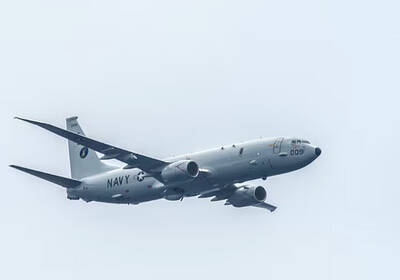
CHINA REACTS: The patrol and reconnaissance plane ‘transited the Taiwan Strait in international airspace,’ the 7th Fleet said, while Taipei said it saw nothing unusual The US 7th Fleet yesterday said that a US Navy P-8A Poseidon flew through the Taiwan Strait, a day after US and Chinese defense heads held their first talks since November 2022 in an effort to reduce regional tensions. The patrol and reconnaissance plane “transited the Taiwan Strait in international airspace,” the 7th Fleet said in a news release. “By operating within the Taiwan Strait in accordance with international law, the United States upholds the navigational rights and freedoms of all nations.” In a separate statement, the Ministry of National Defense said that it monitored nearby waters and airspace as the aircraft

UNDER DISCUSSION: The combatant command would integrate fast attack boat and anti-ship missile groups to defend waters closest to the coastline, a source said The military could establish a new combatant command as early as 2026, which would be tasked with defending Taiwan’s territorial waters 24 nautical miles (44.4km) from the nation’s coastline, a source familiar with the matter said yesterday. The new command, which would fall under the Naval Command Headquarters, would be led by a vice admiral and integrate existing fast attack boat and anti-ship missile groups, along with the Naval Maritime Surveillance and Reconnaissance Command, said the source, who asked to remain anonymous. It could be launched by 2026, but details are being discussed and no final timetable has been announced, the source


 RSS
RSS