


One of Japan's largest fast-food chains has warned it'll be forced to stop serving its trademark dish, -- shredded beef and onions on rice -- unless authorities lift a ban on US beef imports imposed after the discovery of the US' first case of mad cow disease.
The announcement Tuesday by the Yoshinoya chain underlined the dilemma facing some restaurants in Japan, the world's biggest customer for US beef.
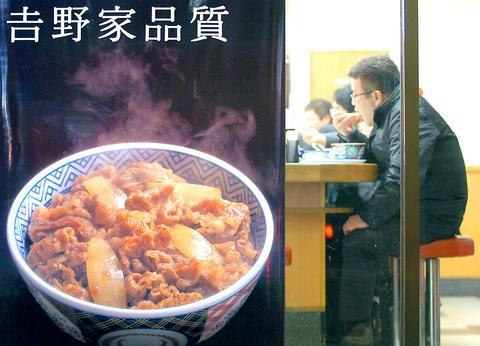
PHOTO: AP
News that a cow in Washington state tested positive last week for the brain-wasting bovine disease unnerved Japanese consumers, who've only recently regained their appetite for beef after a mad cow scare at home.
But for down-market eateries like Yoshinoya, whose 980 orange-and-white restaurants are a common sight on Japan's city streets, as well as in Taiwan, there's no substitute for inexpensive American beef.
Yoshinoya relies on US suppliers for 99 percent of the beef used in its trademark gyudon beef bowls -- which at ?260 (about US$2.50) are a staple for office workers and budget-conscious students.
Yoshinoya's president Shuji Abe called a news conference yesterday to announce that gyudon is being stricken from his menus unless Japan resumes US beef imports before the chain's stocks run out in February.
"I never thought our business would come to this," Abe said.
The company's sales have dipped about 15 percent since the US mad cow scare, and its shares took a beating on the stock market last week.
But Yoshinoya has stood by its product, insisting US beef is safe, and says finding a substitute would be too expensive.
"If our prices went up it would drag down our image," Abe said.
Japanese beef is typically pricier than imports, and often reserved for delicacies like sukiyaki -- thin strips of marbled meat boiled with vegetables.
At one Tokyo meat shop Tuesday, a kilogram of homegrown sukiyaki-quality beef was selling for about ?3,000 (US$28) -- about twice the price of comparable imported meat.
Japan imports about two-thirds of its beef, of which around 47 percent, or 226,524 tonnes, came from the US last year.
The rest comes mostly from Australia, which has never recorded a case of mad cow disease.
The Japan Food Service Association last week advised restaurants to rethink their entire business strategies.
"Relying completely on foreign procurement is risky," chairman Kiwamu Yokokawa said.
The US sold US$1.03 billion worth of beef, veal, prepared beef products and variety meats to Japan last year, accounting for about 32 percent of total exports, US data shows.
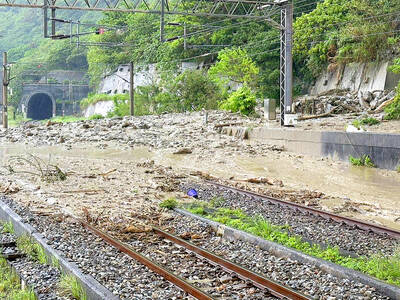
ROLLER-COASTER RIDE: More than five earthquakes ranging from magnitude 4.4 to 5.5 on the Richter scale shook eastern Taiwan in rapid succession yesterday afternoon Back-to-back weather fronts are forecast to hit Taiwan this week, resulting in rain across the nation in the coming days, the Central Weather Administration said yesterday, as it also warned residents in mountainous regions to be wary of landslides and rockfalls. As the first front approached, sporadic rainfall began in central and northern parts of Taiwan yesterday, the agency said, adding that rain is forecast to intensify in those regions today, while brief showers would also affect other parts of the nation. A second weather system is forecast to arrive on Thursday, bringing additional rain to the whole nation until Sunday, it

CONDITIONAL: The PRC imposes secret requirements that the funding it provides cannot be spent in states with diplomatic relations with Taiwan, Emma Reilly said China has been bribing UN officials to obtain “special benefits” and to block funding from countries that have diplomatic ties with Taiwan, a former UN employee told the British House of Commons on Tuesday. At a House of Commons Foreign Affairs Committee hearing into “international relations within the multilateral system,” former Office of the UN High Commissioner for Human Rights (OHCHR) employee Emma Reilly said in a written statement that “Beijing paid bribes to the two successive Presidents of the [UN] General Assembly” during the two-year negotiation of the Sustainable Development Goals. Another way China exercises influence within the UN Secretariat is
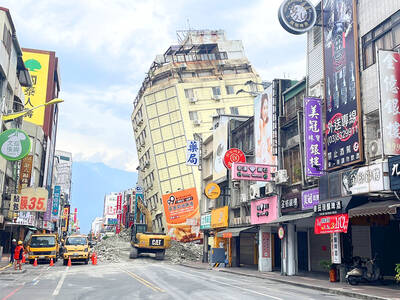
LANDSLIDES POSSIBLE: The agency advised the public to avoid visiting mountainous regions due to more expected aftershocks and rainfall from a series of weather fronts A series of earthquakes over the past few days were likely aftershocks of the April 3 earthquake in Hualien County, with further aftershocks to be expected for up to a year, the Central Weather Administration (CWA) said yesterday. Based on the nation’s experience after the quake on Sept. 21, 1999, more aftershocks are possible over the next six months to a year, the agency said. A total of 103 earthquakes of magnitude 4 on the local magnitude scale or higher hit Hualien County from 5:08pm on Monday to 10:27am yesterday, with 27 of them exceeding magnitude 5. They included two, of magnitude

Taiwan’s first drag queen to compete on the internationally acclaimed RuPaul’s Drag Race, Nymphia Wind (妮妃雅), was on Friday crowned the “Next Drag Superstar.” Dressed in a sparkling banana dress, Nymphia Wind swept onto the stage for the final, and stole the show. “Taiwan this is for you,” she said right after show host RuPaul announced her as the winner. “To those who feel like they don’t belong, just remember to live fearlessly and to live their truth,” she said on stage. One of the frontrunners for the past 15 episodes, the 28-year-old breezed through to the final after weeks of showcasing her unique


 RSS
RSS