


Defying gloomy predictions after voters rejected the euro two weeks ago, the krona has gone from strength to strength, reflecting Sweden's ruddy economic health, in stark contrast to the sluggish euro zone.
The "yes" camp ahead of the Sept. 14 single currency referendum had warned of capital flight, inflation and higher interest rates if Swedes rejected the euro, but none of this has happened after 56 percent of voters turned down the single currency.
The krona's surprising strength, which has taken it to a three-year high, could now give Swedes some of the key benefits of euro-zone membership, without any of the constraints, analysts said.
"Sweden may get the best of both worlds, keeping its independence and getting the economic benefits of joining the euro zone," James Knightley, European economist at ING Financial Markets, told reporters.
After shaking off a short-lived post-vote blues which took it to 9.20 against the euro, it quickly cut through the key 9.00 level in the days following the referendum, to trade near 8.90 throughout last week, a level not seen since September 2000.
This was all the more remarkable because the euro itself was strengthening against the dollar during the same period.
Analysts said krona-based assets were attractive because of much better growth prospects in Sweden than in the euro zone.
Swedish GDP, set to grow by 1.5 percent this year and by around 2.5 percent next year, easily outperforms the 12-nation zone, where growth will be more like 0.5 percent this year, and below 2.0 percent next year.
And as investors' money floods into Swedish assets, there is every chance interest rate parity between Sweden and the euro zone may be achieved years before anyone thought possible.
"We did not expect another rate cut in Sweden this year, but now that the krona has strengthened, the Swedish central bank may be a little nervous of what this means for the economic recovery which is only just beginning," Knightley said.
The Riksbank's key interest rate stands at 2.75 percent, compared with the European Central Bank's 2.00 percent, and euro supporters had argued the Swedish economy would receive a welcome boost from looser monetary conditions in the euro zone when it joined in 2006.
But ironically this boost could now come much earlier, and markets are abuzz with talk that the Riksbank will slash interest rates over the next few weeks.
Most say rates will come down to ECB levels, but others predict a much deeper cut, to 1.5 percent.
Euro opponents have argued that tying monetary policy into the euro zone would rob Sweden of the key interest rate and currency weapons flexibility needed to combat economic downturns.
Signs that Sweden looks set not only to hold on to its monetary independence, but also enjoy a thriving economy outside the euro zone will further strengthen opposition to the euro in Denmark and Britain, the only other EU members to have declined euro-zone membership so far.
"This shows that there is life outside the euro zone," said Knightley.
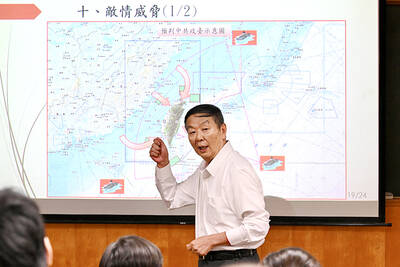
RETHINK? The defense ministry and Navy Command Headquarters could take over the indigenous submarine project and change its production timeline, a source said Admiral Huang Shu-kuang’s (黃曙光) resignation as head of the Indigenous Submarine Program and as a member of the National Security Council could affect the production of submarines, a source said yesterday. Huang in a statement last night said he had decided to resign due to national security concerns while expressing the hope that it would put a stop to political wrangling that only undermines the advancement of the nation’s defense capabilities. Taiwan People’s Party Legislator Vivian Huang (黃珊珊) yesterday said that the admiral, her older brother, felt it was time for him to step down and that he had completed what he

Taiwan has experienced its most significant improvement in the QS World University Rankings by Subject, data provided on Sunday by international higher education analyst Quacquarelli Symonds (QS) showed. Compared with last year’s edition of the rankings, which measure academic excellence and influence, Taiwanese universities made great improvements in the H Index metric, which evaluates research productivity and its impact, with a notable 30 percent increase overall, QS said. Taiwanese universities also made notable progress in the Citations per Paper metric, which measures the impact of research, achieving a 13 percent increase. Taiwanese universities gained 10 percent in Academic Reputation, but declined 18 percent
UNDER DISCUSSION: The combatant command would integrate fast attack boat and anti-ship missile groups to defend waters closest to the coastline, a source said The military could establish a new combatant command as early as 2026, which would be tasked with defending Taiwan’s territorial waters 24 nautical miles (44.4km) from the nation’s coastline, a source familiar with the matter said yesterday. The new command, which would fall under the Naval Command Headquarters, would be led by a vice admiral and integrate existing fast attack boat and anti-ship missile groups, along with the Naval Maritime Surveillance and Reconnaissance Command, said the source, who asked to remain anonymous. It could be launched by 2026, but details are being discussed and no final timetable has been announced, the source
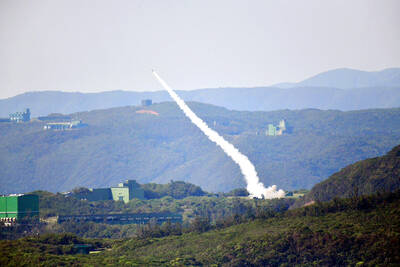
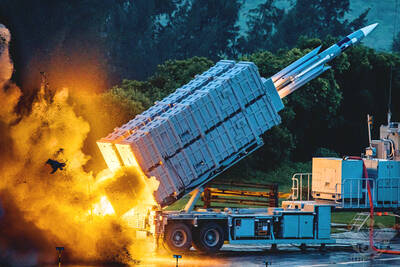
SHOT IN THE ARM: The new system can be integrated with Avenger and Stinger missiles to bolster regional air defense capabilities, a defense ministry report said Domestically developed Land Sword II (陸射劍二) missiles were successfully launched and hit target drones during a live-fire exercise at the Jiupeng Military Base in Pingtung County yesterday. The missiles, developed by the Chungshan Institute of Science and Technology (CSIST), were originally scheduled to launch on Tuesday last week, after the Tomb Sweeping Day holiday long weekend, but were postponed to yesterday due to weather conditions. Local residents and military enthusiasts gathered outside the base to watch the missile tests, with the first one launching at 9:10am. The Land Sword II system, which is derived from the Sky Sword II (天劍二) series, was turned


 RSS
RSS