


Asia-Pacific economies are likely to ignore or seek to fight off pressure from Washington to push up the value of their currencies, in what is being seen as a pre-election ploy, analysts and economists in the region say.
The US currency came under renewed selling pressure after finance ministers and central bank governors from the Group of Seven (G7) -- Britain, Canada, France, Germany, Italy, Japan and the US -- called for "more flexibility in exchange rates" following a meeting a week ago.
Market participants interpreted the line in the G7 communique as an implicit but strong message from Washington that it wants its trade partners that maintain chronic surpluses -- namely China and Japan -- to let their currencies appreciate against the dollar to trim their export competitiveness.
But many currency market watchers and economists interviewed by reporters said there has been no drastic shift in dollar policy agreed upon by the world's richest democracies.
"I'm not sure if there is a G7 policy. From the interpretations of the statement, there is now disagreement about the desired outcome," said Richard Jerram, economist at ING Financial Markets in Tokyo.
Japanese Finance Minister Sadakazu Tanigaki told reporters on Friday that the recent rise in the yen was too rapid and suggested that Tokyo would continue to intervene in the currency market as it had in the past.
Washington cannot explicitly say that it wants a weaker dollar because it needs to attract foreign capital inflows to fund its current account deficit, Jerram and other economists point out.
"Making an outright policy change would simply risk an avalanche of selling [of US dollars]," Marshall Gittler, currency strategist at Deutsche Bank in Tokyo, wrote in a commentary.
The authorities want to keep the markets guessing about their intentions and be cautious about selling dollars, he said.
Song Seng Wun, a regional economist with GK Goh Research in Singapore, said he did not think the G7 statement marked a turning point for the dollar and Asian currencies.
"The G7 is trying to be politically-correct by issuing a statement targeting China and yet not be seen to be specifically targeting China," Song said. "I suppose the statement is broad enough to be seen to be also applicable to countries which are so-called interventionist such as Taiwan, Korea, and Japan."
As for China, which has been posting the largest trade surplus with the US for several years, the timing of revaluing its currency the yuan will depend on whether the currency's appreciation would have a negative impact on its state-owned enterprises, Song said.
"It's inevitable the yuan will appreciate in the long run," said Xia Yeliang, an economist at Beijing University. "China's huge foreign exchange reserves and the strong and fast-paced growth of China's economy are all strong arguments for its appreciation."
The G7 countries are feeling increasingly threatened by China as it moves rapidly up the value-added scale, offering higher quality goods than in the past at competitive prices.
"They don't expect China to say yes [to a stronger yuan] tomorrow. This is just one of the first in a series of salvos to be fired aimed at China as the country continues to attract more foreign direct investment and account more for the US and G7 trade deficits," said Song.
Confronted by sagging popularity, US President George W. Bush could be motivated to use the currency card in a bid to boost US exports and create jobs before the presidential election next year, analysts said.
But other leaders also face elections. Japanese Prime Minister Junichiro Koizumi is expected to call Lower House elections next month for an early November vote.
"We are seeing at least eight elections in this region over the next 12-15 months and with the kind of fragile recovery we are seeing now, I don't see the governments or the central banks in this region wanting to see their currencies appreciate," Song said.
Taiwan, another major exporter to the US market, is also feeling the pressure. In theory the appreciation of the Taiwan dollar would hurt Taiwan's export sector, largely electronics.
"The negative impacts on the electronics sector would not be as huge as in the late 1980s when the Taiwan dollar rose sharply from NT$40 to around NT$26 against the US dollar because a large chunk of Taiwan's electronic companies have already shifted their production lines to the mainland," said Bentham Hung of Fuh Hwa Securites Investment and Trust Co.
In South Korea, government officials fear that the won's rise against the dollar will hurt the Asian tiger's exports but they agree the impact should be bearable.

Chinese President Xi Jinping (習近平) yesterday met with former president Ma Ying-jeou (馬英九) at the Great Hall of the People in Beijing, with Xi’s opening statement once more emphasizing that people on both sides of the Taiwan Strait are Chinese and that foreign intervention cannot change their inevitable unification. Xi said that 5,000 years of history of zhonghua minzu (中華民族, ethnic Chinese group) have seen their ancestors move to Taiwan to establish new lives, while also documenting them fighting side-by-side against foreign forces and finally freeing Taiwan. “Both sides are Chinese,” and there are no issues that cannot be worked through, he
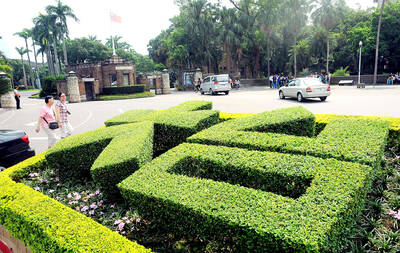
Taiwan has experienced its most significant improvement in the QS World University Rankings by Subject, data provided on Sunday by international higher education analyst Quacquarelli Symonds (QS) showed. Compared with last year’s edition of the rankings, which measure academic excellence and influence, Taiwanese universities made great improvements in the H Index metric, which evaluates research productivity and its impact, with a notable 30 percent increase overall, QS said. Taiwanese universities also made notable progress in the Citations per Paper metric, which measures the impact of research, achieving a 13 percent increase. Taiwanese universities gained 10 percent in Academic Reputation, but declined 18 percent
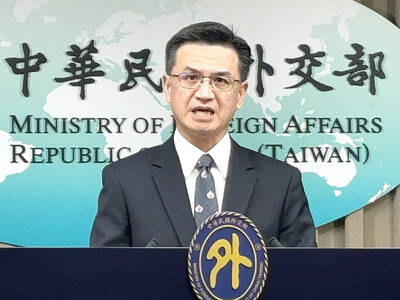
BULLY TACTICS: Beijing has continued its incursions into Taiwan’s airspace even as Xi Jinping talked about Taiwan being part of the Chinese family and nation China should stop its coercion of Taiwan and respect mainstream public opinion in Taiwan about sovereignty if its expression of goodwill is genuine, the Ministry of Foreign Affairs (MOFA) said yesterday. Ministry spokesman Jeff Liu (劉永健) made the comment in response to media queries about a meeting between former president Ma Ying-jeou (馬英九) and Chinese President Xi Jinping (習近平) the previous day. Ma voiced support for the so-called “1992 consensus,” while Xi said that although the two sides of the Taiwan Strait have “different systems,” this does not change the fact that they are “part of the same country,” and that “external
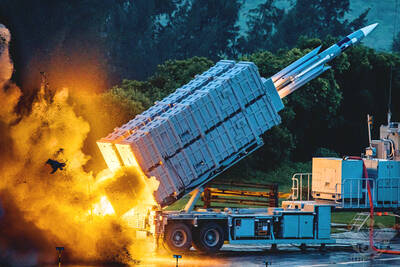
UNDER DISCUSSION: The combatant command would integrate fast attack boat and anti-ship missile groups to defend waters closest to the coastline, a source said The military could establish a new combatant command as early as 2026, which would be tasked with defending Taiwan’s territorial waters 24 nautical miles (44.4km) from the nation’s coastline, a source familiar with the matter said yesterday. The new command, which would fall under the Naval Command Headquarters, would be led by a vice admiral and integrate existing fast attack boat and anti-ship missile groups, along with the Naval Maritime Surveillance and Reconnaissance Command, said the source, who asked to remain anonymous. It could be launched by 2026, but details are being discussed and no final timetable has been announced, the source


 RSS
RSS