


The world's oldest woman has a recipe for longevity -- sleep, and lots of it.
Kamato Hongo, who turns 116 a day after a national holiday on Monday to honor Japan's elderly, attributes her long life to a strict regimen that includes sleeping for two straight days.

PHOTO: REUTERS
It's a lifestyle that has allowed Hongo, a resident of the southern island of Kyushu, to collect a government pension for 56 years without worrying about where the money was coming from.
Her 146 children, grandchildren and great-great grandchildren don't have such a worry-free future.
In a country where life expectancy is the highest in the world -- more than 20,000 people are aged over 100 -- pensions are a serious social and financial concern.
A newspaper survey yesterday showed 57 percent of those polled had "no faith" in the public pension system, the highest figure since the Asian financial crisis of 1997 to 1998.
"Once I think about it I get so worried, so I'd prefer not to think about it," said Shinobu Hano, 54, who works as a maintenance engineer in a Tokyo office building after losing his job at electronics giant Hitachi a year ago.
"Right now, people are able to receive pensions by the age of 60," Hano said. "But that age has been extended to 65 by the time I am eligible. And I don't know about 20 years from now."
Japan faces a growing pension crisis as its 127 million people age and its birthrate plunges.
Japanese men can now expect to live for 78 years, while the life expectancy for women is 85. In comparison, American men can expect to live to 76 and women 80.
At the same time the population is ageing, Japan's fertility rate has reached a record low 1.35 per woman, leading the government to worry that the number of workers in the future will not be enough to support an increasingly top-heavy society.
By 2025, Japan will have roughly one person over 65 for every two of working age, a higher dependency ratio than any other major industrialized nation.
Japan already spends an annual Japanese Yen 40 trillion (US$342 billion) or 8 percent of GDP on pensions for 28 million people, who make up more than 20 percent of the population. That spending is set to grow.
Social security payments -- most of which are made up of elderly care costs -- totaled Japanese Yen 78 trillion in 2000, about 20 percent of national income. By 2025 social security is seen ballooning to Japanese Yen 207 trillion, 31.5 percent of national income.
The government, already grappling with the biggest public debt levels in the industrialized world -- 40 percent bigger than the economy itself -- is increasingly hard-pressed to pay the Japanese Yen 66,000 (US$564) it shells out to each pensioner every month.
Companies, which run their own pension schemes, usually pay even more -- a standard amount of Japanese Yen 119,000. But most corporate plans are stretched.
The government has raised the minimum age at which people are eligible for pensions, and Japanese expect -- and fear -- the government is set to do more.
Government advisers proposed in June that Japan double its consumption tax to 10 percent and impose a heftier tax on pensions, measures which find support among some experts.
Doubling the consumption tax alone would give the government an additional 12.5 trillion in annual revenue, analysts say.
"If people sacrifice a little bit it can be sustainable," said Masahiro Kawai, an economist at the University of Tokyo.
Calling for sacrifice may not be a popular option for politicians ahead of elections next year.
Prime Minister Junichiro Koizumi pledged on Thursday he would keep Japan's sales tax at 5 percent if he wins a new term as leader of Japan's ruling party this month.
"I think the longer-term problem is in order to bring the pension fund system into some sort of balance, they will have to increase pension contributions further and cut benefits," said Peter Morgan, a senior economist at HSBC Securities Japan. "That will reduce the disposable income of workers."
Workers now contribute an average seven percent of incomes.
The situation is creating a generational clash between the young, who balk at paying more, and the elderly, many of whom believe decades of work entitle them to promised benefits.
"Politicians are always saying old people have money, but we're struggling to make ends meet too. It's not fair," griped Noriko Kikuchi, a 72-year-old living alone on the northern island of Hokkaido.
Ultimately, Japan needs to find a system that will be acceptable to both its young and old, engineer Hano says.
"I think the system has to be something young people can feel comfortable with," he said. "If young people don't agree, the system can't go on."
Taiwan has experienced its most significant improvement in the QS World University Rankings by Subject, data provided on Sunday by international higher education analyst Quacquarelli Symonds (QS) showed. Compared with last year’s edition of the rankings, which measure academic excellence and influence, Taiwanese universities made great improvements in the H Index metric, which evaluates research productivity and its impact, with a notable 30 percent increase overall, QS said. Taiwanese universities also made notable progress in the Citations per Paper metric, which measures the impact of research, achieving a 13 percent increase. Taiwanese universities gained 10 percent in Academic Reputation, but declined 18 percent

Chinese President Xi Jinping (習近平) yesterday met with former president Ma Ying-jeou (馬英九) at the Great Hall of the People in Beijing, with Xi’s opening statement once more emphasizing that people on both sides of the Taiwan Strait are Chinese and that foreign intervention cannot change their inevitable unification. Xi said that 5,000 years of history of zhonghua minzu (中華民族, ethnic Chinese group) have seen their ancestors move to Taiwan to establish new lives, while also documenting them fighting side-by-side against foreign forces and finally freeing Taiwan. “Both sides are Chinese,” and there are no issues that cannot be worked through, he
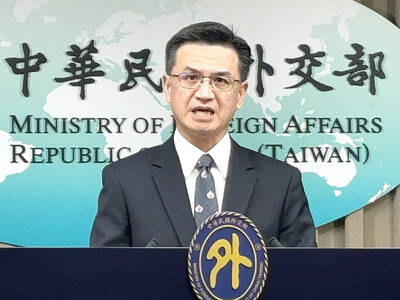
BULLY TACTICS: Beijing has continued its incursions into Taiwan’s airspace even as Xi Jinping talked about Taiwan being part of the Chinese family and nation China should stop its coercion of Taiwan and respect mainstream public opinion in Taiwan about sovereignty if its expression of goodwill is genuine, the Ministry of Foreign Affairs (MOFA) said yesterday. Ministry spokesman Jeff Liu (劉永健) made the comment in response to media queries about a meeting between former president Ma Ying-jeou (馬英九) and Chinese President Xi Jinping (習近平) the previous day. Ma voiced support for the so-called “1992 consensus,” while Xi said that although the two sides of the Taiwan Strait have “different systems,” this does not change the fact that they are “part of the same country,” and that “external

UNDER DISCUSSION: The combatant command would integrate fast attack boat and anti-ship missile groups to defend waters closest to the coastline, a source said The military could establish a new combatant command as early as 2026, which would be tasked with defending Taiwan’s territorial waters 24 nautical miles (44.4km) from the nation’s coastline, a source familiar with the matter said yesterday. The new command, which would fall under the Naval Command Headquarters, would be led by a vice admiral and integrate existing fast attack boat and anti-ship missile groups, along with the Naval Maritime Surveillance and Reconnaissance Command, said the source, who asked to remain anonymous. It could be launched by 2026, but details are being discussed and no final timetable has been announced, the source


 RSS
RSS