


Ratings agency Standard and Poor's said yesterday it has cut its estimate on the non-performing loan (NPL) ratio for Chinese banks to 44 to 45 percent from 50 percent.
It also raised its estimate on NPL recovery rate to 20 percent from 15 percent based on recent observations of Chinese banks and asset management companies.
But S&P said the Chinese financial system still needs direct or indirect capital from the government to solve the NPL issue in the short and medium term due to low capital adequacy ratios at these banks.
Chinese banks have become more market-oriented in offering loans, but still need several years to assess the overall asset quality of newly offered loans and their risk control capability, it said.
The ratings agency said the ratio of China's outstanding loans to GDP value rose to 138 percent at the end last year from 88 percent in 1995, reflecting that part of the loans over the past few years have been channeled to inefficient or even loss-making state firms.
According to government figures, China's four largest banks cut their NPL ratios by more than four percentage points in the first six months of the year to an average 22.19 percent by June.
Although this is as much as the ratio fell during all last year, the China Banking Regulatory Commission, which published the data on its website, warned the figure could be deceptive and disguise a serious situation.
"The amount of non-performing loans is still large and the non-performing loan ratio remains high," the commission said.
It pointed out that one of the reasons why the non-performing loan ratio has fallen is the rapid growth of new loans -- and they could theoretically become problematic in the future.
Total outstanding loans at China's major banks rose by almost 13 percent in the first half to stand at 12.95 trillion yuan (US$1.57 trillion) by the end of June.
The `big four' of China's banking system -- Industrial and Commercial Bank of China, Bank of China, China Construction Bank and Agricultural Bank of China -- play a crucial role in the world's fastest growing major economy.
Given the lack of investment options open to the average Chinese, they hold a large part of China's enormous savings and provide the financing that oils the majority of the country's businesses.
In the past, they have been forced to give priority to borrowers among China's large but inefficient state-owned enterprises, which often have been unable to repay their debts, leading to the non-performing loans problem.
China's regulators have given the banks a deadline until 2005 to reduce their NPL ratio to 15 percent.
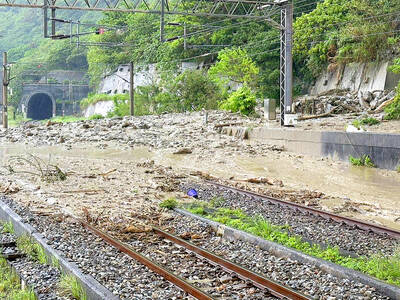
ROLLER-COASTER RIDE: More than five earthquakes ranging from magnitude 4.4 to 5.5 on the Richter scale shook eastern Taiwan in rapid succession yesterday afternoon Back-to-back weather fronts are forecast to hit Taiwan this week, resulting in rain across the nation in the coming days, the Central Weather Administration said yesterday, as it also warned residents in mountainous regions to be wary of landslides and rockfalls. As the first front approached, sporadic rainfall began in central and northern parts of Taiwan yesterday, the agency said, adding that rain is forecast to intensify in those regions today, while brief showers would also affect other parts of the nation. A second weather system is forecast to arrive on Thursday, bringing additional rain to the whole nation until Sunday, it

CONDITIONAL: The PRC imposes secret requirements that the funding it provides cannot be spent in states with diplomatic relations with Taiwan, Emma Reilly said China has been bribing UN officials to obtain “special benefits” and to block funding from countries that have diplomatic ties with Taiwan, a former UN employee told the British House of Commons on Tuesday. At a House of Commons Foreign Affairs Committee hearing into “international relations within the multilateral system,” former Office of the UN High Commissioner for Human Rights (OHCHR) employee Emma Reilly said in a written statement that “Beijing paid bribes to the two successive Presidents of the [UN] General Assembly” during the two-year negotiation of the Sustainable Development Goals. Another way China exercises influence within the UN Secretariat is

LANDSLIDES POSSIBLE: The agency advised the public to avoid visiting mountainous regions due to more expected aftershocks and rainfall from a series of weather fronts A series of earthquakes over the past few days were likely aftershocks of the April 3 earthquake in Hualien County, with further aftershocks to be expected for up to a year, the Central Weather Administration (CWA) said yesterday. Based on the nation’s experience after the quake on Sept. 21, 1999, more aftershocks are possible over the next six months to a year, the agency said. A total of 103 earthquakes of magnitude 4 on the local magnitude scale or higher hit Hualien County from 5:08pm on Monday to 10:27am yesterday, with 27 of them exceeding magnitude 5. They included two, of magnitude

Taiwan’s first drag queen to compete on the internationally acclaimed RuPaul’s Drag Race, Nymphia Wind (妮妃雅), was on Friday crowned the “Next Drag Superstar.” Dressed in a sparkling banana dress, Nymphia Wind swept onto the stage for the final, and stole the show. “Taiwan this is for you,” she said right after show host RuPaul announced her as the winner. “To those who feel like they don’t belong, just remember to live fearlessly and to live their truth,” she said on stage. One of the frontrunners for the past 15 episodes, the 28-year-old breezed through to the final after weeks of showcasing her unique


 RSS
RSS