


China and the US agreed yesterday that the yuan should eventually float freely, but Beijing resisted calls by the US treasury secretary to speed up the process, fearing it will worsen unemployment.
China's central bank governor, Zhou Xiaochuan (周小川), in comments that struck a conciliatory note but broke little new ground, said the yuan's value would eventually be determined by market forces.
US Secretary of the Treasury John Snow, under pressure at home to push Beijing into a revaluation to save US jobs, said he was heartened China was working towards a free-floating currency.
"On the currency issue in particular, I was encouraged to hear a reaffirmation of China's long-standing goal to move toward greater flexibility," Snow told reporters in Beijing.
"I was assured that interim policy steps are now being taken and progress in this area will continue," Snow said.
Among the policy steps he said he had discussed with Chinese officials were relaxation of capital controls that restrict the amount of foreign currency Chinese companies and individuals can take out of the country. He said Chinese officials also told him they were moving to loosen regulations on companies and individuals who want to invest abroad, a step he said could lead to an increase in the flow of Chinese money into American stocks and bonds.
He said he hoped that China would also move to create more opportunities for American financial firms to own asset management companies, and for American insurance companies to open branch offices around the country.
"These are interim measures that prepare an economy for a more flexible exchange rate system," Snow said. "It is to China's advantage to encourage flows both in and out."
While pleased by China's pledge to move towards a more flexible yuan, Snow urged faster relaxation of currency controls.
"The objective here is to get a commitment to move to a free-floating currency," he told a news conference, adding that he thought the US$103 billion US trade deficit with the US was "unsustainably large."
Beijing has made clear it won't be goaded into swift action, but Zhou repeated the government's line that it would reform the policy when the time was right.
"The market will play a bigger and bigger role [in deciding the exchange rate] and we will gradually allow the market to play a decisive role. At that time we will allow the exchange rate to have a bigger floating range," Zhou said.
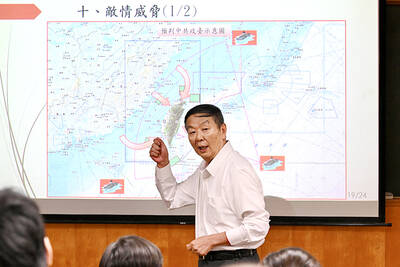
RETHINK? The defense ministry and Navy Command Headquarters could take over the indigenous submarine project and change its production timeline, a source said Admiral Huang Shu-kuang’s (黃曙光) resignation as head of the Indigenous Submarine Program and as a member of the National Security Council could affect the production of submarines, a source said yesterday. Huang in a statement last night said he had decided to resign due to national security concerns while expressing the hope that it would put a stop to political wrangling that only undermines the advancement of the nation’s defense capabilities. Taiwan People’s Party Legislator Vivian Huang (黃珊珊) yesterday said that the admiral, her older brother, felt it was time for him to step down and that he had completed what he
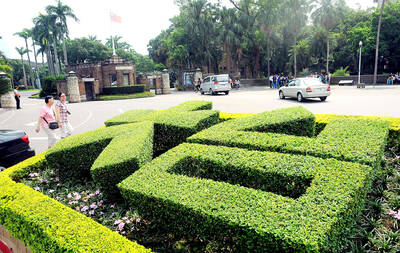
Taiwan has experienced its most significant improvement in the QS World University Rankings by Subject, data provided on Sunday by international higher education analyst Quacquarelli Symonds (QS) showed. Compared with last year’s edition of the rankings, which measure academic excellence and influence, Taiwanese universities made great improvements in the H Index metric, which evaluates research productivity and its impact, with a notable 30 percent increase overall, QS said. Taiwanese universities also made notable progress in the Citations per Paper metric, which measures the impact of research, achieving a 13 percent increase. Taiwanese universities gained 10 percent in Academic Reputation, but declined 18 percent
UNDER DISCUSSION: The combatant command would integrate fast attack boat and anti-ship missile groups to defend waters closest to the coastline, a source said The military could establish a new combatant command as early as 2026, which would be tasked with defending Taiwan’s territorial waters 24 nautical miles (44.4km) from the nation’s coastline, a source familiar with the matter said yesterday. The new command, which would fall under the Naval Command Headquarters, would be led by a vice admiral and integrate existing fast attack boat and anti-ship missile groups, along with the Naval Maritime Surveillance and Reconnaissance Command, said the source, who asked to remain anonymous. It could be launched by 2026, but details are being discussed and no final timetable has been announced, the source
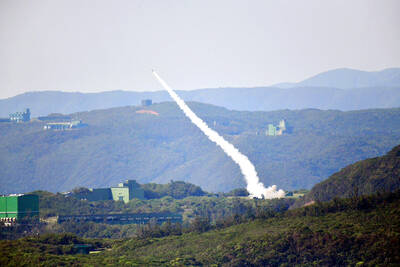
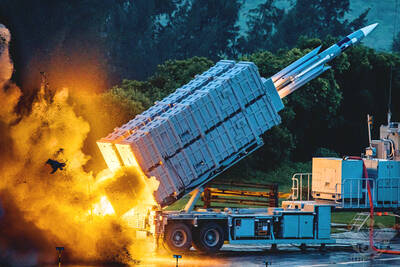
SHOT IN THE ARM: The new system can be integrated with Avenger and Stinger missiles to bolster regional air defense capabilities, a defense ministry report said Domestically developed Land Sword II (陸射劍二) missiles were successfully launched and hit target drones during a live-fire exercise at the Jiupeng Military Base in Pingtung County yesterday. The missiles, developed by the Chungshan Institute of Science and Technology (CSIST), were originally scheduled to launch on Tuesday last week, after the Tomb Sweeping Day holiday long weekend, but were postponed to yesterday due to weather conditions. Local residents and military enthusiasts gathered outside the base to watch the missile tests, with the first one launching at 9:10am. The Land Sword II system, which is derived from the Sky Sword II (天劍二) series, was turned


 RSS
RSS