


Secretary of the Treasury John Snow, Secretary of Commerce Donald Evans and other advisers want US President George W. Bush to roll back tariffs he imposed on US$3 billion in steel imports, people familiar with the matter said.
Bush's economic team will argue that the tariffs ended up hurting US manufacturers more than it helped steelmakers such as US Steel Corp, said administration officials and outside advisers who requested anonymity.
They said it hasn't been decided whether the team will recommend that Bush eliminate or just trim the tariffs, which are now as high as 24 percent.
Opponents of the tariffs blame higher steel prices that resulted from the duties for keeping 200,000 people out of work last year.
Administration officials say Bush hasn't decided whether to lift the tariffs and is waiting for a report due Sept. 19 from the International Trade Commission (ITC), an independent US government agency.
"We look forward to looking at the ITC report when it comes out," said White House spokesman Scott McClellan, adding that he expects no decisions about the tariffs before then.
The point of the tariffs was "to give America and its steel workers a chance to adjust to a large influx of steel," he said.
It's "too early" to comment on the economy team's stance toward the tariffs while different government agencies are still discussing the issue, said John Taylor, the Treasury Department's undersecretary for international affairs, on Friday.
"The steel tariffs have different kind of effects which are being assessed and estimated now," Taylor said. "There is a conversation going on about how to get to the heart of those estimates and make a policy decision."
Snow, Evans, Council of Economic Affairs Chairman Greg Mankiw, White House economic policy chief Stephen Friedman and other advisers want the tariffs removed or reduced in part because they're concerned the EU may impose sanctions on the US after a WTO appeals panel ruling last November, according to people familiar with the process.
The EU has drawn up a list of US$2.2 billion in goods that will be targeted with tariffs, ranging from fruit juice to T-shirts.
The US just last week submitted its appeal to the WTO of a ruling against the tariffs, which originally were set as high as 30 percent last March.
When the tariffs were first imposed, Bush followed the advice of political strategists rather than economic advisers such as then-treasury secretary Paul O'Neill, who said that the duties risked undermining his free trade agenda and hurting employment.
"All economists will agree that the steel tariffs are bad policy," said Kevin Hassett, a senior fellow of the American Enterprise Institute.
"The threat of WTO retaliation provides the Bush economic team with a welcome opportunity to persuade the politicians to do away with the tariffs," he said.
Other economists point to the success of the steel companies in restructuring over the past 18 months as a reason to end the protection. The tariffs gave an incentive for companies to buy out weak competitors, shut inefficient plants, adjust deals with unions and make new capital investments, financier Wilbur Ross told an ITC hearing on July 22.
Still, critics say that the success of the steel industry has meant losses for auto-parts makers, tool-and-die companies and other small manufacturers.
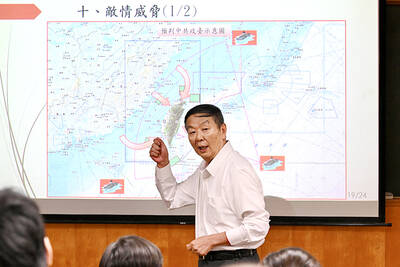
RETHINK? The defense ministry and Navy Command Headquarters could take over the indigenous submarine project and change its production timeline, a source said Admiral Huang Shu-kuang’s (黃曙光) resignation as head of the Indigenous Submarine Program and as a member of the National Security Council could affect the production of submarines, a source said yesterday. Huang in a statement last night said he had decided to resign due to national security concerns while expressing the hope that it would put a stop to political wrangling that only undermines the advancement of the nation’s defense capabilities. Taiwan People’s Party Legislator Vivian Huang (黃珊珊) yesterday said that the admiral, her older brother, felt it was time for him to step down and that he had completed what he
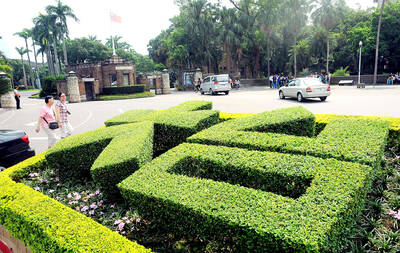
Taiwan has experienced its most significant improvement in the QS World University Rankings by Subject, data provided on Sunday by international higher education analyst Quacquarelli Symonds (QS) showed. Compared with last year’s edition of the rankings, which measure academic excellence and influence, Taiwanese universities made great improvements in the H Index metric, which evaluates research productivity and its impact, with a notable 30 percent increase overall, QS said. Taiwanese universities also made notable progress in the Citations per Paper metric, which measures the impact of research, achieving a 13 percent increase. Taiwanese universities gained 10 percent in Academic Reputation, but declined 18 percent
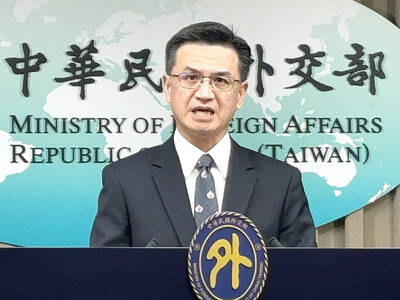
BULLY TACTICS: Beijing has continued its incursions into Taiwan’s airspace even as Xi Jinping talked about Taiwan being part of the Chinese family and nation China should stop its coercion of Taiwan and respect mainstream public opinion in Taiwan about sovereignty if its expression of goodwill is genuine, the Ministry of Foreign Affairs (MOFA) said yesterday. Ministry spokesman Jeff Liu (劉永健) made the comment in response to media queries about a meeting between former president Ma Ying-jeou (馬英九) and Chinese President Xi Jinping (習近平) the previous day. Ma voiced support for the so-called “1992 consensus,” while Xi said that although the two sides of the Taiwan Strait have “different systems,” this does not change the fact that they are “part of the same country,” and that “external
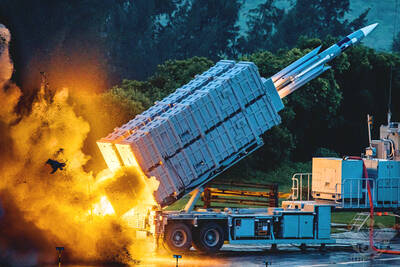
UNDER DISCUSSION: The combatant command would integrate fast attack boat and anti-ship missile groups to defend waters closest to the coastline, a source said The military could establish a new combatant command as early as 2026, which would be tasked with defending Taiwan’s territorial waters 24 nautical miles (44.4km) from the nation’s coastline, a source familiar with the matter said yesterday. The new command, which would fall under the Naval Command Headquarters, would be led by a vice admiral and integrate existing fast attack boat and anti-ship missile groups, along with the Naval Maritime Surveillance and Reconnaissance Command, said the source, who asked to remain anonymous. It could be launched by 2026, but details are being discussed and no final timetable has been announced, the source


 RSS
RSS