


About five years ago, Jacques Cazaban decided he couldn't take the heat. Yet he wanted to stay in the kitchen all the same.
So Cazaban, 58, who runs a medical equipment business in Bordeaux, paid the equivalent of about US$1,700 for a home air-conditioner.
In the US, almost three of every four homes has some kind of air-conditioning. In Europe, people have traditionally just slowed down and baked in summer. But with the arrival of this summer's heat wave, fans and air-conditioners have been leaping off appliance store shelves. And Cazaban has been delighted with his investment.
"It's indispensable," he said by phone recently, as the worst heat wave in decades continued to wither Europe.
While air-conditioner sales in the US have been fairly stable in recent years, they have grown in Europe by more than 10 percent a year.
The engine of this growth is in part the global economy, which is forcing more and more Europeans to work summers. But Europeans have also come to know the benefits of air-conditioning in offices and in their cars and decided they want it at home, too. Sniffing a trend, air-conditioner manufacturers, most notably producers of inexpensive units from Japan, South Korea and China, have flooded the market with affordable models well adapted to small European homes.
Now, this year's seemingly endless heat wave has given the market a huge lift.
"Our busiest months are usually June and July," said Christophe Mutz, marketing director in Paris for the French unit of Daikin of Japan. "This year it's been all summer long."
Not surprisingly, most air-conditioner makers are viewing Europe as a potential El Dorado.
Daikin, Mutz said in a telephone interview, originally projected a growth in sales of about 8 to 10 percent for this year, compared to growth rates of 15 percent and more in recent years, based on early weather forecasts and the generally weak economy.
"Now we are thinking more than 20 percent for the whole year," he said. Demand has been strongest for residential units, he said, while sales have been relatively weak to commercial customers, who apparently feel cool enough in the general economic chill.
To be sure, hurdles to the spread of air-conditioning remain. Both air-conditioners and the power to run them are costly, and there are serious moves in the European Union to curtail both energy use and the gases traditionally used as coolants. Moreover, many Europeans continue to harbor a bias against air-conditioning; some consider it unhealthy, while others say, why not rely on nature?
But as temperatures climbed across Europe, French researchers, echoing warnings from environmental officials elsewhere in Europe, argued that air-conditioners, while cooling the air in homes, force out warm air, raising temperatures outside. Moreover, they said, the devices can contain ozone-depleting gases that contribute to global warming if released into the atmosphere.
"There are several big disadvantages," said Jean-Louis Plazy, deputy director for air and transportation at the French government's Agency for the Environment and Energy Conservation, in Nantes. "For one, there's energy consumption; to produce one calorie of cold, you have to generate three calories of heat. And there's the greenhouse effect, which is linked to emissions."
Makers of air-conditioners are scrambling to find substitutes for chlorofluorocarbons, gases traditionally used as refrigerants. They were banned by the Montreal Protocol, a 1987 treaty signed by more than 150 countries, because the gases deplete the earth's ozone layer. Mutz of Daikin said that EU rules required the replacement of the gas in conventional air-conditioners this year, and in heat pumps, which can both heat and cool living spaces, by January of next year. All of Daikin's equipment meets the new norms, he said.
But France, joining a trend throughout Europe, wants to go a step further, Plazy said. By next year, the government hopes to have in place changes to building codes that will require architects and builders to help limit the use of energy both in winter and summer.
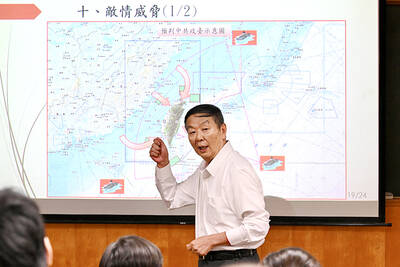
RETHINK? The defense ministry and Navy Command Headquarters could take over the indigenous submarine project and change its production timeline, a source said Admiral Huang Shu-kuang’s (黃曙光) resignation as head of the Indigenous Submarine Program and as a member of the National Security Council could affect the production of submarines, a source said yesterday. Huang in a statement last night said he had decided to resign due to national security concerns while expressing the hope that it would put a stop to political wrangling that only undermines the advancement of the nation’s defense capabilities. Taiwan People’s Party Legislator Vivian Huang (黃珊珊) yesterday said that the admiral, her older brother, felt it was time for him to step down and that he had completed what he

Taiwan has experienced its most significant improvement in the QS World University Rankings by Subject, data provided on Sunday by international higher education analyst Quacquarelli Symonds (QS) showed. Compared with last year’s edition of the rankings, which measure academic excellence and influence, Taiwanese universities made great improvements in the H Index metric, which evaluates research productivity and its impact, with a notable 30 percent increase overall, QS said. Taiwanese universities also made notable progress in the Citations per Paper metric, which measures the impact of research, achieving a 13 percent increase. Taiwanese universities gained 10 percent in Academic Reputation, but declined 18 percent
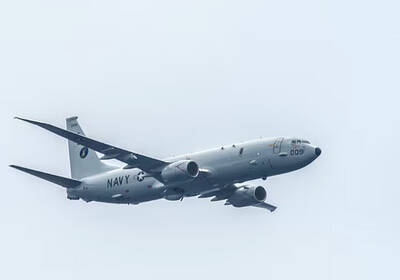
CHINA REACTS: The patrol and reconnaissance plane ‘transited the Taiwan Strait in international airspace,’ the 7th Fleet said, while Taipei said it saw nothing unusual The US 7th Fleet yesterday said that a US Navy P-8A Poseidon flew through the Taiwan Strait, a day after US and Chinese defense heads held their first talks since November 2022 in an effort to reduce regional tensions. The patrol and reconnaissance plane “transited the Taiwan Strait in international airspace,” the 7th Fleet said in a news release. “By operating within the Taiwan Strait in accordance with international law, the United States upholds the navigational rights and freedoms of all nations.” In a separate statement, the Ministry of National Defense said that it monitored nearby waters and airspace as the aircraft
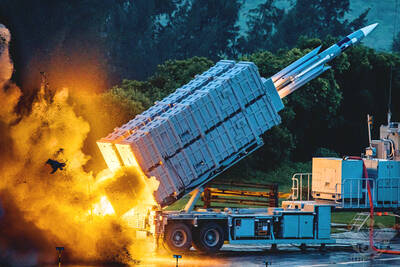
UNDER DISCUSSION: The combatant command would integrate fast attack boat and anti-ship missile groups to defend waters closest to the coastline, a source said The military could establish a new combatant command as early as 2026, which would be tasked with defending Taiwan’s territorial waters 24 nautical miles (44.4km) from the nation’s coastline, a source familiar with the matter said yesterday. The new command, which would fall under the Naval Command Headquarters, would be led by a vice admiral and integrate existing fast attack boat and anti-ship missile groups, along with the Naval Maritime Surveillance and Reconnaissance Command, said the source, who asked to remain anonymous. It could be launched by 2026, but details are being discussed and no final timetable has been announced, the source


 RSS
RSS