


As the US Federal Reserve prepared to meet about interest rates yesterday, recent fears about price deflation have in large part abated.
Three months after the Fed began hinting about its readiness to nip any trend toward declining prices before it started, even if it meant reducing short-term interest rates almost to zero, officials have made it clear they are now less worried than they were before and more reluctant to jump in with unconventional tactics.
Many financial analysts, some taking the cue from the Fed, have shifted their outlook as well. Suddenly there is more talk about faster growth and rising prices for many commodities.
"A few months ago, fears of deflation were extraordinary and in my opinion overdone," said Kermit Schoenholtz, chief economist at Citigroup Global Markets.
"Now the markets are going in the opposite direction, and I think some of that is overdone as well," he said.
Almost all analysts predict that the Federal Open Market Committee will leave the federal funds rate on overnight loans between banks unchanged at 1 percent.
The Fed may also express slightly greater optimism than it did after its meeting in June, when it reiterated its worry about "an unwelcome substantial fall in inflation" and described economic prospects as "weighted toward weakness."
But Fed officials have made it clear they are less worried now about deflation than they were just a few months ago. Fed Chairman Alan Greenspan told a congressional hearing last month that he did not think it would be necessary to fight deflation with unconventional tactics like buying up longer-term Treasury notes.
Buying longer-term securities, rather than simply setting the federal funds rate, would allow the Fed to pump more money into the economy even if the overnight lending rates had dropped to zero, as they have in Japan.
Fed officials say they are still prepared to take such measures, but they say the conditions have improved and that such measures are unnecessary for the moment. They also insist that Greenspan has never really changed his views, because both he and other officials were always careful to say they viewed the likelihood of deflation as remote.
But has the risk of a Japanese-style downward price spiral actually diminished?
Optimists note that a variety of recent data indicates that economic growth in the US accelerated to 2.4 percent at an annual rate in the second quarter. And while nearly half of the economy's growth came from increased government spending, business investment also increased sharply.
Inflation is still running at an annual rate of only 1 percent, the lowest level in nearly four decades, and there are few signs that it will pick up anytime soon. But analysts note that prices for many raw materials have been climbing, which is at least one hint that prices are not poised for an across-the-board decline.
Adam Posen, a senior fellow at the Institute of International Economics in Washington, said he had gradually become convinced that deflation would not turn into the scourge it has proved to be in Japan for nearly a decade.
"If you look underneath the headline numbers, you see that there has been a substantial amount of restructuring in the US economy," Posen said.
Since the stock market bubble burst three years ago, he said, shaky technology companies have been closed, businesses have cut back on their costs and banks have tightened up on credit standards.
That revamping, he said, has now given the US economy a better basis for new economic growth going forward.
James Paulsen, chief investment strategist at Wells Capital Management, said he was more skeptical about the possibility of deflation than he was a year ago.
But even within the Fed, some officials have been quick to caution that deflation or at least "disinflation" -- a further decline in inflation, but a rate still slightly above zero -- is possible even if economic growth picks up.
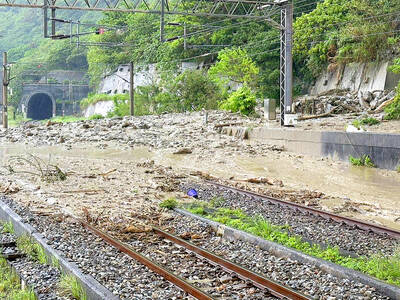
ROLLER-COASTER RIDE: More than five earthquakes ranging from magnitude 4.4 to 5.5 on the Richter scale shook eastern Taiwan in rapid succession yesterday afternoon Back-to-back weather fronts are forecast to hit Taiwan this week, resulting in rain across the nation in the coming days, the Central Weather Administration said yesterday, as it also warned residents in mountainous regions to be wary of landslides and rockfalls. As the first front approached, sporadic rainfall began in central and northern parts of Taiwan yesterday, the agency said, adding that rain is forecast to intensify in those regions today, while brief showers would also affect other parts of the nation. A second weather system is forecast to arrive on Thursday, bringing additional rain to the whole nation until Sunday, it

CONDITIONAL: The PRC imposes secret requirements that the funding it provides cannot be spent in states with diplomatic relations with Taiwan, Emma Reilly said China has been bribing UN officials to obtain “special benefits” and to block funding from countries that have diplomatic ties with Taiwan, a former UN employee told the British House of Commons on Tuesday. At a House of Commons Foreign Affairs Committee hearing into “international relations within the multilateral system,” former Office of the UN High Commissioner for Human Rights (OHCHR) employee Emma Reilly said in a written statement that “Beijing paid bribes to the two successive Presidents of the [UN] General Assembly” during the two-year negotiation of the Sustainable Development Goals. Another way China exercises influence within the UN Secretariat is
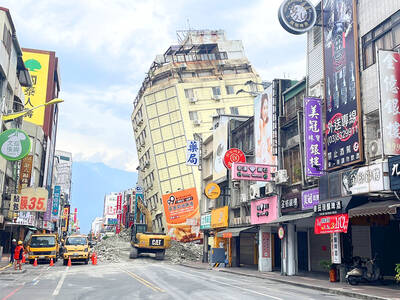
LANDSLIDES POSSIBLE: The agency advised the public to avoid visiting mountainous regions due to more expected aftershocks and rainfall from a series of weather fronts A series of earthquakes over the past few days were likely aftershocks of the April 3 earthquake in Hualien County, with further aftershocks to be expected for up to a year, the Central Weather Administration (CWA) said yesterday. Based on the nation’s experience after the quake on Sept. 21, 1999, more aftershocks are possible over the next six months to a year, the agency said. A total of 103 earthquakes of magnitude 4 on the local magnitude scale or higher hit Hualien County from 5:08pm on Monday to 10:27am yesterday, with 27 of them exceeding magnitude 5. They included two, of magnitude

Taiwan’s first drag queen to compete on the internationally acclaimed RuPaul’s Drag Race, Nymphia Wind (妮妃雅), was on Friday crowned the “Next Drag Superstar.” Dressed in a sparkling banana dress, Nymphia Wind swept onto the stage for the final, and stole the show. “Taiwan this is for you,” she said right after show host RuPaul announced her as the winner. “To those who feel like they don’t belong, just remember to live fearlessly and to live their truth,” she said on stage. One of the frontrunners for the past 15 episodes, the 28-year-old breezed through to the final after weeks of showcasing her unique


 RSS
RSS