


In two weeks' time scientists in Geneva will throw the switch on the biggest development in global communication since Tim Berners-Lee, the inventor of the internet, scrawled "www" on a blackboard in 1989. They will announce that ten laboratories around the world can now talk to each other through their computers.
In the age of high-speed digital communication this may not seem revolutionary. But this small step for computer kind marks the launch of a new technological concept -- the next generation of the Web.
It is called the grid, and scientists say that before long it will change everything we do -- from scientific research to business to tackling fires to booking holidays, and even to the way we watch and craft movies.
The internet currently consists of huge servers which contain information on Web pages that is then downloaded on to computers. As a user, you are limited in what you can do with that information by how much memory or processing power your own computer has.
Under the grid, the power of your machine -- all those gigabytes, RAM and gigahertz -- will become irrelevant. No matter how primitive and cheap your computer, you will have access to more power than currently exists in the Pentagon.
"You just say I want this information and the [grid] is set up so that it goes out and collects that for you and makes it accessible," says Roger Cashmore, director of research at the European particle physics laboratory, in Cern near Geneva.
The backbone of the grid will be computer centers filled with thousands of PCs linked together. Users will be able to use the programs, processing power or the storage they need as if it all existed on their own computer. And it is seamless -- a user could be sitting tapping into their handheld on a train in England, using an application on a computer in the US and storing files in Thailand and still have unlimited computer power at their disposal.
It will be a while before the grid has any impact on our lives. Like the Web, the grid is being developed to help scientific research. Cern is building the large hadron collider (LHC), an enormous microscope to investigate the properties of matter.
The LHC will produce phenomenal amounts of data as it accelerates protons to near the speed of light and smashes them together.
Over a year, it will produce some 500 million to 800 million gigabytes of data.
It would take a pile of CDs the height of the Eiffel tower to store that, Cashmore said.
To make any use of this mountain of information, scientists need a way to analyze and filter out what is useful and what can be tossed aside.
To do that, huge quantities of computing power are needed. That is where the grid comes in.
"In a nutshell, the vision [for the grid] is you describe what the input data should be, where you want the output to go and what you want to happen on this data," says Ian Bird, one of those responsible for deploying the grid at Cern. Once the request has been submitted to the grid, specifically designed software -- the resource broker -- gets on the job.
The resource broker acts as a user's agent on the network, picking out the best places to carry out the necessary work at the best prices and making sure everything runs smoothly.
Like stocks and shares, computer power becomes a commodity: users can buy it whenever they need it.
Bob Jones, a grid project manager who was at Cern when the original Web was invented, talks of applications in biology -- ever more genomes are being seq-uenced producing piles and piles of information.
The grid is the perfect way of analyzing and sharing that data, he says.
Like the electrical grid -- which gives the system its name -- the computing power will become available on demand. But it is about more than particle physics.
A small handheld computer, connected by mobile phone to the internet, would become a supercomputer.
Movies could be edited and watched on it. It could access a word processor that is stored on a PC anywhere in cyberspace.
Having the power of several supercomputers at its disposal, a small architecture company, for example, could model buildings far more complex than any technology it could afford now.
But for the public to get access to the grid, it needs to be publicly available. The EU is already considering a project to develop a network of computers available to the public.
It took eight years for the internet to catch on, says Bob Jones. This time, governments and scientists are already on board, so the results will be seen far quicker.
"It'll be like the Web," said Jones."When you have it you'll wonder how you ever got by without it."
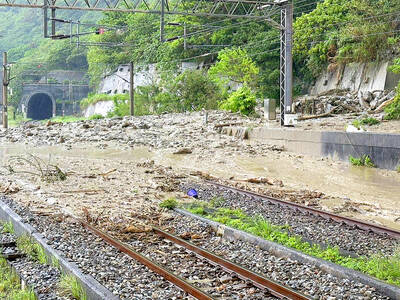
ROLLER-COASTER RIDE: More than five earthquakes ranging from magnitude 4.4 to 5.5 on the Richter scale shook eastern Taiwan in rapid succession yesterday afternoon Back-to-back weather fronts are forecast to hit Taiwan this week, resulting in rain across the nation in the coming days, the Central Weather Administration said yesterday, as it also warned residents in mountainous regions to be wary of landslides and rockfalls. As the first front approached, sporadic rainfall began in central and northern parts of Taiwan yesterday, the agency said, adding that rain is forecast to intensify in those regions today, while brief showers would also affect other parts of the nation. A second weather system is forecast to arrive on Thursday, bringing additional rain to the whole nation until Sunday, it
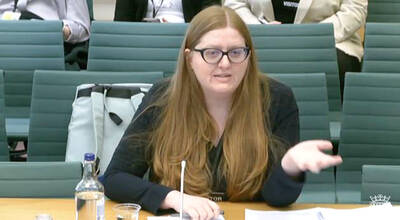
CONDITIONAL: The PRC imposes secret requirements that the funding it provides cannot be spent in states with diplomatic relations with Taiwan, Emma Reilly said China has been bribing UN officials to obtain “special benefits” and to block funding from countries that have diplomatic ties with Taiwan, a former UN employee told the British House of Commons on Tuesday. At a House of Commons Foreign Affairs Committee hearing into “international relations within the multilateral system,” former Office of the UN High Commissioner for Human Rights (OHCHR) employee Emma Reilly said in a written statement that “Beijing paid bribes to the two successive Presidents of the [UN] General Assembly” during the two-year negotiation of the Sustainable Development Goals. Another way China exercises influence within the UN Secretariat is

CHINA REACTS: The patrol and reconnaissance plane ‘transited the Taiwan Strait in international airspace,’ the 7th Fleet said, while Taipei said it saw nothing unusual The US 7th Fleet yesterday said that a US Navy P-8A Poseidon flew through the Taiwan Strait, a day after US and Chinese defense heads held their first talks since November 2022 in an effort to reduce regional tensions. The patrol and reconnaissance plane “transited the Taiwan Strait in international airspace,” the 7th Fleet said in a news release. “By operating within the Taiwan Strait in accordance with international law, the United States upholds the navigational rights and freedoms of all nations.” In a separate statement, the Ministry of National Defense said that it monitored nearby waters and airspace as the aircraft

Taiwan’s first drag queen to compete on the internationally acclaimed RuPaul’s Drag Race, Nymphia Wind (妮妃雅), was on Friday crowned the “Next Drag Superstar.” Dressed in a sparkling banana dress, Nymphia Wind swept onto the stage for the final, and stole the show. “Taiwan this is for you,” she said right after show host RuPaul announced her as the winner. “To those who feel like they don’t belong, just remember to live fearlessly and to live their truth,” she said on stage. One of the frontrunners for the past 15 episodes, the 28-year-old breezed through to the final after weeks of showcasing her unique


 RSS
RSS