


The US seems determined to cut interest rates to a 45-year low in a preemptive anti-deflation strike, but early disquiet is emerging of the risk of a housing bubble.
US Federal Reserve chairman Alan Greenspan and his colleagues are expected to trim the key federal funds rate from 1.25 percent now to a 45-year low of 1.00 percent, possibly even 0.75 percent.
The Federal Open Market Committee meets tomorrow and Wednesday, releasing the decision with an explanatory statement.
Early signs of a tentative turnaround in the US economy led many economists to predict policymakers will opt for an interest rate cut of a quarter percentage point.
Greenspan has alerted the financial markets he wants to nip in the bud even a "remote" threat of deflation, which depresses consumer spending and raises real interest rates.
With inflation fears all but vanquished, analysts said he could squash deflation before it emerges, and at very little risk, by trimming interest rates now.
Even more important, however, the Federal Reserve wanted to convince the financial markets that it would keep interest rates low for as long as it took to reflate the economy.
"Ever since rates got where we are now, and before, people started asking: `When do they start turning this around because rates are so low?,'" said Naroff Economic Advisors president Joel Naroff.
"They are fighting that expectation now," Naroff said. "The reality is that they have got to break that expectation. That is the message they have got to send."
Citigroup economist Steven Wieting agreed.
Inevitably, as the economy built up steam, people traditionally would ask when the Federal Reserve would begin to tighten interest rates and stamp out the recovery, he said.
"That is not their job," Wieting said.
"The economy is below potential," he said. "They should ideally be able to tolerate a fairly prolonged period of above-trend growth before we are dealing with an economy bumping up against capacity constraints and threatening inflation."
Driving interest rates so low carried risks, however, beyond the already widely cited concerns about how far the Federal Reserve could cut rates before it ran out of room.
"Whether we realize it or not, the Fed is running the risk of inflating potential speculative bubbles by taking Fed funds down to 1.0 percent or lower," said Moody's Investors Service chief US economist John Lonski.
Last month, the US had experienced the biggest jump in money supply since the Sept. 11 2001 attacks, when the Federal Reserve took emergency action to pump liquidity into the markets.
This time, the money supply was being boosted by home owners flocking to re-finance their mortgages at lower interest rates, Lonski said.
Low interest rates risked feeding a treasury bond market bubble, and as a result a mortgage bubble, he said.
"That could prove quite damaging to residential real estate in the event that the Fed does find itself facing a rising inflation threat late 2004 [or] 2005 and as a result sharply higher 10-year treasury yields drive mortgage yields up to such a height that we suffer a drop in residential real estate values," Lonski said. "That is the risk right there: that you perhaps unnecessarily lower Fed funds to such a level that you are perhaps risking some future destabilization in the finanical market once the Fed has to tighten to ward off the build up of inflationary pressures."
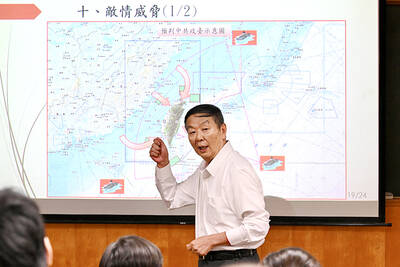
RETHINK? The defense ministry and Navy Command Headquarters could take over the indigenous submarine project and change its production timeline, a source said Admiral Huang Shu-kuang’s (黃曙光) resignation as head of the Indigenous Submarine Program and as a member of the National Security Council could affect the production of submarines, a source said yesterday. Huang in a statement last night said he had decided to resign due to national security concerns while expressing the hope that it would put a stop to political wrangling that only undermines the advancement of the nation’s defense capabilities. Taiwan People’s Party Legislator Vivian Huang (黃珊珊) yesterday said that the admiral, her older brother, felt it was time for him to step down and that he had completed what he
Taiwan has experienced its most significant improvement in the QS World University Rankings by Subject, data provided on Sunday by international higher education analyst Quacquarelli Symonds (QS) showed. Compared with last year’s edition of the rankings, which measure academic excellence and influence, Taiwanese universities made great improvements in the H Index metric, which evaluates research productivity and its impact, with a notable 30 percent increase overall, QS said. Taiwanese universities also made notable progress in the Citations per Paper metric, which measures the impact of research, achieving a 13 percent increase. Taiwanese universities gained 10 percent in Academic Reputation, but declined 18 percent

CHINA REACTS: The patrol and reconnaissance plane ‘transited the Taiwan Strait in international airspace,’ the 7th Fleet said, while Taipei said it saw nothing unusual The US 7th Fleet yesterday said that a US Navy P-8A Poseidon flew through the Taiwan Strait, a day after US and Chinese defense heads held their first talks since November 2022 in an effort to reduce regional tensions. The patrol and reconnaissance plane “transited the Taiwan Strait in international airspace,” the 7th Fleet said in a news release. “By operating within the Taiwan Strait in accordance with international law, the United States upholds the navigational rights and freedoms of all nations.” In a separate statement, the Ministry of National Defense said that it monitored nearby waters and airspace as the aircraft

UNDER DISCUSSION: The combatant command would integrate fast attack boat and anti-ship missile groups to defend waters closest to the coastline, a source said The military could establish a new combatant command as early as 2026, which would be tasked with defending Taiwan’s territorial waters 24 nautical miles (44.4km) from the nation’s coastline, a source familiar with the matter said yesterday. The new command, which would fall under the Naval Command Headquarters, would be led by a vice admiral and integrate existing fast attack boat and anti-ship missile groups, along with the Naval Maritime Surveillance and Reconnaissance Command, said the source, who asked to remain anonymous. It could be launched by 2026, but details are being discussed and no final timetable has been announced, the source


 RSS
RSS