


The leading standard-setting body for wireless communications equip-ment was expected to give final approval yesterday to rules for designing apparatus in the Wi-Fi format that operates at up to four times the speed of today's most popular Wi-Fi devices.
Equipment makers and industry analysts expect final approval of the standard to prompt a new wave of investment by computer companies in building and marketing devices that can wirelessly connect to the Internet whenever they are near a Wi-Fi base station.
"Now there will be guaranteed interoperability," said Marc Cetto, the general manager for wireless networking at Texas Instruments, a leading chipmaker.
The new standard, which is being issued by the Institute of Electrical and Electronics Engineers, is formally known as 802.11(g).
The spread of laptop computers and other mobile devices built to that standard will allow hot spots, as the base stations are known, to handle more users without interference or dropped connections.
The new standard also makes it more practical to download bigger documents or multimedia presentations than today's leading standard, which is formally known as 802.11(b). It also is expected to enhance security for Wi-Fi users.
The new standard represents a compromise among competing proposals and is not the only Wi-Fi standard likely to gain widespread acceptance. Another standard, called 802.11(a) and already in use, is at least as fast and operates at a different radio frequency that is less subject to disruption from microwave signals than that used by the (b) and (g) formats. But 802.11(a) operates over a much shorter range -- no more than 75 feet in most cases.
Both 802.11(b) and the new (g) variant can connect to a base station from up to 300 feet away, although performance in offices, airports and other busy environments is best within 150 feet.
Moreover, because they operate at the same frequency, devices made to the new standard are expected to be compatible with the millions of 802.11(b) devices already deployed.
Some companies, anticipating the approval, have already been shipping so-called pre-(g) chips and equipment incorporating earlier versions of the standard. In practice, such products have often proved incompatible with pre-(g) devices from other companies, causing them to default to the slower 802.11(b) performance or to fail to connect to other devices altogether.
"People made assumptions that didn't pan out," said Stan Schatt, a wireless industry analyst with Forrester Research in San Diego.
With publication of the new standards, analysts expect chip giants like Texas Instruments and computer makers like HP, which have held back from the 802.11(g) market, to move rapidly into it. And companies that entered the market early are expected to issue software updates to bring their versions of the standard into line with those published Thursday.
The market for Wi-Fi chips is expected to jump to US$559 million this year, from US$471 million last year, according to IDC, a market research firm. Kenneth Furer, an IDC analyst in Mountain View, Calif, predicted that 802.11(b) shipments will fall to 50 percent of Wi-Fi chips this year from 94 percent last year.
By next year, he said, 802.11(g) will become the most popular form of Wi-Fi, but dual-band systems capable of handling both 802.11(g) and (a) will grow more rapidly. By 2007, he said, such dual-frequency chips will account for nearly 80 percent of shipments.

RETHINK? The defense ministry and Navy Command Headquarters could take over the indigenous submarine project and change its production timeline, a source said Admiral Huang Shu-kuang’s (黃曙光) resignation as head of the Indigenous Submarine Program and as a member of the National Security Council could affect the production of submarines, a source said yesterday. Huang in a statement last night said he had decided to resign due to national security concerns while expressing the hope that it would put a stop to political wrangling that only undermines the advancement of the nation’s defense capabilities. Taiwan People’s Party Legislator Vivian Huang (黃珊珊) yesterday said that the admiral, her older brother, felt it was time for him to step down and that he had completed what he

Taiwan has experienced its most significant improvement in the QS World University Rankings by Subject, data provided on Sunday by international higher education analyst Quacquarelli Symonds (QS) showed. Compared with last year’s edition of the rankings, which measure academic excellence and influence, Taiwanese universities made great improvements in the H Index metric, which evaluates research productivity and its impact, with a notable 30 percent increase overall, QS said. Taiwanese universities also made notable progress in the Citations per Paper metric, which measures the impact of research, achieving a 13 percent increase. Taiwanese universities gained 10 percent in Academic Reputation, but declined 18 percent

UNDER DISCUSSION: The combatant command would integrate fast attack boat and anti-ship missile groups to defend waters closest to the coastline, a source said The military could establish a new combatant command as early as 2026, which would be tasked with defending Taiwan’s territorial waters 24 nautical miles (44.4km) from the nation’s coastline, a source familiar with the matter said yesterday. The new command, which would fall under the Naval Command Headquarters, would be led by a vice admiral and integrate existing fast attack boat and anti-ship missile groups, along with the Naval Maritime Surveillance and Reconnaissance Command, said the source, who asked to remain anonymous. It could be launched by 2026, but details are being discussed and no final timetable has been announced, the source
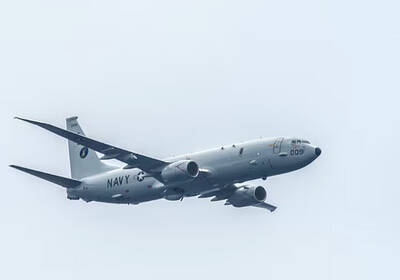
CHINA REACTS: The patrol and reconnaissance plane ‘transited the Taiwan Strait in international airspace,’ the 7th Fleet said, while Taipei said it saw nothing unusual The US 7th Fleet yesterday said that a US Navy P-8A Poseidon flew through the Taiwan Strait, a day after US and Chinese defense heads held their first talks since November 2022 in an effort to reduce regional tensions. The patrol and reconnaissance plane “transited the Taiwan Strait in international airspace,” the 7th Fleet said in a news release. “By operating within the Taiwan Strait in accordance with international law, the United States upholds the navigational rights and freedoms of all nations.” In a separate statement, the Ministry of National Defense said that it monitored nearby waters and airspace as the aircraft


 RSS
RSS