


The Federal Trade Commission (FTC) asked the US Congress Wednesday for expanded authority to combat spam, or unsolicited e-mail advertisements that some claim are choking the Internet.
The FTC already investigates spam if it involves fraud, the agency said it is seeking authority for broader cooperation with foreign investigators and the ability to conduct secret probes into spammers.
The proposal was delivered to committees of the Senate and House of Representatives by FTC Chairman Timothy Muris.
One change proposed by the FTC would allow the agency to more easily share information with foreign law enforcement agencies, because much of the spam is sent without regard to borders, Muris said.
"The FTC's law enforcement experience shows that the path from a fraudulent spammer to a consumer's in-box frequently crosses at least one international border and often several," he said.
Additionally, the FTC proposal said that hackers and spammers who take over someone else's Internet account or e-mail should not be afforded the same privacy protection as other users.
Muris also said the FTC should be allowed to keep its probe of spammers confidential to keep the target of the probe from changing tactics.
"The FTC's experience is that when fraud targets are given notice of FTC investigations they often destroy documents or secrete assets," Muris said.
But Marc Rotenberg of the Electronic Privacy Information Center said it would be wrong to conduct secret probes and end the privacy protection that exists for the Internet.
"Arguments for denying notice to the target of an investigation could too easily be made with respect to targets in the US," Rotenberg testified.
"The proposed changes here not only set a bad precedent but would also send a bad message to consumer protection agencies in other countries about the conduct of investigative actions by democratic governments."
The FTC further asked that it be able to obtain information from Internet service providers (ISPs) about possible spam cases, noting that courts have ruled the amount of information ISPs can turn over is limited.
Spam is believed to account for about half of all e-mail traffic and is seen as a growing threat to confidence of the Internet.
Legislators and regulators have been seeking ways to crack down on spam, and a number of lawsuits have been filed seeking to halt unwanted e-mails.
Spam is seen as an annoyance to individual users, but a major cost to many companies, which collectively spend billions of dollars in an effort to keep out the unsolicited e-mails that could choke their networks.
Additionally, authorities and Internet companies are concerned that the junk e-mails for penis enlargement or breast enhancement, or those directing users to porn sites, can be fraudulent or turn users away from the Web.

ROLLER-COASTER RIDE: More than five earthquakes ranging from magnitude 4.4 to 5.5 on the Richter scale shook eastern Taiwan in rapid succession yesterday afternoon Back-to-back weather fronts are forecast to hit Taiwan this week, resulting in rain across the nation in the coming days, the Central Weather Administration said yesterday, as it also warned residents in mountainous regions to be wary of landslides and rockfalls. As the first front approached, sporadic rainfall began in central and northern parts of Taiwan yesterday, the agency said, adding that rain is forecast to intensify in those regions today, while brief showers would also affect other parts of the nation. A second weather system is forecast to arrive on Thursday, bringing additional rain to the whole nation until Sunday, it
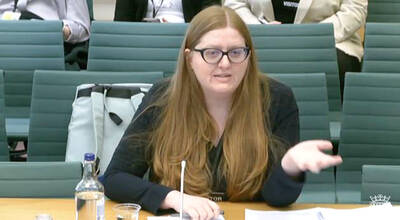
CONDITIONAL: The PRC imposes secret requirements that the funding it provides cannot be spent in states with diplomatic relations with Taiwan, Emma Reilly said China has been bribing UN officials to obtain “special benefits” and to block funding from countries that have diplomatic ties with Taiwan, a former UN employee told the British House of Commons on Tuesday. At a House of Commons Foreign Affairs Committee hearing into “international relations within the multilateral system,” former Office of the UN High Commissioner for Human Rights (OHCHR) employee Emma Reilly said in a written statement that “Beijing paid bribes to the two successive Presidents of the [UN] General Assembly” during the two-year negotiation of the Sustainable Development Goals. Another way China exercises influence within the UN Secretariat is

CHINA REACTS: The patrol and reconnaissance plane ‘transited the Taiwan Strait in international airspace,’ the 7th Fleet said, while Taipei said it saw nothing unusual The US 7th Fleet yesterday said that a US Navy P-8A Poseidon flew through the Taiwan Strait, a day after US and Chinese defense heads held their first talks since November 2022 in an effort to reduce regional tensions. The patrol and reconnaissance plane “transited the Taiwan Strait in international airspace,” the 7th Fleet said in a news release. “By operating within the Taiwan Strait in accordance with international law, the United States upholds the navigational rights and freedoms of all nations.” In a separate statement, the Ministry of National Defense said that it monitored nearby waters and airspace as the aircraft

Taiwan’s first drag queen to compete on the internationally acclaimed RuPaul’s Drag Race, Nymphia Wind (妮妃雅), was on Friday crowned the “Next Drag Superstar.” Dressed in a sparkling banana dress, Nymphia Wind swept onto the stage for the final, and stole the show. “Taiwan this is for you,” she said right after show host RuPaul announced her as the winner. “To those who feel like they don’t belong, just remember to live fearlessly and to live their truth,” she said on stage. One of the frontrunners for the past 15 episodes, the 28-year-old breezed through to the final after weeks of showcasing her unique


 RSS
RSS