


Now that his re-election is secured, US President Barack Obama has a freer hand to deal with a world of familiar problems in new ways, from toughening the US’ approach to Iran and Syria while potentially engaging other repressive countries such as Cuba and North Korea and refocusing on moribund Middle East peace efforts. The first tweaks in his Iran policy could come within weeks, officials said.
However, a pressing task for Obama will be to assign a new team to carry out his national security agenda. US Secretary of State Hillary Rodham Clinton has announced her plans to retire, but could stay a few weeks past January to help the administration as it reshuffles personnel. Secretary of Defense Leon Panetta is likely to depart shortly after her. CIA Director General David Petraeus is expected to stay on.
The favorite to succeed Clinton, UN Ambassador Susan Rice, would face a difficult Senate confirmation process after her much-maligned explanations of the attack on the US consulate in Benghazi, Libya, meaning she could land instead as Obama’s national security adviser. That job that doesn’t require the Senate’s approval. Tom Donilon, who currently holds that position, and Chuck Hagel, a former Republican senator, are among the other contenders.
The chances of another early favorite, Senate Foreign Relations Committee Chairman John Kerry, are hampered by Democrats’ fear that Republican Senator Scott Brown, who lost his Massachusetts seat on Tuesday, could win Kerry’s seat in a race to replace him.
Officials, however, are pointing to Jon Huntsman, the former Utah governor, Obama’s ambassador to China and potential Republican presidential candidate, and the State Department’s current No. 2, William Burns.
Huntsman is still widely respected by the administration even if he’d hoped to unseat Obama. Choosing Huntsman would allow the president to claim bipartisanship while putting an Asia expert in the job at a time when the US is focusing more attention on the world’s most populous continent.
However, Burns would be an option as caretaker secretary until post-election passions in Congress subside and a permanent replacement might face smoother confirmation. He is a career diplomat who has no political baggage and would be unlikely to stir significant opposition among lawmakers.
At the Pentagon, speculation about successors has been limited. Panetta’s deputy, Ashton Carter, is seen as a possibility, along with Michele Flournoy, who served as Defense Department policy chief from 2009 to this year and would be the first woman in the top job.
New Cabinet members will enter at a time of various global security challenges, from the Arab Spring to China’s rapid economic and military expansion in Asia.
However, the president’s escape from any future campaigning also offers unique diplomatic opportunities, which Obama himself hinted at in March when he told then-Russian president and now Prime Minister Dmitry Medvedev that he’d have “more flexibility” on thorny issues after the election.
Obama’s immediate predecessors, Bill Clinton and George W. Bush, used their second terms to launch major, though ultimately unsuccessful initiatives for an Israeli-Palestinian accord, an elusive goal that Obama also deeply desires. This summer he listed the lack of progress toward peace among the biggest disappointments of his presidency so far, suggesting another US attempt in the offing.
Clinton’s Camp David negotiations and Bush’s Annapolis process became signature foreign policy priorities in 2000 and 2007. However, the Israelis and the Palestinians remain as far apart as ever on the contours of an agreement, from the borders of their two separate states to issues related to refugees and resources.
Any Obama-led plan for the Middle East will be complicated by Israel’s fears about the Iranian nuclear program, civil war in Syria and the new reality of an Islamist-led Egypt having replaced the US’ most faithful Arab ally. Obama’s difficult relationship with Israeli Prime Minister Benjamin Netanyahu could also complicate the process.
With Iran, the president is holding out hope that crippling economic sanctions will force the Islamic republic’s leaders to scale back its uranium enrichment activity.
Iran insists its program is designed for energy and medical research purposes, even as many in the West fear the ultimate goal is to produce nuclear weapons. Obama has stressed the narrowing time frame for Tehran to negotiate a peaceful solution to the standoff, while pressing Israel to hold off on any plans for a pre-emptive strike.
Officials say the administration is likely to adjust its two-track approach to Iran — which offers Tehran rewards for coming clean on its nuclear program and harsher penalties for continued defiance — in the coming weeks. Details are still being debated. However, in the end, Obama may have to resort to a military strategy if Iran continues to enrich uranium at higher levels and nears production of weapons-grade material — a possible scenario he acknowledges.
“The clock is ticking. We’re not going to allow Iran to perpetually engage in negotiations that lead nowhere,” Obama said in his last foreign policy debate with Republican presidential candidate Mitt Romney.
“We have a sense of when they would get breakout capacity, which means that we would not be able to intervene in time to stop their nuclear program,” he said.
Syria’s widening conflict is another concern. More than 36,000 people have died in the last 20 months, as a brutal crackdown on dissent by Syrian President Bashar al-Assad’s regime has descended into a full-scale civil war.
Obama has demanded al-Assad’s departure, yet has ruled out military assistance to the rebels or US military actions such as airstrikes or enforcing a no-fly zone over Syria.
Last week, in a significant shift in policy, the secretary of state demanded a major shakeup in the opposition’s ranks in the hopes of rallying Syrians behind the rebellion. However, Clinton’s spokeswoman, Victoria Nuland, reiterated on Wednesday the administration still rejects the notion of providing weapons to anti-al-Assad fighters or any talk of armed intervention.
In other places, Obama’s engagement efforts may get another look. After some success with a rapidly liberalizing Myanmar, there are hopes for democratic reforms and human rights advances in Cuba and North Korea, among others.
However, short of a rapid change in attitude from these governments, Obama’s options for a landmark breakthrough in US diplomacy are limited. He won’t be able to reach out to Havana until it frees the jailed US contractor Alan Gross, while Pyongyang will have to denuclearize if it wants better relations with the US — steps neither regime has shown a willingness to entertain. The recent re-election of Venezuelan President Hugo Chavez has halted chances for now of any rapprochement between Washington and Caracas.
In Afghanistan, the president will seek to stick to NATO’s 2014 withdrawal date for most international troops, a central campaign promise. His administration has been trying unsuccessfully to jump-start peace negotiations between Afghan President Hamid Karzai’s Western-backed government and the Taliban.
The so-called reconciliation effort relies heavily on the US’ frustrating and unreliable ally Pakistan, where extremist groups such as al-Qaeda and the Haqqani network will continue to face US drone attacks.
Behind all the diplomatic efforts are larger questions of US geopolitical strategy.
Obama had initial success improving US relations with Russia, getting a nuclear arms-reduction pact last year, but has since seen the US’ former Cold War foe frustrate US missile defense plans and hopes of an international consensus on Syria. The president has continued to trumpet the benefits of his Russia “reset” policy, but may take a firmer stance against Moscow if it refuses to show compromise.
For economic reasons, China policy is less likely to change. The world’s two biggest economies are deeply interdependent and, despite lingering disagreements over Beijing’s currency exchange rates and intellectual property infringement, neither side will want to do anything that threatens a trade war and jeopardizes China’s booming growth or the US’ still-fragile jobs recovery.
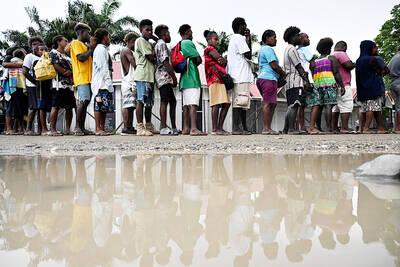
SEEKING CHANGE: A hospital worker said she did not vote in previous elections, but ‘now I can see that maybe my vote can change the system and the country’ Voting closed yesterday across the Solomon Islands in the south Pacific nation’s first general election since the government switched diplomatic allegiance from Taiwan to Beijing and struck a secret security pact that has raised fears of the Chinese navy gaining a foothold in the region. The Solomon Islands’ closer relationship with China and a troubled domestic economy weighed on voters’ minds as they cast their ballots. As many as 420,000 registered voters had their say across 50 national seats. For the first time, the national vote also coincided with elections for eight of the 10 local governments. Esther Maeluma cast her vote in the
Nearly half of China’s major cities are suffering “moderate to severe” levels of subsidence, putting millions of people at risk of flooding, especially as sea levels rise, according to a study of nationwide satellite data released yesterday. The authors of the paper, published by the journal Science, found that 45 percent of China’s urban land was sinking faster than 3mm per year, with 16 percent at more than 10mm per year, driven not only by declining water tables, but also the sheer weight of the built environment. With China’s urban population already in excess of 900 million people, “even a small portion

UNSETTLING IMAGES: The scene took place in front of TV crews covering the Trump trial, with a CNN anchor calling it an ‘emotional and unbelievably disturbing moment’ A man who doused himself in an accelerant and set himself on fire outside the courthouse where former US president Donald Trump is on trial has died, police said yesterday. The New York City Police Department (NYPD) said the man was declared dead by staff at an area hospital. The man was in Collect Pond Park at about 1:30pm on Friday when he took out pamphlets espousing conspiracy theories, tossed them around, then doused himself in an accelerant and set himself on fire, officials and witnesses said. A large number of police officers were nearby when it happened. Some officers and bystanders rushed

HYPOCRISY? The Chinese Ministry of Foreign Affairs yesterday asked whether Biden was talking about China or the US when he used the word ‘xenophobic’ US President Joe Biden on Wednesday called for a hike in steel tariffs on China, accusing Beijing of cheating as he spoke at a campaign event in Pennsylvania. Biden accused China of xenophobia, too, in a speech to union members in Pittsburgh. “They’re not competing, they’re cheating. They’re cheating and we’ve seen the damage here in America,” Biden said. Chinese steel companies “don’t need to worry about making a profit because the Chinese government is subsidizing them so heavily,” he said. Biden said he had called for the US Trade Representative to triple the tariff rates for Chinese steel and aluminum if Beijing was


 RSS
RSS