


A standoff between Iran and the West over Iran’s nuclear plans could erupt in military conflict, a Chinese state newspaper said yesterday, after the release of a UN report likely to increase pressure on Beijing to curb its Iranian ties.
Chinese policymakers are caught between their demand for Iranian oil and worry that the US and its allies will demand harsher sanctions against Iran, even risk military action, after the International Atomic Energy Agency (IAEA) concluded Iran appeared to have worked on designing an atomic weapon.
“It is clear that contention between the various sides over the Iranian nuclear issue has reached white hot levels and could even be on the precipice of a showdown,” the overseas edition of the People’s Daily said in a front-page commentary.
If Iran refused to back down in the face of growing US conviction that it was developing nuclear weapons, “the risks of war will grow,” the paper said, noting reports that Israel could consider a military strike on Iranian nuclear sites.
The People’s Daily is the top newspaper of the Chinese Communist Party and broadly reflects official thinking.
A commentary in the small-circulation overseas edition of the newspaper falls short of a formal government response, but it suggests the anxieties weighing on Beijing after the latest UN nuclear agency report.
Xinhua news agency also suggested Beijing would respond warily to the report. The UN watchdog still “lacks a smoking gun,” Xinhua said in a commentary.
“There are no witnesses or physical evidence to prove that Iran is making nuclear weapons,” it said. “In dealing with the Iran nuclear issue, it is extremely dangerous to rely on suspicions, and the destructive consequences of any armed action would endure for a long time.”
China is likely to face difficult choices as it tries to keep steady ties with the US, which is likely to introduce new unilateral sanctions on Iran.
“If these sanctions harm China’s substantive interests, then China will have to respond in some way,” said Li Hong (黎弘), secretary-general of the China Arms Control and Disarmament Association, a government-controlled body.
“It would certainly have an impact on bilateral relations,” Li said in an interview.
Iran is China’s third-largest crude oil supplier, shipping 20.3 million tonnes in the first nine months of the year, up by almost one-third on the same time last year, according to Chinese data. Overall trade between the two countries grew to US$32.9 billion in value in the first nine months, up by 58 percent.
“The onus will really be on China, as the only country whose economic relations with Iran have grown,” Suzanne Maloney an expert on Iran at the Brookings Institution, a think tank in Washington, said in a telephone interview.
Over the past year or more, China has quietly stalled on oil and gas investments in Iran, seeking to ward off stricter unilateral sanctions from Washington, while preserving a foothold in Iran. However, that implicit deal will come under growing pressure, especially from the US Congress, Maloney said.
“They’ve had a compromise for the past 18 months of a go-slow in investment, but it’s difficult to see how that bargain can hold in the wake of the latest revelations,” Maloney said.
Citing what it called “credible” information from member states and elsewhere, the IAEA said Iran appeared to have carried out activities applicable to developing nuclear weapons, such as high explosives testing and developing a trigger that could be used for an atomic bomb.
China has kept close bilateral ties with Iran, but also backed past UN Security Council resolutions criticizing Iran’s position on nuclear issues and authorizing limited sanctions.
However, China has repeatedly resisted Western proposals for sanctions that could seriously curtail its energy and economic ties with Iran. As one of the Security Council’s five permanent members, China holds the power to veto any resolutions.
China has been urging Iran this month to show flexibility over its nuclear program and warned that the use of force to resolve the issue was the last thing the Middle East needed.
Li said Beijing was worried about the tension, but war remained a slim risk.
“Overall, I think the international conditions show governments couldn’t stomach armed conflict over Iran,” he said.

Republican US lawmakers on Friday criticized US President Joe Biden’s administration after sanctioned Chinese telecoms equipment giant Huawei unveiled a laptop this week powered by an Intel artificial intelligence (AI) chip. The US placed Huawei on a trade restriction list in 2019 for contravening Iran sanctions, part of a broader effort to hobble Beijing’s technological advances. Placement on the list means the company’s suppliers have to seek a special, difficult-to-obtain license before shipping to it. One such license, issued by then-US president Donald Trump’s administration, has allowed Intel to ship central processors to Huawei for use in laptops since 2020. China hardliners
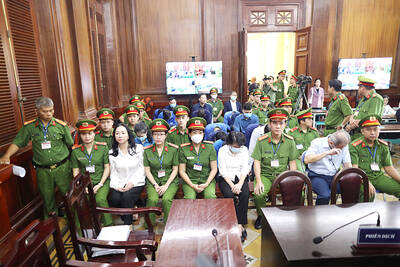
A top Vietnamese property tycoon was on Thursday sentenced to death in one of the biggest corruption cases in history, with an estimated US$27 billion in damages. A panel of three hand-picked jurors and two judges rejected all defense arguments by Truong My Lan, chair of major developer Van Thinh Phat, who was found guilty of swindling cash from Saigon Commercial Bank (SCB) over a decade. “The defendant’s actions ... eroded people’s trust in the leadership of the [Communist] Party and state,” read the verdict at the trial in Ho Chi Minh City. After the five-week trial, 85 others were also sentenced on

Conjoined twins Lori and George Schappell, who pursued separate careers, interests and relationships during lives that defied medical expectations, died this month in Pennsylvania, funeral home officials said. They were 62. The twins, listed by Guinness World Records as the oldest living conjoined twins, died on April 7 at the Hospital of the University of Pennsylvania, obituaries posted by Leibensperger Funeral Homes of Hamburg said. The cause of death was not detailed. “When we were born, the doctors didn’t think we’d make 30, but we proved them wrong,” Lori said in an interview when they turned 50, the Philadelphia Inquirer reported. The
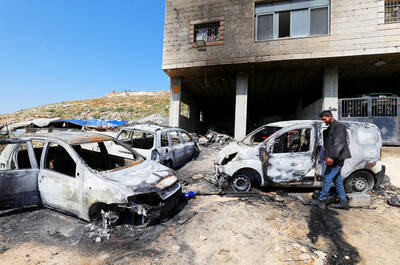
RAMPAGE: A Palestinian man was left dead after dozens of Israeli settlers searching for a missing 14-year-old boy stormed a village in the Israeli-occupied West Bank US President Joe Biden on Friday said he expected Iran to attack Israel “sooner, rather than later” and warned Tehran not to proceed. Asked by reporters about his message to Iran, Biden simply said: “Don’t,” underscoring Washington’s commitment to defend Israel. “We are devoted to the defense of Israel. We will support Israel. We will help defend Israel and Iran will not succeed,” he said. Biden said he would not divulge secure information, but said his expectation was that an attack could come “sooner, rather than later.” Israel braced on Friday for an attack by Iran or its proxies as warnings grew of


 RSS
RSS