


Turkmenistan’s all-powerful leader promises that, one day soon, he will build a Las Vegas on the windswept shores of the Caspian Sea.
Illuminated by distant gas flares, thousands of construction workers toil through the night to build the next stage of Avaza: a fantasy resort built on the reclusive Central Asian nation’s fabulous energy riches.
Seven colossal, marble-fronted hotels ordered by Turkmen President Kurbanguly Berdymukhamedov line the coast. At least another 23 are planned in a project that some say could divert up to US$5 billion from Turkmenistan’s state coffers.
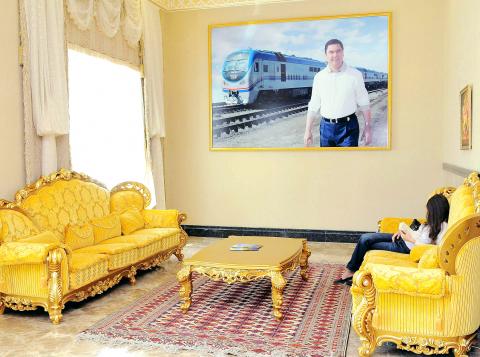
Photo: Reuters
However, state publicity and lavish spending cannot hide the fact that Turkmenistan is one of the world’s most authoritarian and secretive nations, where Berdymukhamedov’s word is final and opposition among the 5.4 million population is non-existent.
Avaza is an alien world to the 70,000 residents of Turkmenbashi, an oil-refining port 20 minutes’ drive away now bypassed by a motorway that shuttles curious visitors and officials from the region’s airport.
In Turkmenbashi, shoppers in the meat section of a local grocery store are offered bones from a plastic crate or sausages covered in flies. The air is thick with sulfur from the oil refinery.
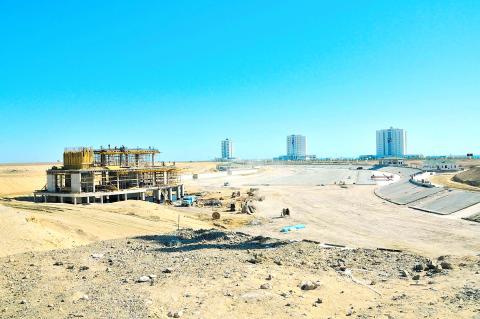
Photo: Reuters
It’s enough to make some residents long for Saparmurat Niyazov, Turkmenistan’s first post-Soviet leader, who ruled with a bizarre personality cult and renamed the city to reflect his own self-awarded title: Turkmenbashi, or Leader of All Turkmens.
“Under Niyazov, we lived in paradise, but we didn’t realize it,” said Vlad, a 22-year-old resident who scrapes a living driving rare visitors around Turkmenbashi in his old Opel car.
Revealing only the short form of his first name, Vlad was one of the few residents of Turkmenbashi willing to be quoted. Others, fearing recrimination, would not reveal their names.
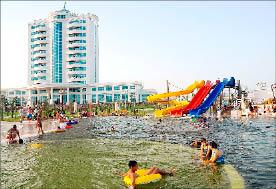
Photo: Reuters
“In the good old days, I could fill my car for just a dollar. Now gas prices have jumped sevenfold,” he said. “Why has it all become so costly? I don’t know. We are never told.”
Turkmenistan’s gas export revenues are fueling breakneck economic growth. The IMF predicts GDP will expand by 9 percent this year.
Turkmenistan itself is planning 14 percent growth this year. The long-term outlook for economic output is also strong, as it plans to triple natural gas output over the next two decades by drawing on the world’s fourth-largest reserves.
Official literature describes Avaza as “a synonym for our unprecedented reforms.”
The planned tourist zone will cover an area of 5,000 hectares and Berdymukhamedov has said: “In the third stage of the project, a Turkmen ‘Las Vegas’ will appear here, with numerous casinos and other entertainment centers.”
A fountain gushing from the Caspian will evoke images of Geneva’s Jet d’Eau, while a 7km canal filled with yachts is designed to bring to mind Venice or Amsterdam.
A huge portrait of the president in parade uniform greets guests at the largest hotel in the complex, the Watanchy, or “Patriot.” It was built by the Ministry of Defense. Berdymukhamedov has ordered banks and other ministries to build their own hotels to match.
However, foreign visitors, who pay up to US$300 for a night at the Watanchy, must overcome bureaucratic hurdles to secure a visa and encounter hotel staff often baffled by words such as Internet and Wi-Fi or requests to send an e-mail.
Even at the Watanchy, restaurants serve a frugal choice of dishes smacking of Soviet-era canteens and usually close at 10pm, just like elsewhere in the country, where electricity is routinely turned off to rush out straggling guests.
The expansion has also taken place at the expense of the private summer houses built along the shore in Soviet times.
“We had a school-leaving party in a wooden two-story house owned by the parents of a girl from my class,” said a security guard at a local hotel, who declined to give his name.
“Then it was bulldozed,” he said, pointing to a garbage heap near the canal. “They got no compensation. Some people created a fuss and were offered allotments, deep into the desert.”
While Avaza dazzles its visitors, little has changed for the ordinary citizens of Turkmenbashi, where clothes and linen dry on ropes slung between rows of two and three-story apartment blocks. The roads are dusty and potholed.
Formerly known as Krasnovodsk, the city was a springboard for Russia’s invasion of Central Asia in its 19th-century Great Game with the British Empire for influence in the region.
In the main market, buyers were far outnumbered by sellers.
Few locals would buy fresh mutton at US$4 per kilogram and almost nobody approached fishmongers’ stalls laden with live sturgeon offered at US$11 per kilogram, chunks of smoked -beluga at US$35 per kilogram and -silvery gray mullet at US$2.50 per kilogram.
However, Anna, who sells poached beluga caviar from under the table at US$1,200 per kilogram, was smiling after several foreign delegates attending a gas conference in Avaza paid a visit.
“They bought 50 to 100 grams of my caviar each to eat it back at their hotels,” she said. She had just earned several times the average monthly wage of less than US$250.
Gas, electricity and water are still free of charge for most Turkmen households, the legacy of a gift once made by Niyazov.
Avaza has given citizens its own gift, special discount room rates of US$45 to US$108 per night at local hotels.
“Yes, we do go to Avaza,” Anna says. “But no, we do not visit spas or hotels. We mainly go to see Avaza’s great fountains because we have no fountains in Turkmenbashi.”
Nearly half of China’s major cities are suffering “moderate to severe” levels of subsidence, putting millions of people at risk of flooding, especially as sea levels rise, according to a study of nationwide satellite data released yesterday. The authors of the paper, published by the journal Science, found that 45 percent of China’s urban land was sinking faster than 3mm per year, with 16 percent at more than 10mm per year, driven not only by declining water tables, but also the sheer weight of the built environment. With China’s urban population already in excess of 900 million people, “even a small portion

UNSETTLING IMAGES: The scene took place in front of TV crews covering the Trump trial, with a CNN anchor calling it an ‘emotional and unbelievably disturbing moment’ A man who doused himself in an accelerant and set himself on fire outside the courthouse where former US president Donald Trump is on trial has died, police said yesterday. The New York City Police Department (NYPD) said the man was declared dead by staff at an area hospital. The man was in Collect Pond Park at about 1:30pm on Friday when he took out pamphlets espousing conspiracy theories, tossed them around, then doused himself in an accelerant and set himself on fire, officials and witnesses said. A large number of police officers were nearby when it happened. Some officers and bystanders rushed

HYPOCRISY? The Chinese Ministry of Foreign Affairs yesterday asked whether Biden was talking about China or the US when he used the word ‘xenophobic’ US President Joe Biden on Wednesday called for a hike in steel tariffs on China, accusing Beijing of cheating as he spoke at a campaign event in Pennsylvania. Biden accused China of xenophobia, too, in a speech to union members in Pittsburgh. “They’re not competing, they’re cheating. They’re cheating and we’ve seen the damage here in America,” Biden said. Chinese steel companies “don’t need to worry about making a profit because the Chinese government is subsidizing them so heavily,” he said. Biden said he had called for the US Trade Representative to triple the tariff rates for Chinese steel and aluminum if Beijing was

Beijing is continuing to commit genocide and crimes against humanity against Uyghurs and other Muslim minorities in its western Xinjiang province, U.S. Secretary of State Antony Blinken said in a report published on Monday, ahead of his planned visit to China this week. The State Department’s annual human rights report, which documents abuses recorded all over the world during the previous calendar year, repeated language from previous years on the treatment of Muslims in Xinjiang, but the publication raises the issue ahead of delicate talks, including on the war in Ukraine and global trade, between the top U.S. diplomat and Chinese


 RSS
RSS