


China launches a ban on smoking in indoor public spaces tomorrow, but the effort is widely viewed as vague and half-hearted and few expect it to have much of an impact in the tobacco-addicted country.
The nationwide prohibition is designed to bring China — which has more than 300 million smokers, roughly equal to the entire population of the US — more in line with health regulations in developed countries.
However, it faces a tough test.
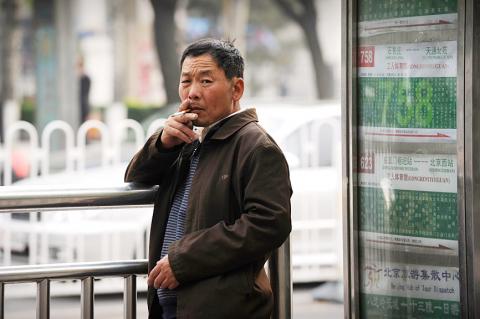
Photo: AFP
Tobacco use is deeply ingrained in China, where offering a cigarette is a common greeting ritual. Lighting up in elevators or even hospital waiting rooms is routine.
“I don’t think this ban on smoking will have a big effect,” said Yang Lei, a 32-year-old Beijinger who has been smoking for four years. “In China, when you are in a restaurant, people smoke even if there is a ‘No Smoking’ sign. When you eat with friends, few people ask others if it’s OK to smoke and restaurant managers rarely stop clients who smoke.”
Many health experts have warned that China, the world’s largest producer and consumer of tobacco, faces a ticking health timebomb unless it curbs smoking, and the ban marks a significant move for the Chinese government.
“The Chinese ministry of health has taken an important step forward in their tobacco control efforts,” said Kelly Henning, head of public health initiatives, including tobacco control, at the US-based Bloomberg Foundation, which finances anti-smoking efforts worldwide.
However, the nation’s commitment to the ban remains unclear.
Similar temporary bans were introduced during the 2008 Olympics in Beijing and last year’s World Expo in Shanghai, but were rarely respected or enforced.
The specifics of the new nationwide ban are sketchy and vague.
The ministry of health guidelines say smoking will be banned in “indoor public spaces” and that cigarette vending machines cannot be located in public places.
However, state press reports have said offices and factories will not be covered by the ban, and it remains unclear whether it will be adequately enforced in bars, restaurants and public transport.
Tobacco kills more than 1 million people each year in China, where some brands can be purchased for as little as 3 yuan (US$0.46). Chinese and foreign experts say the number of smoking deaths could triple by 2030.
Experts point to the state monopoly on the tobacco industry, which accounts for nearly a tenth of national tax revenue, as one of the biggest obstacles to anti-smoking efforts.
Beijing dragged its feet in adopting the ban — it takes effect four months after the expiration of a deadline set by the WHO Framework Convention on Tobacco Control, which China signed five years ago.
So far, there has been no major nationwide public awareness campaigns to promote the ban.
Enforcement issues and penalties also are not clearly spelled out.
The guidelines say “operators of businesses in public places” must put up “no smoking” notices and take the initiative to stop smokers from lighting up.
Even China’s state news agency Xinhua said yesterday the ban is “likely to be ignored by smokers, public venue operators and the general public due to its vague content,” singling out a lack of clarity on penalties and enforcement.
“The crucial points are control, enforcement and collection of fines. Who will be involved? If these elements are missing, respect [for the ban] becomes optional,” said Hu Teh-wei, a professor of public health at the University of California, Berkeley.
Hu said he saw no high-level commitment in China to cut tobacco consumption.
“Given the Chinese political system, we need the premier and the president — or even the vice-premier — to raise this issue publicly. So far we have not heard any comment from them on this topic,” Hu said.
Chen Chi, a 22-year-old public health student, is paying his way through university by working as a waiter in Beijing. He admitted the ban was news to him.
“People won’t change,” he said. “More and more young men are starting to smoke.”
Nearly half of China’s major cities are suffering “moderate to severe” levels of subsidence, putting millions of people at risk of flooding, especially as sea levels rise, according to a study of nationwide satellite data released yesterday. The authors of the paper, published by the journal Science, found that 45 percent of China’s urban land was sinking faster than 3mm per year, with 16 percent at more than 10mm per year, driven not only by declining water tables, but also the sheer weight of the built environment. With China’s urban population already in excess of 900 million people, “even a small portion

UNSETTLING IMAGES: The scene took place in front of TV crews covering the Trump trial, with a CNN anchor calling it an ‘emotional and unbelievably disturbing moment’ A man who doused himself in an accelerant and set himself on fire outside the courthouse where former US president Donald Trump is on trial has died, police said yesterday. The New York City Police Department (NYPD) said the man was declared dead by staff at an area hospital. The man was in Collect Pond Park at about 1:30pm on Friday when he took out pamphlets espousing conspiracy theories, tossed them around, then doused himself in an accelerant and set himself on fire, officials and witnesses said. A large number of police officers were nearby when it happened. Some officers and bystanders rushed
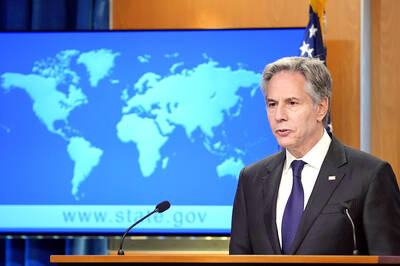
Beijing is continuing to commit genocide and crimes against humanity against Uyghurs and other Muslim minorities in its western Xinjiang province, U.S. Secretary of State Antony Blinken said in a report published on Monday, ahead of his planned visit to China this week. The State Department’s annual human rights report, which documents abuses recorded all over the world during the previous calendar year, repeated language from previous years on the treatment of Muslims in Xinjiang, but the publication raises the issue ahead of delicate talks, including on the war in Ukraine and global trade, between the top U.S. diplomat and Chinese

HYPOCRISY? The Chinese Ministry of Foreign Affairs yesterday asked whether Biden was talking about China or the US when he used the word ‘xenophobic’ US President Joe Biden on Wednesday called for a hike in steel tariffs on China, accusing Beijing of cheating as he spoke at a campaign event in Pennsylvania. Biden accused China of xenophobia, too, in a speech to union members in Pittsburgh. “They’re not competing, they’re cheating. They’re cheating and we’ve seen the damage here in America,” Biden said. Chinese steel companies “don’t need to worry about making a profit because the Chinese government is subsidizing them so heavily,” he said. Biden said he had called for the US Trade Representative to triple the tariff rates for Chinese steel and aluminum if Beijing was


 RSS
RSS