


The UN reported that more than 500 systematic rapes were committed by armed combatants in eastern parts of the Democratic Republic of the Congo (DRC) since late July — more than double the number previously reported — and accepted partial responsibility for not protecting citizens.
UN Assistant Secretary-General for Peacekeeping Atul Khare told the UN Security Council on Tuesday that at least 267 more rapes occurred in another area of the country’s east, in addition to 242 rapes earlier reported in and around Luvungi, a village of about 2,200 people located about 30km from a UN peacekeepers’ camp.
“While the primary responsibility for protection of civilians lies with the state, its national army and police force,” Khare said, “clearly, we have also failed. Our actions were not adequate, resulting in unacceptable brutalization of the population of the villages in the area. We must do better.”
The UN peacekeeping force in the DRC, called MONUSCO, on Sept. 1 launched an operation using 750 troops to back efforts by DR Congolese security forces to arrest the perpetrators of the attacks, Khare said. At least 27 rebels armed with automatic rifles have surrendered and at least four more have been arrested, he said.
Meanwhile, Khare said, peacekeepers will undertake more night patrols and perform more random checks on communities. The UN is also looking into ways of providing peacekeepers with mobile phones by installing a high frequency radio in Luvungi, he said.
Rape as a weapon of war has become shockingly commonplace in the DRC, where the government army and UN peacekeepers have failed to defeat the few thousand rebels responsible for a protracted conflict fueled by vast mineral reserves. Luvungi is a farming center on the main road between Goma, the eastern provincial capital, and the major mining town of Walikale.
Khare told reporters after the council session that more than 15,000 rapes were reported in the DRC in both 2008 and last year.
Ambassador Susan Rice, the US representative to the UN, called Tuesday’s briefing “very frank, comprehensive and illuminating,” and said she looked forward to more sessions examining ways to prevent future mass rapes in DR Congo.
UN Secretary-General Ban Ki-moon in recent days sent Khare to the DRC to investigate why UN peacekeepers didn’t learn about at least 242 mass rapes in the Luvungi area from July 30 to Aug. 4 until Aug. 12, when it was informed by the International Medical Corps, which was treating many of the victims.
The additional sexual attacks, in an area called Uvira and other regions of North and South Kivu, came to light during Khare’s trip.
He told council members he learned of 74 cases of sexual violence, including against 21 minors — all girls between the ages of seven and 15 — and six men, in a village called Miki, in South Kivu. All the women in another village, Kiluma, may have been systematically raped, he said.
Altogether, he detailed new reports of mass rapes on various communities that added up to at least 267.
The assistant secretary-general called for prosecution of Rwandan rebel FDLR and Congolese Mai-Mai rebels blamed for many of the attacks and UN sanctions against their leaders.
Margot Wallstrom, who is responsible for UN efforts to combat sexual violence in conflict, expressed her alarm over the increase in reported rapes, saying they show “a broader pattern of widespread and systematic rape and pillage.” A senior member of Wallstrom’s staff accompanied Khare on his recent trip.
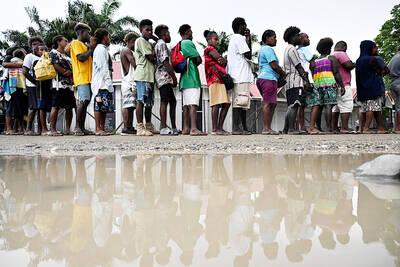
SEEKING CHANGE: A hospital worker said she did not vote in previous elections, but ‘now I can see that maybe my vote can change the system and the country’ Voting closed yesterday across the Solomon Islands in the south Pacific nation’s first general election since the government switched diplomatic allegiance from Taiwan to Beijing and struck a secret security pact that has raised fears of the Chinese navy gaining a foothold in the region. The Solomon Islands’ closer relationship with China and a troubled domestic economy weighed on voters’ minds as they cast their ballots. As many as 420,000 registered voters had their say across 50 national seats. For the first time, the national vote also coincided with elections for eight of the 10 local governments. Esther Maeluma cast her vote in the
Nearly half of China’s major cities are suffering “moderate to severe” levels of subsidence, putting millions of people at risk of flooding, especially as sea levels rise, according to a study of nationwide satellite data released yesterday. The authors of the paper, published by the journal Science, found that 45 percent of China’s urban land was sinking faster than 3mm per year, with 16 percent at more than 10mm per year, driven not only by declining water tables, but also the sheer weight of the built environment. With China’s urban population already in excess of 900 million people, “even a small portion

UNSETTLING IMAGES: The scene took place in front of TV crews covering the Trump trial, with a CNN anchor calling it an ‘emotional and unbelievably disturbing moment’ A man who doused himself in an accelerant and set himself on fire outside the courthouse where former US president Donald Trump is on trial has died, police said yesterday. The New York City Police Department (NYPD) said the man was declared dead by staff at an area hospital. The man was in Collect Pond Park at about 1:30pm on Friday when he took out pamphlets espousing conspiracy theories, tossed them around, then doused himself in an accelerant and set himself on fire, officials and witnesses said. A large number of police officers were nearby when it happened. Some officers and bystanders rushed

HYPOCRISY? The Chinese Ministry of Foreign Affairs yesterday asked whether Biden was talking about China or the US when he used the word ‘xenophobic’ US President Joe Biden on Wednesday called for a hike in steel tariffs on China, accusing Beijing of cheating as he spoke at a campaign event in Pennsylvania. Biden accused China of xenophobia, too, in a speech to union members in Pittsburgh. “They’re not competing, they’re cheating. They’re cheating and we’ve seen the damage here in America,” Biden said. Chinese steel companies “don’t need to worry about making a profit because the Chinese government is subsidizing them so heavily,” he said. Biden said he had called for the US Trade Representative to triple the tariff rates for Chinese steel and aluminum if Beijing was


 RSS
RSS