


The bacon is gone from the bacon burgers, replaced by smoked turkey. At a fast food restaurant outside Paris, a new certificate on the wall proclaims that its beef comes from cows slaughtered in line with Islamic law.
On Wednesday, popular French fast food chain Quick, the No. 2 burger chain in France after McDonald’s, started serving halal-only food in 22 of its French outlets, targeting France’s large Muslim population, an underexploited market that has long been ignored by big business.
If it’s a savvy business decision — Quick says sales doubled at restaurants that have tested the concept — the move has also opened a new chapter in the perennial war over how much society should accommodate Muslim traditions.
Or in essence, what it means to be French.
Politicians left and right have attacked the move from every conceivable angle. Some ask why halal food should be foisted on the general population, while others worry the Quicks in question will promote segregation of the Muslim community instead of acceptance.
France argues that integration is the only option for minorities, and the only way to preserve social cohesion.
The spat over the halal burgers runs alongside an even more high-profile debate in parliament: This month, the Senate looks set to approve a ban on Islamic face-covering veils such as niqabs or burqas, a law that many Muslims worry will stigmatize them.
There are also fears among Muslims that Quick’s strategy change risks creating a stigma — even if many are delighted that a big French chain has their needs in mind, and tired of the filleted fish sandwiches that are often the only fast food option open to them.
Halal beef must come from a cow that has been killed by a cut to its jugular vein from which all the blood from the carcass is drained. It tastes no different from other beef.
Hedi Naamane, a 29-year-old technician who brought his two-year-old son to taste a halal burger for lunch, said he was worried Quick’s move would be fodder for racists.
“There are a lot of people who complain about mosques popping up, about halal products, and this and that, and now some people are going to say, oh la la, hang on, Quick is European!” said Naamane, as he fed his son a kids’ meal.
Naamane himself was not eating. Perhaps a bit strangely, the chain launched its halal-only burger restaurants in the middle of Ramadan, a month when devout Muslims fast from dawn to dusk. Quick says the date was purely a coincidence.
Another oddity of the decision is that Quick is 94-percent owned by a subsidiary of the state-controlled bank Caisse des Depots et Consignations. Some critics find it absurd that the French state — which has such a strict interpretation of secularism that it does not allow girls to wear Muslim headscarves to school — is technically behind the operation.
A main point of contention is that Quick is not offering a non-halal menu at the 22 outlets concerned. It has a total of 346 restaurants in France.
Stephane Gatignon, the mayor of the Paris suburb of Sevran and a member of the environmentalist party Europe Ecologie, said he was worried the Quick in his town would become a Muslims-only hangout, preventing ethnic groups from mingling.
On top of that, “it’s stigmatizing,” he told reporters.
Quick is saying, “in these towns there are only Muslims, but in a town like Sevran, there are not only Muslims, there are a lot of other religions here too. Everyone has to find their place.”
Marine Le Pen, of the far-right National Front party, said Quick’s decision was a “scandal.”
“I’m not Muslim, I don’t want this imposed on me,” the daughter of French far-right icon Jean-Marie Le Pen told Europe-1 radio.
Kentucky Fried Chicken France says it has served halal chicken in its French outlets for 19 years. That fact is not well-known, though, and the chain has largely been left out of the debate over the burger chain.
Quick already sparked a spat earlier this year during the testing phase of the halal operation. The French city of Roubaix filed a legal complaint accusing it of discrimination. The complaint was later withdrawn, with the mayor saying he was satisfied about Quick’s promises to keep the concerns of non-Muslims in mind.
At the 22 restaurants involved, beer is still on sale. For those who object to eating halal beef, the chain also said it was working on a pre-cooked non-halal burger that would be stored in a wrapper so it doesn’t contaminate the rest of the offerings. The company said it expected sales of the product to be minimal.
Quick predicts a great future for halal business in France, citing an independent study last year by France’s Solis agency that estimated the market for halal food was growing by 15 percent a year.
In France, an estimated 5 million of the 63 million population is believed to be Muslim.
Abdel El Machkour, who oversees Quick franchises for the Paris region, said the goal was simply to be able to serve its products to a larger number of people.
“The fact that we propose this halal food range is not led by any kind of will to segregate a particular community — it is to propose a product range that many clients from all religions can consume, and Quick is here to respond to that demand,” he told reporters.

Republican US lawmakers on Friday criticized US President Joe Biden’s administration after sanctioned Chinese telecoms equipment giant Huawei unveiled a laptop this week powered by an Intel artificial intelligence (AI) chip. The US placed Huawei on a trade restriction list in 2019 for contravening Iran sanctions, part of a broader effort to hobble Beijing’s technological advances. Placement on the list means the company’s suppliers have to seek a special, difficult-to-obtain license before shipping to it. One such license, issued by then-US president Donald Trump’s administration, has allowed Intel to ship central processors to Huawei for use in laptops since 2020. China hardliners

Conjoined twins Lori and George Schappell, who pursued separate careers, interests and relationships during lives that defied medical expectations, died this month in Pennsylvania, funeral home officials said. They were 62. The twins, listed by Guinness World Records as the oldest living conjoined twins, died on April 7 at the Hospital of the University of Pennsylvania, obituaries posted by Leibensperger Funeral Homes of Hamburg said. The cause of death was not detailed. “When we were born, the doctors didn’t think we’d make 30, but we proved them wrong,” Lori said in an interview when they turned 50, the Philadelphia Inquirer reported. The
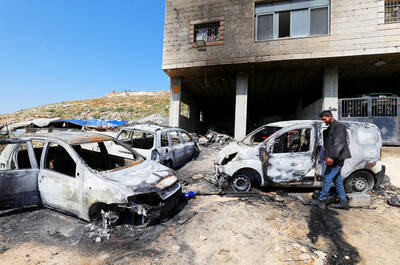
RAMPAGE: A Palestinian man was left dead after dozens of Israeli settlers searching for a missing 14-year-old boy stormed a village in the Israeli-occupied West Bank US President Joe Biden on Friday said he expected Iran to attack Israel “sooner, rather than later” and warned Tehran not to proceed. Asked by reporters about his message to Iran, Biden simply said: “Don’t,” underscoring Washington’s commitment to defend Israel. “We are devoted to the defense of Israel. We will support Israel. We will help defend Israel and Iran will not succeed,” he said. Biden said he would not divulge secure information, but said his expectation was that an attack could come “sooner, rather than later.” Israel braced on Friday for an attack by Iran or its proxies as warnings grew of
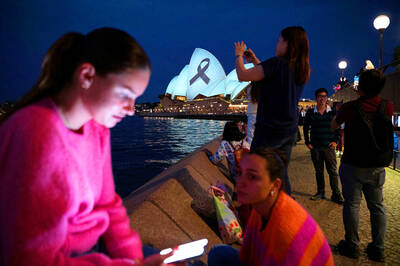
A prominent Christian leader has allegedly been stabbed at the altar during a Mass yesterday in southwest Sydney. Bishop Mar Mari Emmanuel was saying Mass at Christ The Good Shepherd Church in Wakeley just after 7pm when a man approached him at the altar and allegedly stabbed toward his head multiple times. A live stream of the Mass shows the congregation swarm forward toward Emmanuel before it was cut off. The church leader gained prominence during the COVID-19 pandemic, amassing a large online following, Officers attached to Fairfield City police area command attended a location on Welcome Street, Wakeley following reports a number


 RSS
RSS