


Trapped deep beneath the earth, their fate uncertain, the 33 men awaiting rescue at a caved-in Chilean mine have rallied around leaders, including their eldest colleague, 63-year-old Mario Gomez, now a symbol of their resilience.
Gomez became an instant hero here after penning the all-capitals, red ink note that gave Chile its first sign that the miners were still alive.
“All 33 of us are well inside the shelter,” said the note, which was carried to the surface by a drill bit on Sunday, after two weeks of silence, and was greeted with screams of joy and tears of relief from desperate relatives.
Deep in the collapsed mine, where the men are thought to have taken refuge inside a living room-sized shelter, Gomez is believed to be acting as a mentor and leader to a group that ranges in age from 63 to just 19.
Gino Erazo, a miner who worked with Gomez and knows him well, said morale inside the San Jose mine, which caved in on Aug. 2, would depend on his old colleague.
“He is like a father taking care of his children,” he said.
Gomez’s wife Liliana described her husband as a “workaholic” and a life-long miner, who began learning the trade at the age of 12 by his father’s side.
Her husband had sent her an uncharacteristically emotional letter alongside the note he dispatched to the surface announcing the well-being of the miners, she said.
“It said that he loves me. I’ve never received words from him like that, even when we were engaged, he has never been a romantic,” she said.
As a leader, Gomez was likely to be supported by Luis Urzua, the shift manager at the time of the cave-in, colleagues and experts said.
The pair will have to work to maintain morale and peace among a diverse group of men that spans generations. Most of the men are between 40 and 63, but eight are in their 20s, and 19-year-old Jimmy Sandez has not even graduated from high school.
The men are Chileans, with the exception of Carlos Mamani, a 24-year-old Bolivian who had worked in the copper and gold mine for just five days before the accident.
The Ministry of Health said on Tuesday that two of miners have some medical expertise and would be sent thermometers and blood pressure machines.
“This is obviously an immense asset in this situation,” Health Minister Jaime Manalich told reporters.
But the roles of calming influences like Gomez and Urzua will also be crucial, according to experts on confinement in extreme conditions.
Chile has asked the US space agency NASA for assistance in keeping the miners supplied with food.
“The situation is very similar the one experienced by the astronauts, who spend months on end in the space station,” Manalich said.
He said officials were looking for ways to provide condensed, high-protein, calorie-rich nutrition to the men.
Food supplies were being sent through a narrow hole of about 8cm, which engineers are working to widen. But they were not expected to create a passage wide enough to extract the men until Christmas.
The engineer in charge of the rescue effort, Andres Sougarret, has made the decision not to tell the men how long the rescue will take.

‘IN A DIFFERENT PLACE’: The envoy first visited Shanghai, where he attended a Chinese basketball playoff match, and is to meet top officials in Beijing tomorrow US Secretary of State Antony Blinken yesterday arrived in China on his second visit in a year as the US ramps up pressure on its rival over its support for Russia while also seeking to manage tensions with Beijing. The US diplomat tomorrow is to meet China’s top brass in Beijing, where he is also expected to plead for restraint as Taiwan inaugurates president-elect William Lai (賴清德), and to raise US concerns on Chinese trade practices. However, Blinken is also seeking to stabilize ties, with tensions between the world’s two largest economies easing since his previous visit in June last year. At the
Nearly half of China’s major cities are suffering “moderate to severe” levels of subsidence, putting millions of people at risk of flooding, especially as sea levels rise, according to a study of nationwide satellite data released yesterday. The authors of the paper, published by the journal Science, found that 45 percent of China’s urban land was sinking faster than 3mm per year, with 16 percent at more than 10mm per year, driven not only by declining water tables, but also the sheer weight of the built environment. With China’s urban population already in excess of 900 million people, “even a small portion
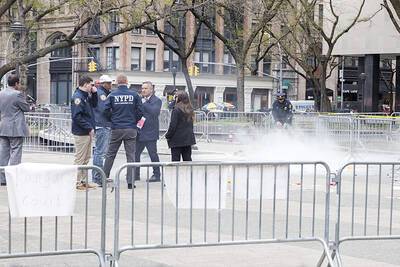
UNSETTLING IMAGES: The scene took place in front of TV crews covering the Trump trial, with a CNN anchor calling it an ‘emotional and unbelievably disturbing moment’ A man who doused himself in an accelerant and set himself on fire outside the courthouse where former US president Donald Trump is on trial has died, police said yesterday. The New York City Police Department (NYPD) said the man was declared dead by staff at an area hospital. The man was in Collect Pond Park at about 1:30pm on Friday when he took out pamphlets espousing conspiracy theories, tossed them around, then doused himself in an accelerant and set himself on fire, officials and witnesses said. A large number of police officers were nearby when it happened. Some officers and bystanders rushed
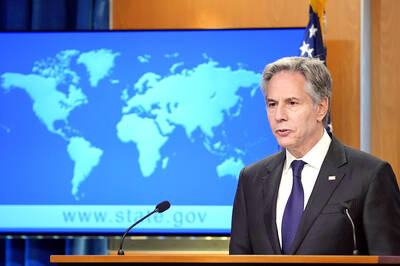
Beijing is continuing to commit genocide and crimes against humanity against Uyghurs and other Muslim minorities in its western Xinjiang province, U.S. Secretary of State Antony Blinken said in a report published on Monday, ahead of his planned visit to China this week. The State Department’s annual human rights report, which documents abuses recorded all over the world during the previous calendar year, repeated language from previous years on the treatment of Muslims in Xinjiang, but the publication raises the issue ahead of delicate talks, including on the war in Ukraine and global trade, between the top U.S. diplomat and Chinese


 RSS
RSS