


Mexican President Felipe Calderon said the country should consider appointing anonymous judges for drug trafficking trials, an unexpected proposal that he acknowledged contradicts efforts to build a more open judicial system.
Calderon, who raised the idea on Thursday during a meeting with senators on national security, said Mexico should at least consider the idea as drug cartels stage increasingly bold attacks on public official at all levels.
“I recognize that this goes against ... our legal tradition, but in all honesty, gentlemen, I have found that citizens, police, judges, prosecutors are at risk, in the sense that they are completely exposed to criminal vengeance,” Calderon said. “We should consider whether this is valid or not, whether anonymous judges would work or not.”
It was a surprise comment from the Mexican leader, who has touted an ongoing reform of Mexico’s secretive, inquisitorial judicial system. That overhaul, backed by millions of dollars of US aid, will create an accusatory system that puts the burden of proof on prosecutors and establishes oral trials to replace proceedings now carried out almost entirely in writing.
A law approved by all 32 Mexican states in 2008 calls for the changeover to be completed by 2016.
Calderon, who gave no plan for carrying out the debate on anonymous judges, is facing mounting complaints from political opponents — and even some allies — that his national security strategy is failing. He has called a series of national meetings to address those concerns.
Even if Mexico decides against anonymous judges, Calderon said the country needs to find a way to protect judges, prosecutors and witnesses. He said some federal police have been gunned down just after testifying at trials.
Peru and Colombia have at times used anonymous or “faceless” judges in their wars against guerrilla groups and drug traffickers as a means to protect judges from reprisals for their rulings. The use of such judges has been criticized by human rights groups.
As if to underscore the distance Mexico’s justice system still has to go, a government human rights ombudsman on Thursday recommended the removal of the top police official in Tijuana after citizens came forward to say they had been tortured by the border city’s crusading public safety chief, Julian Leyzaola.
Baja California State Human Rights Prosecutor Heriberto Garcia told a press conference that the investigators had found evidence to support complaints by five Tijuana residents that they had been picked up without cause following an gun fight in Tijuana in August last year.
The complainants — whose identities were not released — said they were taken to a police station and beaten, partially suffocated with plastic bags or given electric shocks by two policemen and Leyzaola.
“We came to the conclusion that some of them suffered electric shocks that caused wounds on their bodies, others showed contusions, and one in particular had the marks of a blow to his side that is perfectly distinguishable as the mark of a boot,” Garcia said.
In a statement referring to the recommendations, Tijuana Mayor Bernardo Martinez Gomez said the city would cooperate with any investigation into the matter.

Republican US lawmakers on Friday criticized US President Joe Biden’s administration after sanctioned Chinese telecoms equipment giant Huawei unveiled a laptop this week powered by an Intel artificial intelligence (AI) chip. The US placed Huawei on a trade restriction list in 2019 for contravening Iran sanctions, part of a broader effort to hobble Beijing’s technological advances. Placement on the list means the company’s suppliers have to seek a special, difficult-to-obtain license before shipping to it. One such license, issued by then-US president Donald Trump’s administration, has allowed Intel to ship central processors to Huawei for use in laptops since 2020. China hardliners
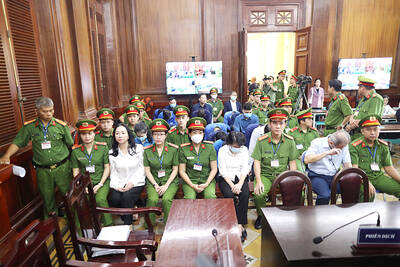
A top Vietnamese property tycoon was on Thursday sentenced to death in one of the biggest corruption cases in history, with an estimated US$27 billion in damages. A panel of three hand-picked jurors and two judges rejected all defense arguments by Truong My Lan, chair of major developer Van Thinh Phat, who was found guilty of swindling cash from Saigon Commercial Bank (SCB) over a decade. “The defendant’s actions ... eroded people’s trust in the leadership of the [Communist] Party and state,” read the verdict at the trial in Ho Chi Minh City. After the five-week trial, 85 others were also sentenced on

Conjoined twins Lori and George Schappell, who pursued separate careers, interests and relationships during lives that defied medical expectations, died this month in Pennsylvania, funeral home officials said. They were 62. The twins, listed by Guinness World Records as the oldest living conjoined twins, died on April 7 at the Hospital of the University of Pennsylvania, obituaries posted by Leibensperger Funeral Homes of Hamburg said. The cause of death was not detailed. “When we were born, the doctors didn’t think we’d make 30, but we proved them wrong,” Lori said in an interview when they turned 50, the Philadelphia Inquirer reported. The
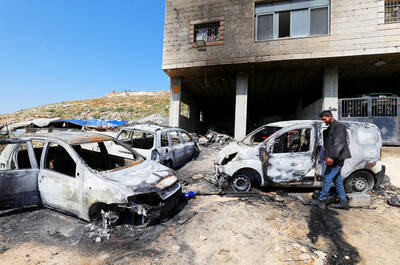
RAMPAGE: A Palestinian man was left dead after dozens of Israeli settlers searching for a missing 14-year-old boy stormed a village in the Israeli-occupied West Bank US President Joe Biden on Friday said he expected Iran to attack Israel “sooner, rather than later” and warned Tehran not to proceed. Asked by reporters about his message to Iran, Biden simply said: “Don’t,” underscoring Washington’s commitment to defend Israel. “We are devoted to the defense of Israel. We will support Israel. We will help defend Israel and Iran will not succeed,” he said. Biden said he would not divulge secure information, but said his expectation was that an attack could come “sooner, rather than later.” Israel braced on Friday for an attack by Iran or its proxies as warnings grew of


 RSS
RSS