


A world away from the scene of a wartime tragedy, relatives of Vietnamese soldiers killed in a helicopter shootdown 39 years ago paid their emotion-choked respects on Tuesday at a memorial containing tiny fragments of the men’s remains.
Some flew from Vietnam to attend the ceremony — their first visit to the country that fought unsuccessfully to preserve South Vietnam, then left it to the victorious communists in 1975.
The helicopter, which also carried an Associated Press (AP) photographer and three other foreign journalists, was knocked out of the sky over southern Laos on Feb. 10, 1971. All 11 aboard perished, but until now relatives of the Vietnamese never got the chance to say their final goodbyes.
“It’s very hard,” said Heather Pham, who was 14 when her father, Lieutenant Colonel Pham Vi, a South Vietnamese army staff officer, was lost in the crash. “This closes the chapter for us.”
She recalled that her father had told the family he was due a break to visit home in one week. They never heard from him again.
“Time went by. We accepted it,” she said.
Tuesday’s ceremony at Washington’s Newseum also demonstrated how, decades after it ended, the Vietnam war is still exacting an emotional toll.
Ly Ho Thi, widow of the doomed chopper’s pilot, 2nd Lieutenant Ta Hoa, traveled from her home in Ho Chi Minh City to pay homage. With her six-year-old granddaughter, Mary, at her side, she broke into tears as her daughter, Vi Ta Ho Thong, spoke of what the moment meant to her.
“I was born one month after” the crash, the daughter said. “I dreamed of coming here a long time.”
AP photographer Henri Huet, 43, was one of four foreign photographers invited to fly to the Laos front on the third day of a major South Vietnamese-led offensive designed to sever the Ho Chi Minh Trail.
Somehow the helicopter ferrying the photographers got separated from the four others it was accompanying and got lost over a section of southern Laos that was heavily defended by North Vietnamese.
Unseen 37mm anti-aircraft guns opened fire, turning the doomed chopper into what Pyle and his co-author, former AP Pulitzer Prize-winning photojournalist Horst Faas, described as a “sudden, tumbling torrent of fire.”
Unable to conduct a ground search in hostile territory, recovery teams didn’t locate the crash site until 1996. A Pentagon search team excavated the site in 1998. They could not scientifically confirm the identity of any of the victims, but personal and bone fragments uncovered by the search team enabled the Pentagon in 2002 to declare the case closed as a “circumstantial group identification,” meaning there was sufficient circumstantial evidence to determine that the 11 men had perished on that spot.
In 2008 a box containing the artifacts and fragmentary remains was buried in the floor beside the Journalists Memorial at the Newseum, with the names of the four photojournalists engraved on its cover.
Pyle said the fact that seven Vietnamese soldiers also perished “kind of got lost in the shuffle,” so he was heartened that the soldiers’ families finally got their chance to pay respects in person.
Vi Ta Ho Tuong, daughter of the chopper’s pilot, wept as she recalled the father she never met. She was born one month after he died in a distant jungle.
“I never had a chance to call him papa,” she said.

Republican US lawmakers on Friday criticized US President Joe Biden’s administration after sanctioned Chinese telecoms equipment giant Huawei unveiled a laptop this week powered by an Intel artificial intelligence (AI) chip. The US placed Huawei on a trade restriction list in 2019 for contravening Iran sanctions, part of a broader effort to hobble Beijing’s technological advances. Placement on the list means the company’s suppliers have to seek a special, difficult-to-obtain license before shipping to it. One such license, issued by then-US president Donald Trump’s administration, has allowed Intel to ship central processors to Huawei for use in laptops since 2020. China hardliners
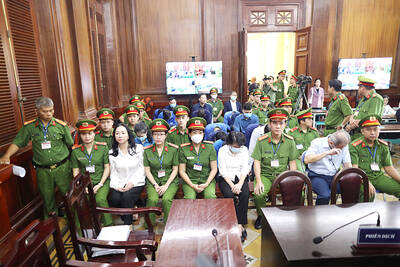
A top Vietnamese property tycoon was on Thursday sentenced to death in one of the biggest corruption cases in history, with an estimated US$27 billion in damages. A panel of three hand-picked jurors and two judges rejected all defense arguments by Truong My Lan, chair of major developer Van Thinh Phat, who was found guilty of swindling cash from Saigon Commercial Bank (SCB) over a decade. “The defendant’s actions ... eroded people’s trust in the leadership of the [Communist] Party and state,” read the verdict at the trial in Ho Chi Minh City. After the five-week trial, 85 others were also sentenced on

Conjoined twins Lori and George Schappell, who pursued separate careers, interests and relationships during lives that defied medical expectations, died this month in Pennsylvania, funeral home officials said. They were 62. The twins, listed by Guinness World Records as the oldest living conjoined twins, died on April 7 at the Hospital of the University of Pennsylvania, obituaries posted by Leibensperger Funeral Homes of Hamburg said. The cause of death was not detailed. “When we were born, the doctors didn’t think we’d make 30, but we proved them wrong,” Lori said in an interview when they turned 50, the Philadelphia Inquirer reported. The
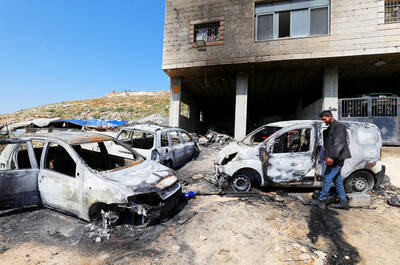
RAMPAGE: A Palestinian man was left dead after dozens of Israeli settlers searching for a missing 14-year-old boy stormed a village in the Israeli-occupied West Bank US President Joe Biden on Friday said he expected Iran to attack Israel “sooner, rather than later” and warned Tehran not to proceed. Asked by reporters about his message to Iran, Biden simply said: “Don’t,” underscoring Washington’s commitment to defend Israel. “We are devoted to the defense of Israel. We will support Israel. We will help defend Israel and Iran will not succeed,” he said. Biden said he would not divulge secure information, but said his expectation was that an attack could come “sooner, rather than later.” Israel braced on Friday for an attack by Iran or its proxies as warnings grew of


 RSS
RSS