


A grenade exploded yesterday on a street in central Bangkok, leaving one person seriously hurt in the latest violence in the Thai capital which is still recovering from deadly protests, police said.
The grenade was put in a plastic rubbish bag and left in Rangnam road near a duty-free shopping center, police said.
The injured person was a Thai man in his 30s who was searching for scrap when the blast occurred shortly after midnight.
“It was a hand grenade ... The pin was removed and a rubber band wrapped around it,” police major general Vichai Sangparpai told local television.
The unnamed victim was in critical condition with shrapnel in his head, according to Rajavithi hospital where he was receiving treatment.
The blast came less than a week after a small bomb exploded at a Bangkok bus stop, killing one person and injuring 10 in an attack that rekindled tensions in the capital two months after the end of bloody street protests.
No one has claimed responsibility for the explosions, which risk delaying a recovery in the country’s vital tourism industry.
About 90 people died and 1,900 were injured in street clashes between armed troops and demonstrators during two months of mass protests by the anti-government “Red Shirts” that ended with a bloody army crackdown in May.
Deputy Prime Minister Suthep Thaugsuban said he believed the grenade blast was politically motivated.
“It’s regrettable that the bomber wanted to incite further unrest to show that the government cannot control the situation,” he said.
Suthep, who is in charge of security, said he instructed Defence Minister Prawit Wongsuwon to deploy police and soldiers to patrol the city.
He added that the blast showed the government needed to maintain emergency rule in Bangkok and 10 other provinces, out of a total of 76.
“Core anti-government leaders are still inciting unrest,” he said.
The latest explosion came hours after Prime Minister Abhisit Vejjajiva announced he was ending emergency rule in six provinces in central and northeast Thailand.
The government has come under pressure from the US and rights groups to end emergency rule to help the country recover from deadly civil unrest that has left it deeply divided.
Authorities have used the powers — introduced in Bangkok on April 7 — to arrest hundreds of Red Shirt suspects and silence anti-government media.
The protests by the Reds, many of whom back fugitive former priprime minister Thaksin Shinawatra, attracted up to 100,000 people demanding immediate elections.
Thaksin, a former telecoms tycoon, was ousted in a bloodless military coup in 2006 and lives in self-imposed exile to avoid a prison sentence imposed in absentia for corruption.
The Reds, who hail Thaksin’s policies for the poor, view the current government as elitist and undemocratic because it came to power after a court ruling threw out the previous administration.
Meanwhile, the Appeals Court agreed to temporarily release the anti-government Red Shirt movement’s chairman Veera Musikapong more than two months after detaining him on terrorism charges in connection with violent street protests, after he posted bail of six million baht (US$186,000), a court official said,
Although released Veera is banned from traveling outside Bangkok without court permission, from joining gatherings of more than five people — except to meet relatives — and from talking to media, the official said. He is also required to report back to court every 15 days.
Veera was among the Red Shirt leaders who surrendered to police after the army stormed the movement’s sprawling encampment in the heart of Bangkok on May 19, ending their two-month rally.
Most senior Red Shirts are now either in prison or in hiding.

Republican US lawmakers on Friday criticized US President Joe Biden’s administration after sanctioned Chinese telecoms equipment giant Huawei unveiled a laptop this week powered by an Intel artificial intelligence (AI) chip. The US placed Huawei on a trade restriction list in 2019 for contravening Iran sanctions, part of a broader effort to hobble Beijing’s technological advances. Placement on the list means the company’s suppliers have to seek a special, difficult-to-obtain license before shipping to it. One such license, issued by then-US president Donald Trump’s administration, has allowed Intel to ship central processors to Huawei for use in laptops since 2020. China hardliners

Conjoined twins Lori and George Schappell, who pursued separate careers, interests and relationships during lives that defied medical expectations, died this month in Pennsylvania, funeral home officials said. They were 62. The twins, listed by Guinness World Records as the oldest living conjoined twins, died on April 7 at the Hospital of the University of Pennsylvania, obituaries posted by Leibensperger Funeral Homes of Hamburg said. The cause of death was not detailed. “When we were born, the doctors didn’t think we’d make 30, but we proved them wrong,” Lori said in an interview when they turned 50, the Philadelphia Inquirer reported. The
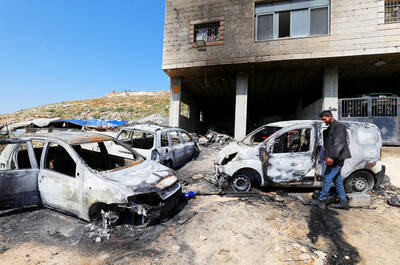
RAMPAGE: A Palestinian man was left dead after dozens of Israeli settlers searching for a missing 14-year-old boy stormed a village in the Israeli-occupied West Bank US President Joe Biden on Friday said he expected Iran to attack Israel “sooner, rather than later” and warned Tehran not to proceed. Asked by reporters about his message to Iran, Biden simply said: “Don’t,” underscoring Washington’s commitment to defend Israel. “We are devoted to the defense of Israel. We will support Israel. We will help defend Israel and Iran will not succeed,” he said. Biden said he would not divulge secure information, but said his expectation was that an attack could come “sooner, rather than later.” Israel braced on Friday for an attack by Iran or its proxies as warnings grew of

A prominent Christian leader has allegedly been stabbed at the altar during a Mass yesterday in southwest Sydney. Bishop Mar Mari Emmanuel was saying Mass at Christ The Good Shepherd Church in Wakeley just after 7pm when a man approached him at the altar and allegedly stabbed toward his head multiple times. A live stream of the Mass shows the congregation swarm forward toward Emmanuel before it was cut off. The church leader gained prominence during the COVID-19 pandemic, amassing a large online following, Officers attached to Fairfield City police area command attended a location on Welcome Street, Wakeley following reports a number


 RSS
RSS