


A popular Saudi cleric said on Saturday that it is permissible for Muslim women to reveal their faces in countries where the Islamic veil is banned to avoid harassment, though he deplored efforts to outlaw the garment in France.
Saudi Arabia, the birthplace of Islam, is one of the few Muslim countries where women are forced by custom to cover their hair with head scarves and their bodies with cloaks called abayas in most parts of the country. It is also common to see Saudi women wearing full-face veils.
Sheik Aedh al-Garni’s religious advice, delivered in response to a question from a Saudi woman in France, generated some opposition from those less compromising.
One cleric said it was better for Muslim women to avoid traveling to such countries unless absolutely necessary.
“We should not confront people in their countries or elsewhere,” al-Garni was quoted as saying in the Saudi-owned daily Al-Hayat.
“In case a ban is enforced against a Muslim woman there — and as a consequence there is a reaction or negative implications or harassment or harm — it is better for the Muslim woman to reveal her face,” he said.
France, Belgium and Spain are debating legislation that would ban the veil. Other nations in Europe have struggled to balance national identities with growing Muslim populations whose cultural practices that clash with their own.
Some secularists as well as those who argue the veil is oppressive have applauded the movement for a ban.
Others say it is a ploy to win over right-wing voters.
In France, the lower house of parliament overwhelmingly approved a ban on wearing burqa-style Islamic veils, with proponents of the law saying such attire is incompatible with the French ideal of gender equality or its secular tradition.
In September, the bill goes to the Senate, where it also is likely to pass, though it could be thrown out by France’s constitutional watchdog.
“It is illogical and unreasonable for the French government to do this,” al-Garni said. “Objective non-Muslims have also criticized it because the secular state respects freedom of religion. It should respect religious rituals and rites, including those of Muslims,” Al-Hayat said.
Not all Islamic clerics agree that the face veil is an obligation, with some calling it a tradition, though there is general agreement that a head scarf is a religious requirement.
Beyond Saudi Arabia, the face veil is becoming more popular in other Arab countries. Some governments, like Egypt and Syria, have taken measures to stop its spread by barring it in universities and academic institutions.
Al-Garni’s religious guidance, or fatwa, is an advisory opinion and not a law. It is significant because it comes from a Saudi cleric whose writings are widely read.
However, other clerics in the kingdom did not see eye-to-eye with al-Garni.

Republican US lawmakers on Friday criticized US President Joe Biden’s administration after sanctioned Chinese telecoms equipment giant Huawei unveiled a laptop this week powered by an Intel artificial intelligence (AI) chip. The US placed Huawei on a trade restriction list in 2019 for contravening Iran sanctions, part of a broader effort to hobble Beijing’s technological advances. Placement on the list means the company’s suppliers have to seek a special, difficult-to-obtain license before shipping to it. One such license, issued by then-US president Donald Trump’s administration, has allowed Intel to ship central processors to Huawei for use in laptops since 2020. China hardliners

Conjoined twins Lori and George Schappell, who pursued separate careers, interests and relationships during lives that defied medical expectations, died this month in Pennsylvania, funeral home officials said. They were 62. The twins, listed by Guinness World Records as the oldest living conjoined twins, died on April 7 at the Hospital of the University of Pennsylvania, obituaries posted by Leibensperger Funeral Homes of Hamburg said. The cause of death was not detailed. “When we were born, the doctors didn’t think we’d make 30, but we proved them wrong,” Lori said in an interview when they turned 50, the Philadelphia Inquirer reported. The

RAMPAGE: A Palestinian man was left dead after dozens of Israeli settlers searching for a missing 14-year-old boy stormed a village in the Israeli-occupied West Bank US President Joe Biden on Friday said he expected Iran to attack Israel “sooner, rather than later” and warned Tehran not to proceed. Asked by reporters about his message to Iran, Biden simply said: “Don’t,” underscoring Washington’s commitment to defend Israel. “We are devoted to the defense of Israel. We will support Israel. We will help defend Israel and Iran will not succeed,” he said. Biden said he would not divulge secure information, but said his expectation was that an attack could come “sooner, rather than later.” Israel braced on Friday for an attack by Iran or its proxies as warnings grew of
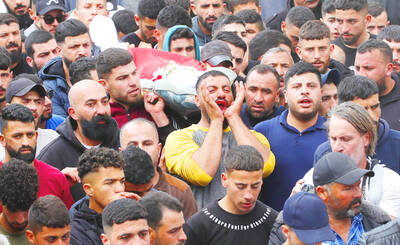
IN PURSUIT: Israel’s defense minister said the revenge attacks by Israeli settlers would make it difficult for security forces to find those responsible for the 14-year-old’s death Israeli Prime Minister Benjamin Netanyahu on Saturday condemned the “heinous murder” of an Israeli teenager in the occupied West Bank as attacks on Palestinian villages intensified following news of his death. After Benjamin Achimeir, 14, was reported missing near Ramallah on Friday, hundreds of Jewish settlers backed by Israeli forces raided nearby Palestinian villages, torching vehicles and homes, leaving at least one villager dead and dozens wounded. The attacks escalated in several villages on Saturday after Achimeir’s body was found near the Malachi Hashalom outpost. Agence France-Presse correspondents saw smoke rising from burned houses and fields. Mayor Amin Abu Alyah, of the


 RSS
RSS