


A new ranking of nations by environmental performance puts some of the globe’s largest economies far down the list, with the US sinking to 61st and China to 121st.
In the previous version of the Environmental Performance Index, compiled every two years by Yale and Columbia University researchers, the US ranked 39th and China 105th.
The top performer this year is Iceland, which gets virtually all of its power from renewable sources — hydropower and geothermal energy. It was joined in the top tier by a cluster of European countries known for their green efforts, including Switzerland, Sweden, Norway and Finland.
“Countries that take seriously the environment as a policy challenge do improve and those that don’t deteriorate,” said Daniel Esty, director of the Yale Center for Environmental Law and Policy, who oversees the index project. “Both the US and China are suffering because they’re industrial and haven’t been paying much attention to environmental policy.”
The index, viewable online at epi.yale.edu, assigns each country a cumulative score based on its performance in areas that include environmental health, preservation of habitat and reductions in greenhouse gases, air pollution and waste.
Costa Rica and Colombia stayed in the top ranks. Costa Rica has made important efforts to conserve its rain forest, while Colombia has led the way in shifting to fuel-efficient mass transit.
Yet the new rankings, which are to be presented today at the World Economic Forum in Davos, Switzerland, cannot be precisely compared with the 2008 index, researchers said. The scientists have shifted their methodology slightly as they seek to zero in on the fairest way to quantify the broad and nebulous area of environmental performance.
Because most of the data are from 2007 and 2008, the index does not fully reflect new efforts by the Obama administration or China’s government to improve environmental performance.
It also does not fully capture the reduction in greenhouse gas emissions in many countries resulting from the current recession.
One reason that Iceland scored so well, beyond its energy policies, may be its economic tailspin, one of Western Europe’s worst, which began with a banking crisis in 2008, Esty said.
Another crucial caveat is that the researchers rely heavily on data that the countries themselves report to international groups such as the UN and the World Bank. The researchers said that countries like Cuba, in ninth place, are thought to score artificially high because the data is either collected poorly or massaged to signal progress.
The lack of reliable environmental data is a major challenge, the researchers said.
“There are so many countries that are not collecting even minimal data sets,” said Christine Kim, a researcher at Yale who is program manager of the project. “The state of the data hasn’t gotten much better in the last 10 years. We have better data on baseball than we do on climate change.”
Developing a system to quantify and track environmental performance would be essential to the success of any global climate treaty requiring industrialized countries to cut their emissions and emerging economies to reduce their emissions growth. Negotiators from around the globe failed to produce a binding agreement in Copenhagen last month, but plan to meet again in Mexico City in late November.
Some countries that score extraordinarily well in one area may not perform well overall because of unusually lackluster performances in another. The US scores well in forestry and the provision of safe drinking water, but its ranking is low because of poor scores in areas like heat-trapping emissions and urban air pollutants, such as sulfur dioxide.
“This data requires people to dig in and see why they are where they are,” Kim said. “For every country, there are strengths and weaknesses.”
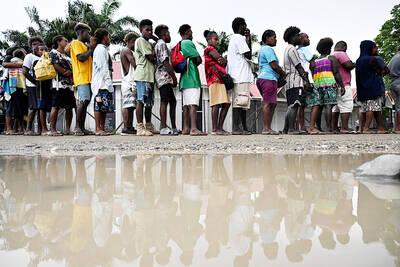
SEEKING CHANGE: A hospital worker said she did not vote in previous elections, but ‘now I can see that maybe my vote can change the system and the country’ Voting closed yesterday across the Solomon Islands in the south Pacific nation’s first general election since the government switched diplomatic allegiance from Taiwan to Beijing and struck a secret security pact that has raised fears of the Chinese navy gaining a foothold in the region. The Solomon Islands’ closer relationship with China and a troubled domestic economy weighed on voters’ minds as they cast their ballots. As many as 420,000 registered voters had their say across 50 national seats. For the first time, the national vote also coincided with elections for eight of the 10 local governments. Esther Maeluma cast her vote in the
Nearly half of China’s major cities are suffering “moderate to severe” levels of subsidence, putting millions of people at risk of flooding, especially as sea levels rise, according to a study of nationwide satellite data released yesterday. The authors of the paper, published by the journal Science, found that 45 percent of China’s urban land was sinking faster than 3mm per year, with 16 percent at more than 10mm per year, driven not only by declining water tables, but also the sheer weight of the built environment. With China’s urban population already in excess of 900 million people, “even a small portion

UNSETTLING IMAGES: The scene took place in front of TV crews covering the Trump trial, with a CNN anchor calling it an ‘emotional and unbelievably disturbing moment’ A man who doused himself in an accelerant and set himself on fire outside the courthouse where former US president Donald Trump is on trial has died, police said yesterday. The New York City Police Department (NYPD) said the man was declared dead by staff at an area hospital. The man was in Collect Pond Park at about 1:30pm on Friday when he took out pamphlets espousing conspiracy theories, tossed them around, then doused himself in an accelerant and set himself on fire, officials and witnesses said. A large number of police officers were nearby when it happened. Some officers and bystanders rushed

HYPOCRISY? The Chinese Ministry of Foreign Affairs yesterday asked whether Biden was talking about China or the US when he used the word ‘xenophobic’ US President Joe Biden on Wednesday called for a hike in steel tariffs on China, accusing Beijing of cheating as he spoke at a campaign event in Pennsylvania. Biden accused China of xenophobia, too, in a speech to union members in Pittsburgh. “They’re not competing, they’re cheating. They’re cheating and we’ve seen the damage here in America,” Biden said. Chinese steel companies “don’t need to worry about making a profit because the Chinese government is subsidizing them so heavily,” he said. Biden said he had called for the US Trade Representative to triple the tariff rates for Chinese steel and aluminum if Beijing was


 RSS
RSS