


Bus driver Mynor Gonzalez ignored the threats: “200 quetzales a week, or we’ll kill you.”
He knew drivers who didn’t pay the roughly US$24 “protection” fee had been murdered, but always on other routes. He knew his job — once considered secure and well-paying for Guatemala’s poor — had become deadly.
Then it happened on his route. The gangs used his friend, driver Miguel Angel Chacon, 34, to show they meant business.
“He saw them approaching the bus, so he jammed on the brakes and started running toward the back,” said Gonzalez, 30. “They shot him twice in the back, right there in the aisle in front of all the passengers.”
Gunmen have killed more than 170 bus drivers this year to scare them and transportation companies into paying extortion fees that fuel the country’s organized crime network.
It’s a small number of deaths given Guatemala’s roughly 6,200 murders a year — a homicide rate that puts the Central American country among the world’s 10 most dangerous, UN crime studies show. But the public execution of bus drivers — often witnessed by as many as 50 passengers — adds a new level of brutality to an already terrorized nation.
There is no viable public transit in Guatemala City outside of the 8,000 buses that carry about 1 million people daily in the capital of 3 million. Passengers have no choice but to ride.
“You are always scared that the bus you take is the one that they will target and maybe you will get a stray bullet,” said Damaris Lopez, 21, a student who regularly takes a route where 10 drivers have been shot. “But I don’t have a car. How else can I get around?”
Drivers and transportation companies have no choice but to pay.
Congressman Anibal Salguero owns a bus company and says he shells out an average of about US$60 a week per bus.
“I’m a congressman, I could have them arrested,” Salguero said. “But then what? Have the gangs take it out on my drivers?”
Even jailing doesn’t work. Gangs run extortion rings from their cells, said Rony Lopez, a prosecutor who heads the organized crime unit.
“They smuggle in cellphones, pay or terrorize prison guards into turning off the signal blockers and have people working outside to collect the money and carry out the murder of drivers,” Lopez said.
It started small about five years ago, with gang members extorting US$1 to US$2 a day in protection fees on individual routes. But it quickly grew into an organized racket once criminals realized they could rake in hundreds of thousands of dollars.
At first, assassins would hop a crowded bus, insult the driver and then shoot him in the head to set an example.
Then buses took on armed guards. So criminals would ride two to a motorcycle and drive up alongside the bus. The rider on the back would shoot the driver through the window.
Now that the government has banned more than one person riding on a motorcycle, children deliver cell phones to drivers who then receive extortion calls telling them how much and where to leave the money.
The gangs use children so they face lesser penalties if caught.
“We are victims of 14 and 15-year-old kids. Those are the ones that the gangs send out to murder us,” said Otto Estrada, 35.
Once one gang gets money off a route, others come in to collect a share.
Drivers earn about US$90 a week, higher than the national minimum wage of US$50. But up to US$60 of that goes to pay “protection.”
Estrada, who covers the 30km route between Amatitlan and Guatemala City, said that together, he and the bus owner pay about US$90 a week to three different gangs.
But he keeps driving.
“I come from a poor town. I dare you to go and find any job there. There are none. That’s why those like me who only know how to drive keep working,” Estrada said. “Some weeks I pay more in extortion than what I earn.”
Luis Gomez, head of the largest bus owners organization, says every killing makes it harder to find drivers.
“We have routes where drivers are working double shifts of about 13 hours because we just can’t find drivers,” he said.
The murder rate has become so high, drivers’ widows formed a group and recently won pensions from the government — about US$65 a month for every dependent child a slain driver leaves behind.
So far 78 widows have sought pensions.
Meanwhile, Mynor Gonzalez has taken another job and only drives on Sundays on one of the few safe routes not controlled by gangs.
“I was lucky,” he said. “Other drivers are old or have no education. Nowadays employers ask for a high school diploma for any job.”

Republican US lawmakers on Friday criticized US President Joe Biden’s administration after sanctioned Chinese telecoms equipment giant Huawei unveiled a laptop this week powered by an Intel artificial intelligence (AI) chip. The US placed Huawei on a trade restriction list in 2019 for contravening Iran sanctions, part of a broader effort to hobble Beijing’s technological advances. Placement on the list means the company’s suppliers have to seek a special, difficult-to-obtain license before shipping to it. One such license, issued by then-US president Donald Trump’s administration, has allowed Intel to ship central processors to Huawei for use in laptops since 2020. China hardliners

A top Vietnamese property tycoon was on Thursday sentenced to death in one of the biggest corruption cases in history, with an estimated US$27 billion in damages. A panel of three hand-picked jurors and two judges rejected all defense arguments by Truong My Lan, chair of major developer Van Thinh Phat, who was found guilty of swindling cash from Saigon Commercial Bank (SCB) over a decade. “The defendant’s actions ... eroded people’s trust in the leadership of the [Communist] Party and state,” read the verdict at the trial in Ho Chi Minh City. After the five-week trial, 85 others were also sentenced on

Conjoined twins Lori and George Schappell, who pursued separate careers, interests and relationships during lives that defied medical expectations, died this month in Pennsylvania, funeral home officials said. They were 62. The twins, listed by Guinness World Records as the oldest living conjoined twins, died on April 7 at the Hospital of the University of Pennsylvania, obituaries posted by Leibensperger Funeral Homes of Hamburg said. The cause of death was not detailed. “When we were born, the doctors didn’t think we’d make 30, but we proved them wrong,” Lori said in an interview when they turned 50, the Philadelphia Inquirer reported. The
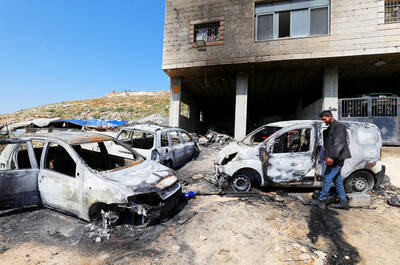
RAMPAGE: A Palestinian man was left dead after dozens of Israeli settlers searching for a missing 14-year-old boy stormed a village in the Israeli-occupied West Bank US President Joe Biden on Friday said he expected Iran to attack Israel “sooner, rather than later” and warned Tehran not to proceed. Asked by reporters about his message to Iran, Biden simply said: “Don’t,” underscoring Washington’s commitment to defend Israel. “We are devoted to the defense of Israel. We will support Israel. We will help defend Israel and Iran will not succeed,” he said. Biden said he would not divulge secure information, but said his expectation was that an attack could come “sooner, rather than later.” Israel braced on Friday for an attack by Iran or its proxies as warnings grew of


 RSS
RSS