


Hopes of a breakthrough that would allow women to protect themselves from HIV have been dashed with yesterday’s revelation from a large, British-funded trial that a promising microbicide has turned out to be ineffective.
Britain’s Medical Research Council (MRC) and the UK government’s Department for International Development (DfID) had backed the trial in four African countries, involving 9,385 women. But after four years and significant investment, scientists have been forced to conclude that the PRO 2000 gel does not prevent HIV/AIDs.
Sheena McCormack of the MRC, chief investigator of the trial known as MDP 301, said they were deeply disappointed, but that the search must go on.
A microbicide, in the form of a vaginal cream or gel that kills the virus, would give women in Africa and Asia the power to defend themselves against HIV given the refusal of many men to wear condoms. The trials in Africa showed that both men and women found its use acceptable.
Expectations were raised in March when a smaller US-led trial of PRO 2000, involving 3,099 women, found a 30 percent reduction in infections, but the actual numbers of people who became HIV positive were not large enough to give conclusive results.
“I have to say then we got quite excited,” McCormack said. “But in a big trial you get closer to the truth, and unfortunately the truth is it didn’t work. It is bitterly disappointing for us, but it will inform the way we go forward.”
Half the participants were given PRO 2000 while the other half got an inactive gel. There were 130 infections among those who used the real thing and 123 among those who had the placebo.
The hunt for a microbicide was given a big boost when then British international development secretary Clare Short endorsed it in 2002 as a gender and equity issue.
Her department gave £14 million (US$22.7 million) to the MRC, Imperial College and five African countries. The final cost to DfID of the PRO 2000 trial has been £40 million, with £2 million from the MRC — a large sum, but tiny compared with the cost of pharmaceutical company trials.
Other gains were made, however, despite the results.
Gita Ramjee, who enrolled 2,385 women at her center in Durban, South Africa, said they had received health checks and treatment for conditions that would not otherwise have been picked up. All the women and their partners had also been counseled on avoiding HIV and given condoms.
But Ramjee, who has conducted five microbicide trials, said she felt “very despondent” at having to tell staff and participants the gel did not work.
“A lot of my staff are HIV positive and do a lot of counseling and they hear the pleas of women who say we desperately need something to prevent HIV infection as our partners don’t want to wear condoms,” she said.
About 2.7 million people were infected with HIV last year.
A number of African countries have already run out of money to put newly diagnosed people on drugs to keep them alive.
Nearly half of China’s major cities are suffering “moderate to severe” levels of subsidence, putting millions of people at risk of flooding, especially as sea levels rise, according to a study of nationwide satellite data released yesterday. The authors of the paper, published by the journal Science, found that 45 percent of China’s urban land was sinking faster than 3mm per year, with 16 percent at more than 10mm per year, driven not only by declining water tables, but also the sheer weight of the built environment. With China’s urban population already in excess of 900 million people, “even a small portion

UNSETTLING IMAGES: The scene took place in front of TV crews covering the Trump trial, with a CNN anchor calling it an ‘emotional and unbelievably disturbing moment’ A man who doused himself in an accelerant and set himself on fire outside the courthouse where former US president Donald Trump is on trial has died, police said yesterday. The New York City Police Department (NYPD) said the man was declared dead by staff at an area hospital. The man was in Collect Pond Park at about 1:30pm on Friday when he took out pamphlets espousing conspiracy theories, tossed them around, then doused himself in an accelerant and set himself on fire, officials and witnesses said. A large number of police officers were nearby when it happened. Some officers and bystanders rushed
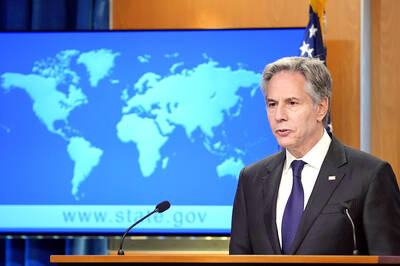
Beijing is continuing to commit genocide and crimes against humanity against Uyghurs and other Muslim minorities in its western Xinjiang province, U.S. Secretary of State Antony Blinken said in a report published on Monday, ahead of his planned visit to China this week. The State Department’s annual human rights report, which documents abuses recorded all over the world during the previous calendar year, repeated language from previous years on the treatment of Muslims in Xinjiang, but the publication raises the issue ahead of delicate talks, including on the war in Ukraine and global trade, between the top U.S. diplomat and Chinese

HYPOCRISY? The Chinese Ministry of Foreign Affairs yesterday asked whether Biden was talking about China or the US when he used the word ‘xenophobic’ US President Joe Biden on Wednesday called for a hike in steel tariffs on China, accusing Beijing of cheating as he spoke at a campaign event in Pennsylvania. Biden accused China of xenophobia, too, in a speech to union members in Pittsburgh. “They’re not competing, they’re cheating. They’re cheating and we’ve seen the damage here in America,” Biden said. Chinese steel companies “don’t need to worry about making a profit because the Chinese government is subsidizing them so heavily,” he said. Biden said he had called for the US Trade Representative to triple the tariff rates for Chinese steel and aluminum if Beijing was


 RSS
RSS