


Commando units loyal to the wounded leader of Guinea’s military junta have swept through neighborhoods near the capital, arresting civilians believed to have ties with the renegade soldier that tried to assassinate their leader.
The arrests came late on Monday, as the ruling junta tried to reassure the population about the president’s health. It insisted that Captain Moussa “Dadis” Camara was recovering well from surgery in a Moroccan hospital where he had been rushed for emergency treatment, but the capital remained tense as the fate of the military dictatorship remained unknown.
Residents said that at least three military pickup trucks filled with soldiers descended on a street of corrugated tin shops, looking for a local witch doctor. The young man fled but was pursued by the soldiers, who opened fire, wounding him, residents said. He is rumored to have been one of the witch doctors that performed spells for Lieutenant Abubakar “Toumba” Diakite, the former head of the presidential guard, who opened fire on the head of the junta last Thursday.
The security sweep showed that the military is widening its net to include civilians. Earlier, only soldiers allied with Diakite had been arrested. The arrests came one day after the junta announced a toll-free number where citizens could call with tips on the whereabouts of the wanted lieutenant.
The soldiers came back three different times, arresting four people in all, including an imam in his 70s or 80s who was returning from evening prayers at the local mosque. The arrests and the volleys of gunfire sowed panic. It reverberated across the capital as Guinea entered a fifth day without a clear sense of whether the 45-year-old army captain who grabbed power in a coup a year ago would survive his wounds.
In an effort to tamp down speculation that he was badly hurt, the country’s foreign minister said on Monday that Camara is conscious and speaking.
“I saw him, I spoke to him, he answered me, all this shows that he retains his mental faculties,” Alexandre Cece Loua said in Rabat. “He recognizes his entourage. His breathing is not assisted.”
But a doctor who saw Camara’s CAT scan and who agreed to speak on the condition of anonymity because of patient confidentiality said the bullet had skimmed the right side of the leader’s skull, causing a splinter of bone to wedge itself in his brain.
He said the injury could be life-threatening if it causes excessive swelling in the brain, but he added that he was told by the technician who administered the scan that Camara had been able to step inside the CAT scan tunnel without assistance.
Even if the piece of bone can be removed, the doctor said Camara could suffer mental impairments, especially memory loss, given that the frontal part of the brain, where memory is stored, was affected.
Opposition leaders held a meeting on Monday at the home of Jean Marie Dore, the spokesman for the various opposition voices in the country.
“What we need to know is the exact status of his health. How is he really doing? Until we know that, it is very hard to make a decision on how to move forward,” Dore said.
Camara came to power last December after the death of the country’s former strongman, Lansana Conte — who was also a captain in the Guinean army when he grabbed power 24 years earlier.
Conte’s regime had been marked by excessive corruption and Camara promised he had come to “clean.” He pledged to punish all those who had embezzled from the state and then to hand over power to civilians in democratic elections in which he would not run.
It was only months later that he reversed course. In September, the presidential guard opened fire on unarmed protesters demanding an end to military rule, killing at least 157 people. Dozens of women were raped by the presidential guard.
The shocking level of violence prompted the AU and the EU to immediately impose an arms embargo on Guinea and to impose sanctions. The army, which was already deeply divided, began to fracture further as leaders of the massacre began pointing the finger at each other.
The tension increased last week as a UN commission investigating the killings began interviewing members of the junta in an effort to assign blame.
Residents feel helpless in the face of the heavily armed presidential guard, whose members zoom through town in pickups, pushing other cars onto the shoulder. Residents say the guardsmen routinely enter bars, order what they want and leave without paying.
Gas stations close early because they are afraid the armed men will demand their tanks be filled for free.
Nearly half of China’s major cities are suffering “moderate to severe” levels of subsidence, putting millions of people at risk of flooding, especially as sea levels rise, according to a study of nationwide satellite data released yesterday. The authors of the paper, published by the journal Science, found that 45 percent of China’s urban land was sinking faster than 3mm per year, with 16 percent at more than 10mm per year, driven not only by declining water tables, but also the sheer weight of the built environment. With China’s urban population already in excess of 900 million people, “even a small portion

UNSETTLING IMAGES: The scene took place in front of TV crews covering the Trump trial, with a CNN anchor calling it an ‘emotional and unbelievably disturbing moment’ A man who doused himself in an accelerant and set himself on fire outside the courthouse where former US president Donald Trump is on trial has died, police said yesterday. The New York City Police Department (NYPD) said the man was declared dead by staff at an area hospital. The man was in Collect Pond Park at about 1:30pm on Friday when he took out pamphlets espousing conspiracy theories, tossed them around, then doused himself in an accelerant and set himself on fire, officials and witnesses said. A large number of police officers were nearby when it happened. Some officers and bystanders rushed
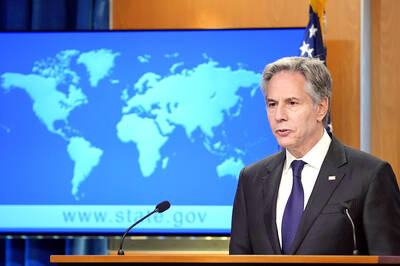
Beijing is continuing to commit genocide and crimes against humanity against Uyghurs and other Muslim minorities in its western Xinjiang province, U.S. Secretary of State Antony Blinken said in a report published on Monday, ahead of his planned visit to China this week. The State Department’s annual human rights report, which documents abuses recorded all over the world during the previous calendar year, repeated language from previous years on the treatment of Muslims in Xinjiang, but the publication raises the issue ahead of delicate talks, including on the war in Ukraine and global trade, between the top U.S. diplomat and Chinese

HYPOCRISY? The Chinese Ministry of Foreign Affairs yesterday asked whether Biden was talking about China or the US when he used the word ‘xenophobic’ US President Joe Biden on Wednesday called for a hike in steel tariffs on China, accusing Beijing of cheating as he spoke at a campaign event in Pennsylvania. Biden accused China of xenophobia, too, in a speech to union members in Pittsburgh. “They’re not competing, they’re cheating. They’re cheating and we’ve seen the damage here in America,” Biden said. Chinese steel companies “don’t need to worry about making a profit because the Chinese government is subsidizing them so heavily,” he said. Biden said he had called for the US Trade Representative to triple the tariff rates for Chinese steel and aluminum if Beijing was


 RSS
RSS