


Businessman Len Goodman owns a company that makes hand-painted art tiles, but these days his office desk is strewn with the raw materials of a new enterprise: fat, sweetly pungent marijuana buds.
Newly licensed by the state to produce and distribute medical marijuana, Goodman must decide which strains he will grow in a steel-doored industrial building somewhere in Santa Fe County that will soon be converted into a high-tech indoor greenhouse.
‘LIKE WINE’
“Every one is different,” Goodman said of the brownish buds in plastic bags. “It’s like wine.”
While California confronts a proliferation of marijuana shops and Colorado wrestles with regulations, New Mexico is slowly and quietly breathing life into a 2007 law that allows patients with certain medical conditions to get relief from marijuana.
The first state to license producers, New Mexico gave the go-ahead to one nonprofit in March and four others last week.
Patients with a qualifying condition — there are 15 — must get recommendations from medical providers, apply to the Department of Health, then, if they are approved, reapply each year.
There were 755 approved patients as of last week, the state agency said.
“This is medical marijuana,” said Goodman, who submitted 100 pages of plans to the department to get licensed. “This is not de facto legalization.”
The licensing of four new nonprofits is welcome news to patients. The first provider ran out of marijuana shortly after it began distribution in July and wasn’t expected to have more for months.
With each producer limited to 95 plants, there was no way for one nonprofit to keep up with the growing demand as more patients are certified.
CAUTION
The medical cannabis program, as the department refers to it, “will continue to proceed carefully ... so we can meet the needs of our patients while not creating an excess supply,” Health Secretary Alfredo Vigil said when he announced the latest licensing.
The department doesn’t disclose the names of patients or producers, saying it wants to ensure their safety.
Maine voters recently approved state-licensed dispensaries and Rhode Island allows three nonprofit pot shops.
Reena Szczepanski, director of the Drug Policy Alliance New Mexico, said it remained to be seen whether New Mexico’s supply and distribution system will be adequate and workable.
“But the whole point of having a regulated system is we can find out these things,” she said.
Nearly half of China’s major cities are suffering “moderate to severe” levels of subsidence, putting millions of people at risk of flooding, especially as sea levels rise, according to a study of nationwide satellite data released yesterday. The authors of the paper, published by the journal Science, found that 45 percent of China’s urban land was sinking faster than 3mm per year, with 16 percent at more than 10mm per year, driven not only by declining water tables, but also the sheer weight of the built environment. With China’s urban population already in excess of 900 million people, “even a small portion

UNSETTLING IMAGES: The scene took place in front of TV crews covering the Trump trial, with a CNN anchor calling it an ‘emotional and unbelievably disturbing moment’ A man who doused himself in an accelerant and set himself on fire outside the courthouse where former US president Donald Trump is on trial has died, police said yesterday. The New York City Police Department (NYPD) said the man was declared dead by staff at an area hospital. The man was in Collect Pond Park at about 1:30pm on Friday when he took out pamphlets espousing conspiracy theories, tossed them around, then doused himself in an accelerant and set himself on fire, officials and witnesses said. A large number of police officers were nearby when it happened. Some officers and bystanders rushed
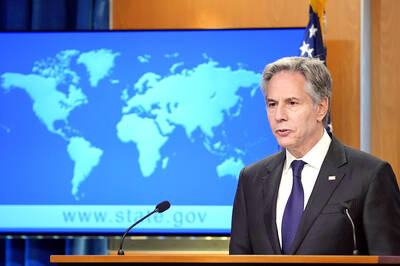
Beijing is continuing to commit genocide and crimes against humanity against Uyghurs and other Muslim minorities in its western Xinjiang province, U.S. Secretary of State Antony Blinken said in a report published on Monday, ahead of his planned visit to China this week. The State Department’s annual human rights report, which documents abuses recorded all over the world during the previous calendar year, repeated language from previous years on the treatment of Muslims in Xinjiang, but the publication raises the issue ahead of delicate talks, including on the war in Ukraine and global trade, between the top U.S. diplomat and Chinese

HYPOCRISY? The Chinese Ministry of Foreign Affairs yesterday asked whether Biden was talking about China or the US when he used the word ‘xenophobic’ US President Joe Biden on Wednesday called for a hike in steel tariffs on China, accusing Beijing of cheating as he spoke at a campaign event in Pennsylvania. Biden accused China of xenophobia, too, in a speech to union members in Pittsburgh. “They’re not competing, they’re cheating. They’re cheating and we’ve seen the damage here in America,” Biden said. Chinese steel companies “don’t need to worry about making a profit because the Chinese government is subsidizing them so heavily,” he said. Biden said he had called for the US Trade Representative to triple the tariff rates for Chinese steel and aluminum if Beijing was


 RSS
RSS