


Supporters of tough US sanctions against the Cuban government have given more than US$10 million to congressional campaigns over the last seven years, a study released by a group supporting campaign finance reform showed.
The Washington-based nonprofit Public Campaign said the study, released late on Sunday, showed how large sums of money from a small group can influence lawmakers.
Public Campaign cites a number of times in which lawmakers changed their position on Cuba-related issues within months of receiving funds from a political action committee (PAC) that supports the US embargo of the communist island.
Those who back the US-Cuba Democracy PAC say they are being unfairly targeted for their passionate views toward their homeland.
“Perhaps it’s the age-old story of money and politics, but 18 members switched their votes on the subject, some in very close proximity to when they got donations,” Public Campaign’s David Donnelly said. “When an issue is not in the front view, like healthcare, our campaign finance system sets up a situation in which the members are more interested in the money than deciding a rational, reasoned approach to politics.”
Mauricio Claver-Carone, the Washington-based director to the PAC, said the group was simply exercising its constitutional right to political participation.
“For some of these folks, it’s OK for unions to support pro-labor members. It’s OK for trial lawyers to help elect pro-litigators. It’s OK for the Jewish community to help elect pro-Israel, but somehow it’s not OK for the Cuban community to help elect members and candidates that help and support conditioning business and tourism with the Castro regime with human rights and democratic reforms,” Claver-Carone said.
Like many other interest groups, those who support the US embargo of Cuba have long donated heavily to whichever party is in power and spread the funds among legislators across the country.
Representative Lincoln Diaz-Balart, who is Cuban-American and staunchly pro-embargo, called the report a “low blow” and a “lot of baloney” from those who oppose the sanctions.
Diaz-Balart, a Florida Republican who receives thousands of dollars from the PAC, said the number of individual contributions and those to PACs demonstrate the community’s continued unity.
Analysts are increasingly calling into question that unity.
Many Cuban-Americans continue to support a ban on tourist travel to the island until political prisoners there are released, free elections are held and independent media is allowed to operate.
Younger members of the community and newer arrivals tend to support easing restrictions on travel by Cuban-Americans to visit family, as well as educational and other exchanges.
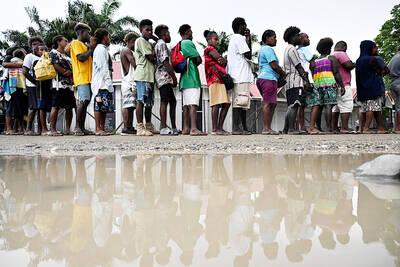
SEEKING CHANGE: A hospital worker said she did not vote in previous elections, but ‘now I can see that maybe my vote can change the system and the country’ Voting closed yesterday across the Solomon Islands in the south Pacific nation’s first general election since the government switched diplomatic allegiance from Taiwan to Beijing and struck a secret security pact that has raised fears of the Chinese navy gaining a foothold in the region. The Solomon Islands’ closer relationship with China and a troubled domestic economy weighed on voters’ minds as they cast their ballots. As many as 420,000 registered voters had their say across 50 national seats. For the first time, the national vote also coincided with elections for eight of the 10 local governments. Esther Maeluma cast her vote in the
Nearly half of China’s major cities are suffering “moderate to severe” levels of subsidence, putting millions of people at risk of flooding, especially as sea levels rise, according to a study of nationwide satellite data released yesterday. The authors of the paper, published by the journal Science, found that 45 percent of China’s urban land was sinking faster than 3mm per year, with 16 percent at more than 10mm per year, driven not only by declining water tables, but also the sheer weight of the built environment. With China’s urban population already in excess of 900 million people, “even a small portion

UNSETTLING IMAGES: The scene took place in front of TV crews covering the Trump trial, with a CNN anchor calling it an ‘emotional and unbelievably disturbing moment’ A man who doused himself in an accelerant and set himself on fire outside the courthouse where former US president Donald Trump is on trial has died, police said yesterday. The New York City Police Department (NYPD) said the man was declared dead by staff at an area hospital. The man was in Collect Pond Park at about 1:30pm on Friday when he took out pamphlets espousing conspiracy theories, tossed them around, then doused himself in an accelerant and set himself on fire, officials and witnesses said. A large number of police officers were nearby when it happened. Some officers and bystanders rushed

HYPOCRISY? The Chinese Ministry of Foreign Affairs yesterday asked whether Biden was talking about China or the US when he used the word ‘xenophobic’ US President Joe Biden on Wednesday called for a hike in steel tariffs on China, accusing Beijing of cheating as he spoke at a campaign event in Pennsylvania. Biden accused China of xenophobia, too, in a speech to union members in Pittsburgh. “They’re not competing, they’re cheating. They’re cheating and we’ve seen the damage here in America,” Biden said. Chinese steel companies “don’t need to worry about making a profit because the Chinese government is subsidizing them so heavily,” he said. Biden said he had called for the US Trade Representative to triple the tariff rates for Chinese steel and aluminum if Beijing was


 RSS
RSS