


Suicide car bombers killed 16 people and wounded more than 80 in two attacks in northwestern Pakistan yesterday, including a devastating strike on the regional headquarters of the spy agency overseeing much of the country’s anti-terror campaign.
The bombings were the latest in a string of attacks on security forces, civilians and Western targets since the government launched an offensive in the middle of last month against militants in the border region of South Waziristan, where al-Qaeda and Taliban leaders are believed to be hiding out.
The attack on the Inter-Services Intelligence (ISI) agency building occurred in the city of Peshawar, which has borne the brunt of the militants’ retaliation against the army offensive. A wave of bombings in the last week alone in and around the city has killed more than 50 people.

PHOTO: EPA
Security forces guarding the intelligence complex opened fire on a pickup laden with explosives, but the bomber was able to detonate his payload, an intelligence official said on condition of anonymity because he was not authorized to talk to the media.
The early morning blast, heard across the city, destroyed much of the three-story building and killed 10 people, including seven who worked for the spy agency, the army said in a statement.
Officials said 55 people were wounded.
“This is a guerrilla war,” said Mian Iftikhar Hussain, the information minister for North West Frontier Province, where Peshawar is the capital. “We will continue our action against these militant terrorists. That is the only way we can survive.”
About an hour later, a second suicide car bomber attacked a police station farther south near the Afghan border, killing six people, police official Tahir Shah said.
Five of the dead were policemen working at the station in Bakkakhel village in Bannu district; the other was a civilian, Shah said, adding that 55 people were wounded.
The station is close to the border with North Waziristan, an area in Pakistan’s semiautonomous tribal region where officials believe many militants have fled to escape the recent army offensive.
The government has vowed the surging militant attacks will not dent the country’s resolve to pursue the operation in South Waziristan, where officials say the most deadly insurgent network in Pakistan is based. The army claims to be making good progress.
Yesterday’s attack in Peshawar was the second to target a spy agency complex this year. A suicide squad using guns, grenades and a van packed with explosives attacked a police and an ISI building in Lahore in May, killing 30 people.
The ISI has been involved in scores of covert operations in the northwest against al-Qaeda targets since 2001, when many militant leaders crossed into the area following the US led invasion of Afghanistan. The region is seen as a likely hiding place for Osama bin Laden.
Its offices in Peshawar are on the main road leading from the city to Afghanistan. The agency was instrumental in using CIA money to train jihadi groups to fight the Soviet Union in Afghanistan in the 1980s.
Despite assisting in the fight against al-Qaeda since then, some Western officials consider the agency an unreliable ally and allege it still maintains links with militants.
Taliban and al-Qaeda fighters are waging a war against the Pakistani government because they deem it un-Islamic and are angry about its alliance with the US. The insurgency began in earnest in 2007, and attacks have spiked since the run-up to the offensive in South Waziristan.
A car bomb exploded in a market in Peshawar at the end of last month, killing at least 112 people in the deadliest attack in Pakistan in more than two years.
On Oct. 10, a team of militants staged a raid on the army headquarters close to the capital, Islamabad, taking soldiers hostages in a 22-hour standoff that left nine militants and 14 others dead.
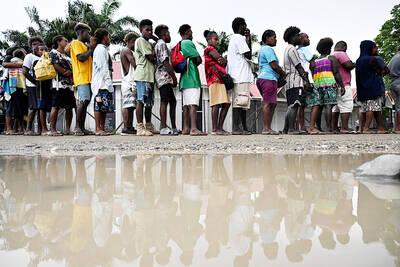
SEEKING CHANGE: A hospital worker said she did not vote in previous elections, but ‘now I can see that maybe my vote can change the system and the country’ Voting closed yesterday across the Solomon Islands in the south Pacific nation’s first general election since the government switched diplomatic allegiance from Taiwan to Beijing and struck a secret security pact that has raised fears of the Chinese navy gaining a foothold in the region. The Solomon Islands’ closer relationship with China and a troubled domestic economy weighed on voters’ minds as they cast their ballots. As many as 420,000 registered voters had their say across 50 national seats. For the first time, the national vote also coincided with elections for eight of the 10 local governments. Esther Maeluma cast her vote in the
Nearly half of China’s major cities are suffering “moderate to severe” levels of subsidence, putting millions of people at risk of flooding, especially as sea levels rise, according to a study of nationwide satellite data released yesterday. The authors of the paper, published by the journal Science, found that 45 percent of China’s urban land was sinking faster than 3mm per year, with 16 percent at more than 10mm per year, driven not only by declining water tables, but also the sheer weight of the built environment. With China’s urban population already in excess of 900 million people, “even a small portion

UNSETTLING IMAGES: The scene took place in front of TV crews covering the Trump trial, with a CNN anchor calling it an ‘emotional and unbelievably disturbing moment’ A man who doused himself in an accelerant and set himself on fire outside the courthouse where former US president Donald Trump is on trial has died, police said yesterday. The New York City Police Department (NYPD) said the man was declared dead by staff at an area hospital. The man was in Collect Pond Park at about 1:30pm on Friday when he took out pamphlets espousing conspiracy theories, tossed them around, then doused himself in an accelerant and set himself on fire, officials and witnesses said. A large number of police officers were nearby when it happened. Some officers and bystanders rushed

HYPOCRISY? The Chinese Ministry of Foreign Affairs yesterday asked whether Biden was talking about China or the US when he used the word ‘xenophobic’ US President Joe Biden on Wednesday called for a hike in steel tariffs on China, accusing Beijing of cheating as he spoke at a campaign event in Pennsylvania. Biden accused China of xenophobia, too, in a speech to union members in Pittsburgh. “They’re not competing, they’re cheating. They’re cheating and we’ve seen the damage here in America,” Biden said. Chinese steel companies “don’t need to worry about making a profit because the Chinese government is subsidizing them so heavily,” he said. Biden said he had called for the US Trade Representative to triple the tariff rates for Chinese steel and aluminum if Beijing was


 RSS
RSS