


A Chinese government spokesman said US President Barack Obama should be especially sympathetic to China’s opposition to the Dalai Lama and Tibetan independence as a black leader who lauded US president Abraham Lincoln for helping abolish slavery.
Chinese Foreign Ministry spokesman Qin Gang (秦剛) made the comments at a news conference on Thursday, four days before Obama arrives in China for a summit that will cover the two big powers’ vast and sometimes tense economic, diplomatic and security ties.
Obama did not meet the Tibetan Buddhist leader when he was in Washington early last month. But the Dalai Lama has said they may meet after Obama’s visit to China, which claims the Buddhist monk is a separatist.

PHOTO: REUTERS
China is sure to condemn such a meeting, and spokesman Qin underscored — and possibly intensified — the political temperature of the issue by citing Obama’s background and admiration for Lincoln, who opposed the secession of the southern states and sought to abolish slavery, which Qin likened to Tibetan society under the Dalai Lama.
After Obama’s inauguration, the US president said he would not have been able to reach that position without the efforts of Lincoln, Qin said.
“He is a black president, and he understands the slavery abolition movement and Lincoln’s major significance for that movement,” Qin said.
“Lincoln played an incomparable role in protecting the national unity and territorial integrity of the United States,” he said.
Beijing calls the Dalai Lama a dangerous “splittist” who encourages Tibetan independence, a charge he denies. The Dalai Lama says he wants true autonomy for Tibet.
China’s stance was like Lincoln’s, Qin said.
“Thus, on this issue we hope that President Obama, more than any other foreign leader, can better, more deeply grasp China’s stance on protecting national sovereignty and territorial integrity,” Qin said.
Asked about any broader consequences of a possible meeting between Obama and the Dalai Lama, Qin said Beijing opposed any meetings between the exiled Tibetan leader and foreign leaders, and said the issue was among China’s core concerns.
“We must treasure the positive circumstances and opportunities for China-US relations,” Qin said. “In particular, both sides must respect each other’s core interests and major concerns, and Tibetan issues are among China’s core interests and major concerns.”
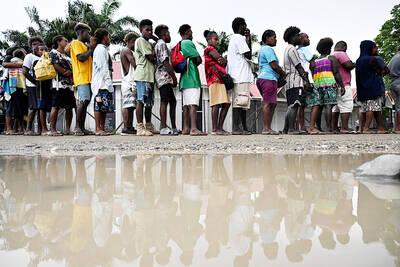
SEEKING CHANGE: A hospital worker said she did not vote in previous elections, but ‘now I can see that maybe my vote can change the system and the country’ Voting closed yesterday across the Solomon Islands in the south Pacific nation’s first general election since the government switched diplomatic allegiance from Taiwan to Beijing and struck a secret security pact that has raised fears of the Chinese navy gaining a foothold in the region. The Solomon Islands’ closer relationship with China and a troubled domestic economy weighed on voters’ minds as they cast their ballots. As many as 420,000 registered voters had their say across 50 national seats. For the first time, the national vote also coincided with elections for eight of the 10 local governments. Esther Maeluma cast her vote in the
Nearly half of China’s major cities are suffering “moderate to severe” levels of subsidence, putting millions of people at risk of flooding, especially as sea levels rise, according to a study of nationwide satellite data released yesterday. The authors of the paper, published by the journal Science, found that 45 percent of China’s urban land was sinking faster than 3mm per year, with 16 percent at more than 10mm per year, driven not only by declining water tables, but also the sheer weight of the built environment. With China’s urban population already in excess of 900 million people, “even a small portion

UNSETTLING IMAGES: The scene took place in front of TV crews covering the Trump trial, with a CNN anchor calling it an ‘emotional and unbelievably disturbing moment’ A man who doused himself in an accelerant and set himself on fire outside the courthouse where former US president Donald Trump is on trial has died, police said yesterday. The New York City Police Department (NYPD) said the man was declared dead by staff at an area hospital. The man was in Collect Pond Park at about 1:30pm on Friday when he took out pamphlets espousing conspiracy theories, tossed them around, then doused himself in an accelerant and set himself on fire, officials and witnesses said. A large number of police officers were nearby when it happened. Some officers and bystanders rushed

HYPOCRISY? The Chinese Ministry of Foreign Affairs yesterday asked whether Biden was talking about China or the US when he used the word ‘xenophobic’ US President Joe Biden on Wednesday called for a hike in steel tariffs on China, accusing Beijing of cheating as he spoke at a campaign event in Pennsylvania. Biden accused China of xenophobia, too, in a speech to union members in Pittsburgh. “They’re not competing, they’re cheating. They’re cheating and we’ve seen the damage here in America,” Biden said. Chinese steel companies “don’t need to worry about making a profit because the Chinese government is subsidizing them so heavily,” he said. Biden said he had called for the US Trade Representative to triple the tariff rates for Chinese steel and aluminum if Beijing was


 RSS
RSS