


British Prime Minister Gordon Brown was to address public concern over immigration in a speech yesterday, acknowledging that many people fear foreign workers are taking their jobs and putting strains on local housing. Steep rises in immigration over the past decade and a recession-led climb in unemployment have boosted support for the far right and fueled charges Brown’s Labour government has lost control of the UK’s borders.
The issue is set to be a factor in a general election to be held by June next year, with the opposition Conservatives pledging they would impose a cap on immigration from outside the EU.
Labour ministers have long hailed immigration as benefiting the economy. They have been accused, however, of ignoring the worries of poorer families, who blame migrant workers for their problems in deprived areas where jobs and social housing are scarce.
Those concerns have seen a rise in support for the anti-immigration British National Party, which has scored gains in local council polls and won two seats in June’s European Parliament elections.
Brown was to say that immigration is neither an issue for fringe parties nor a taboo subject.
“I have never agreed with the lazy elitism that dismisses immigration as an issue, or portrays anyone who has concerns about immigration as a racist,” he will say according to extracts released in advance. “People worry about whether immigration will undermine their wages and the job prospects of their children. They worry about whether their grown-up children will be able to get housing anywhere near them.”
He was also to note, however, that the arrival of overseas workers has been welcome for many.
“If the main effect of immigration on your life is to make it easier to find a plumber, or when you see doctors and nurses from overseas in your local hospital, you are likely to think more about the benefits of migration than the possible costs,” he said.
Brown was to defend his government’s policy of “managed migration” through a points-based system introduced last year that restricts visas for non-EU nationals to a limited range of professions.
He was to hint at a tightening of these restrictions as the recession eases.
“As growth returns, I want to see rising levels of skills, wages and employment among resident workers, rather than employers having to resort to recruiting people from abroad,” he was to say.
The number of non-EU nationals working in the UK has doubled since Labour came to power in 1997, while migration from eastern Europe has far exceeded the government’s initial estimates since controls were eased in 2004.
Although the UK has tightened controls on workers from outside the EU, it has little power to restrict migration from within the 27-nation bloc.

Republican US lawmakers on Friday criticized US President Joe Biden’s administration after sanctioned Chinese telecoms equipment giant Huawei unveiled a laptop this week powered by an Intel artificial intelligence (AI) chip. The US placed Huawei on a trade restriction list in 2019 for contravening Iran sanctions, part of a broader effort to hobble Beijing’s technological advances. Placement on the list means the company’s suppliers have to seek a special, difficult-to-obtain license before shipping to it. One such license, issued by then-US president Donald Trump’s administration, has allowed Intel to ship central processors to Huawei for use in laptops since 2020. China hardliners
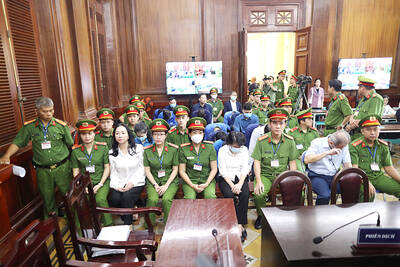
A top Vietnamese property tycoon was on Thursday sentenced to death in one of the biggest corruption cases in history, with an estimated US$27 billion in damages. A panel of three hand-picked jurors and two judges rejected all defense arguments by Truong My Lan, chair of major developer Van Thinh Phat, who was found guilty of swindling cash from Saigon Commercial Bank (SCB) over a decade. “The defendant’s actions ... eroded people’s trust in the leadership of the [Communist] Party and state,” read the verdict at the trial in Ho Chi Minh City. After the five-week trial, 85 others were also sentenced on

‘DELUSIONAL’: Targeting the families of Hamas’ leaders would not push the group to change its position or to give up its demands for Palestinians, Ismail Haniyeh said Israeli aircraft on Wednesday killed three sons of Hamas’ top political leader in the Gaza Strip, striking high-stakes targets at a time when Israel is holding delicate ceasefire negotiations with the militant group. Hamas said four of the leader’s grandchildren were also killed. Ismail Haniyeh’s sons are among the highest-profile figures to be killed in the war so far. Israel said they were Hamas operatives, and Haniyeh accused Israel of acting in “the spirit of revenge and murder.” The deaths threatened to strain the internationally mediated ceasefire talks, which appeared to gain steam in recent days even as the sides remain far

RAMPAGE: A Palestinian man was left dead after dozens of Israeli settlers searching for a missing 14-year-old boy stormed a village in the Israeli-occupied West Bank US President Joe Biden on Friday said he expected Iran to attack Israel “sooner, rather than later” and warned Tehran not to proceed. Asked by reporters about his message to Iran, Biden simply said: “Don’t,” underscoring Washington’s commitment to defend Israel. “We are devoted to the defense of Israel. We will support Israel. We will help defend Israel and Iran will not succeed,” he said. Biden said he would not divulge secure information, but said his expectation was that an attack could come “sooner, rather than later.” Israel braced on Friday for an attack by Iran or its proxies as warnings grew of


 RSS
RSS