


Robert Rines, a lawyer, composer, inventor and physicist whose discoveries led to sharper resolution in radar, sonar and ultrasound imaging and who claimed to have seen the Loch Ness Monster, has died. He was 87.
Rines died of heart failure at his home in Boston on Sunday, surrounded by his family, his wife, Joanne Hayes-Rines, said on Monday.
Born in Boston, Rines graduated from IT and received a law degree from Georgetown. He completed a doctorate thesis at National Chiao Tung University in Taiwan.
Rines invented prototype radar and sonar technology that was later also incorporated in ultrasound imaging of internal organs. He donated the radar patent to the US government and gave the imaging patent to the rest of the world to use for free, Hayes-Rines said.
Rines held more than 80 patents. The radar technology patent — developed while he was a student at Massachusetts Institute of Technology’s radiation laboratory and honed while serving as a US Signal Corps officer during World War II — formed the underlying technology used to guide Patriot missiles during the 1991 Gulf War and produce early warning missile-detection systems and other sophisticated military hardware.
He also wrote music for more than 10 Broadway and off-Broadway productions and shared an Emmy for his work on a piece about former New York City mayor Fiorello LaGuardia.
He is also the founder of the Franklin Pierce Law Center in New Hampshire, the state’s only law school that is also known for its intellectual property law program, and the Academy of Applied Science, a nonprofit group that promotes creativity and interest in science.
Rines used some of his inventions in attempts to prove the existence of the Loch Ness monster, and claimed to have seen Nessie in 1971.
“You don’t get into this passion of trying to find Nessie if you haven’t seen it, and he did see it with his late wife, Carol, and two friends,” Hayes-Rines said.
The encounter enticed Rines to go back to the Scottish lake every few years, hoping to use better imaging and tracking technology to capture sharper images of the animal. He previously said it looked like a plesiosaur, a dinosaur that lived under water millions of years ago.
“It was maybe 45 feet [14m] in length with a neck 4 or 5 feet [1.2m or 1.5m] long, according to eyewitness accounts,” he once said.
Rines taught for more than 50 years at MIT, focusing on invention, patents and innovation before retiring in May last year. He has also been Gordon McKay Lecturer on Patent Law at Harvard University.
Rines was motivated by a determination to find creative solutions to problems.
“He just thought of things that nobody ever thought of, he just thought there was nothing you couldn’t do if you think about it and you wanted to do it, just figure out how to get it done,” Hayes-Rines said.
In 1985, researchers used underwater vessels that used sonar technology developed by Rines to find the Titanic, which sank in more than 3,780m of water in 1912. The systems were also used to find the wreck of the German battleship Bismarck, which was sunk during World War II.
Rines is survived by his wife, two sons, a daughter and stepdaughter. A memorial service is set for Saturday.

Republican US lawmakers on Friday criticized US President Joe Biden’s administration after sanctioned Chinese telecoms equipment giant Huawei unveiled a laptop this week powered by an Intel artificial intelligence (AI) chip. The US placed Huawei on a trade restriction list in 2019 for contravening Iran sanctions, part of a broader effort to hobble Beijing’s technological advances. Placement on the list means the company’s suppliers have to seek a special, difficult-to-obtain license before shipping to it. One such license, issued by then-US president Donald Trump’s administration, has allowed Intel to ship central processors to Huawei for use in laptops since 2020. China hardliners
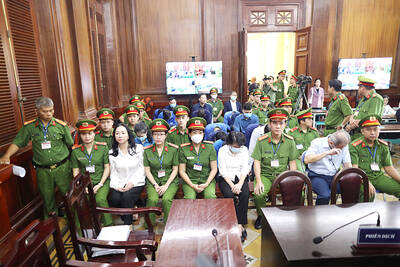
A top Vietnamese property tycoon was on Thursday sentenced to death in one of the biggest corruption cases in history, with an estimated US$27 billion in damages. A panel of three hand-picked jurors and two judges rejected all defense arguments by Truong My Lan, chair of major developer Van Thinh Phat, who was found guilty of swindling cash from Saigon Commercial Bank (SCB) over a decade. “The defendant’s actions ... eroded people’s trust in the leadership of the [Communist] Party and state,” read the verdict at the trial in Ho Chi Minh City. After the five-week trial, 85 others were also sentenced on

‘DELUSIONAL’: Targeting the families of Hamas’ leaders would not push the group to change its position or to give up its demands for Palestinians, Ismail Haniyeh said Israeli aircraft on Wednesday killed three sons of Hamas’ top political leader in the Gaza Strip, striking high-stakes targets at a time when Israel is holding delicate ceasefire negotiations with the militant group. Hamas said four of the leader’s grandchildren were also killed. Ismail Haniyeh’s sons are among the highest-profile figures to be killed in the war so far. Israel said they were Hamas operatives, and Haniyeh accused Israel of acting in “the spirit of revenge and murder.” The deaths threatened to strain the internationally mediated ceasefire talks, which appeared to gain steam in recent days even as the sides remain far

RAMPAGE: A Palestinian man was left dead after dozens of Israeli settlers searching for a missing 14-year-old boy stormed a village in the Israeli-occupied West Bank US President Joe Biden on Friday said he expected Iran to attack Israel “sooner, rather than later” and warned Tehran not to proceed. Asked by reporters about his message to Iran, Biden simply said: “Don’t,” underscoring Washington’s commitment to defend Israel. “We are devoted to the defense of Israel. We will support Israel. We will help defend Israel and Iran will not succeed,” he said. Biden said he would not divulge secure information, but said his expectation was that an attack could come “sooner, rather than later.” Israel braced on Friday for an attack by Iran or its proxies as warnings grew of


 RSS
RSS