


US President Barack Obama yesterday witnessed the homecoming of US war dead from Afghanistan, as he continued to mull whether to send thousands more troops into the battle zone.
For the unscheduled trip, in stark contrast to his predecessor, who banned media coverage of returning bodies from military operations, Obama left the White House just before midnight on Wednesday with a small press contingent to join the transfer ceremony of US personnel killed this week in Afghanistan.
The sobering move, Obama’s first such journey to Dover Air Force Base, where virtually all transfers take place, was highly symbolic as he weighs the decision of a revised strategy for the region.
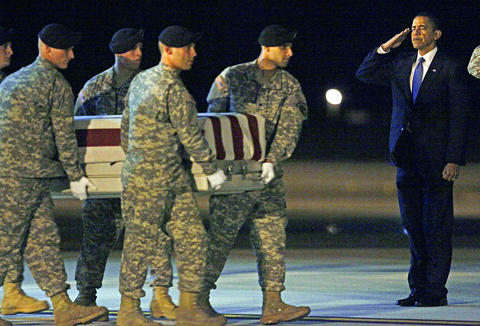
PHOTO: REUTERS
Arriving home were 15 army soldiers and three agents from the Drug Enforcement Agency, who were all killed on Monday, contributing to the deadliest month toll for US forces in the eight-year conflict in Afghanistan.
Obama, wearing a dark overcoat on an unseasonably warm night, met with family members of the dead at an on-base chapel.
The ban on media coverage of transfers began under former US president George H.W. Bush during the first Gulf war, and was renewed by his son George W. Bush, as military action got under way in Afghanistan and later in Iraq.
Images of honor guards carrying the coffins from the bellies of military transport planes became a grim symbol of the Vietnam War, and a graphic reminder of the mounting death toll.
The younger Bush was thus accused of trying to hide the human cost of the wars in Iraq and Afghanistan, which have claimed the lives of more than 5,000 US soldiers.
US Defense Secretary Robert Gates reversed the controversial policy in February this year, saying the Pentagon would leave it up to the families to decide whether to allow coverage of coffins carrying their dead soldiers.
On Wednesday, White House press secretary Robert Gibbs said Obama’s most difficult duty as US commander-in-chief was addressing the families of war dead.
His “hardest task,” Gibbs told reporters, “is signing the condolence letter to a loved one who’s lost a son or a daughter or a husband, a wife, in Iraq or Afghanistan.”
Before the actual transfer, Obama — joined by military officials and members of his administration, including Attorney General Eric Holder — boarded the aircraft carrying the coffins for a prayer led by an Air Force chaplain.
The US’ bloodiest month in Afghanistan has sharpened the dilemma on troop deployments, as political demand continues to grow for swift action.
“The president of the United States needs to make this decision and soon,” Republican Senator John McCain urged at the weekend.
“Our allies are nervous and our military leadership is becoming frustrated,” said McCain, who was Obama’s rival for the White House last year.
Republicans see the turmoil of recent days as a sign Obama must honor war commander General Stanley McChrystal’s request for 40,000 more troops.
The White House, however, counters that Obama’s soul searching is justified by the gravity of his choice on whether to plunge tens of thousands of people into the worsening war.
Outwardly, Obama, who prides himself on thriving under pressure, appears unfazed by the quickening crisis, scheduling the next meeting of his exhaustive policy review with US military chiefs on Friday.
Earlier this week, he told servicemen and women in Florida he would not “rush” a decision on which lives depend.

Republican US lawmakers on Friday criticized US President Joe Biden’s administration after sanctioned Chinese telecoms equipment giant Huawei unveiled a laptop this week powered by an Intel artificial intelligence (AI) chip. The US placed Huawei on a trade restriction list in 2019 for contravening Iran sanctions, part of a broader effort to hobble Beijing’s technological advances. Placement on the list means the company’s suppliers have to seek a special, difficult-to-obtain license before shipping to it. One such license, issued by then-US president Donald Trump’s administration, has allowed Intel to ship central processors to Huawei for use in laptops since 2020. China hardliners

Conjoined twins Lori and George Schappell, who pursued separate careers, interests and relationships during lives that defied medical expectations, died this month in Pennsylvania, funeral home officials said. They were 62. The twins, listed by Guinness World Records as the oldest living conjoined twins, died on April 7 at the Hospital of the University of Pennsylvania, obituaries posted by Leibensperger Funeral Homes of Hamburg said. The cause of death was not detailed. “When we were born, the doctors didn’t think we’d make 30, but we proved them wrong,” Lori said in an interview when they turned 50, the Philadelphia Inquirer reported. The
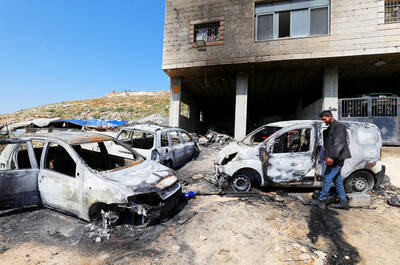
RAMPAGE: A Palestinian man was left dead after dozens of Israeli settlers searching for a missing 14-year-old boy stormed a village in the Israeli-occupied West Bank US President Joe Biden on Friday said he expected Iran to attack Israel “sooner, rather than later” and warned Tehran not to proceed. Asked by reporters about his message to Iran, Biden simply said: “Don’t,” underscoring Washington’s commitment to defend Israel. “We are devoted to the defense of Israel. We will support Israel. We will help defend Israel and Iran will not succeed,” he said. Biden said he would not divulge secure information, but said his expectation was that an attack could come “sooner, rather than later.” Israel braced on Friday for an attack by Iran or its proxies as warnings grew of
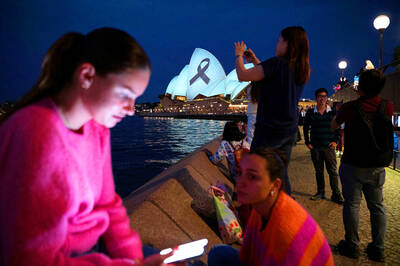
A prominent Christian leader has allegedly been stabbed at the altar during a Mass yesterday in southwest Sydney. Bishop Mar Mari Emmanuel was saying Mass at Christ The Good Shepherd Church in Wakeley just after 7pm when a man approached him at the altar and allegedly stabbed toward his head multiple times. A live stream of the Mass shows the congregation swarm forward toward Emmanuel before it was cut off. The church leader gained prominence during the COVID-19 pandemic, amassing a large online following, Officers attached to Fairfield City police area command attended a location on Welcome Street, Wakeley following reports a number


 RSS
RSS