


Diverging interpretations of World War II in Poland and Russia are weighing heavily on ceremonies marking the 70th anniversary of its outbreak due to draw world leaders to Poland yesterday.
It was to be the first time a senior Russian leader, Prime Minister Vladimir Putin, would be in Westerplatte, close to the Polish Baltic Sea port city of Gdansk, where the first shots of the war were fired on Sept. 1, 1939.
Poles will be paying close attention to what he will say there after a string of Russian publications and a film justifying the Aug. 23, 1939, Nazi-Soviet Non-Aggression Treaty, known as the Molotov-Ribbentrop pact, which led to the partition of Poland between Germany and the USSR.
His declarations “could be decisive for our bilateral relations over the next few years,” Polish political analyst Slawomir Debski told Poland’s Dziennik daily on Monday.
Putin made appeasing statements in an article published on Monday in the mass circulation Gazeta Wyborcza daily, condemning the Molotov-Ribbentrop pact, but added that Stalin’s USSR had no other choice and made no reference to the Soviet invasion of Poland on Sept. 17, 1939.
“Without any doubt, it is possible to condemn — and with good reason — the Molotov-Ribbentrop pact concluded in August 1939,” Putin wrote, referring to the two foreign ministers who signed the pact in the Kremlin.
“But a year earlier, didn’t France and Great Britain sign the famous treaty [Munich Agreement] with [Nazi German leader Adolf] Hitler destroying all hope of creating a united front to fight against fascism?” he asked.
At the same time Putin will be in the company of other European leaders such as German Chancellor Angela Merkel, French Prime Minister Francois Fillon and Italian Prime Minister Silvio Berlusconi at yesterday’s ceremonies in Poland, Russia’s Foreign Intelligence Service (SVR) in Moscow has said it would publish what it calls “unedited documents” detailing Polish policy including Warsaw’s “secret plans” between 1935 and 1945.
In June, the Russian defense ministry was heavily criticized both at home and abroad for publishing an article on its Internet site accusing Poland of having provoked World War II by refusing to concede to the “moderate” demands of Nazi Germany.
The same month, a broadcast by Russian television station Rossia accused Poland of having promised Berlin its military support and having “proposed to Japan it would open a second front against the USSR.” The Polish embassy in Russia protested at what it termed “a falsification of history.”
But “the participants in the ceremonies appear to be coming close to a consensus,” Russian daily Nezavisimaya Gazeta said on Monday.
“The Polish president [Lech Kaczynski] has refused to take part in the discussion on the subject of the despicable films broadcast by Russian television,” the newspaper wrote.
Pointing to the example of good relations which Russia maintains with Germany, Putin said he was “sure that sooner or later Russian-Polish relations will achieve the same elevated level of partnership” in the Monday article.
He recalled the 1940 massacre of 22,000 Polish officers, intellectuals and others by Soviet secret police, many of them in the Katyn forest in western Russia, a crime Moscow blamed on the Nazis for decades.
Warsaw and Moscow have long been at odds over the issue and Russian courts have refused to reopen an investigation of the case.
The speaker of Poland’s lower house of parliament, the Sejm, Bronislaw Komorowski called the statements made by Putin in the Monday article “a great step ahead” and expressed what he called “his great relief.”
The Polish authorities believe that by using “well documented sources” Polish historians can “best respond” to the claims by Russian historians, Poland’s government spokesman Pawel Gras said on Monday.

Republican US lawmakers on Friday criticized US President Joe Biden’s administration after sanctioned Chinese telecoms equipment giant Huawei unveiled a laptop this week powered by an Intel artificial intelligence (AI) chip. The US placed Huawei on a trade restriction list in 2019 for contravening Iran sanctions, part of a broader effort to hobble Beijing’s technological advances. Placement on the list means the company’s suppliers have to seek a special, difficult-to-obtain license before shipping to it. One such license, issued by then-US president Donald Trump’s administration, has allowed Intel to ship central processors to Huawei for use in laptops since 2020. China hardliners

Conjoined twins Lori and George Schappell, who pursued separate careers, interests and relationships during lives that defied medical expectations, died this month in Pennsylvania, funeral home officials said. They were 62. The twins, listed by Guinness World Records as the oldest living conjoined twins, died on April 7 at the Hospital of the University of Pennsylvania, obituaries posted by Leibensperger Funeral Homes of Hamburg said. The cause of death was not detailed. “When we were born, the doctors didn’t think we’d make 30, but we proved them wrong,” Lori said in an interview when they turned 50, the Philadelphia Inquirer reported. The
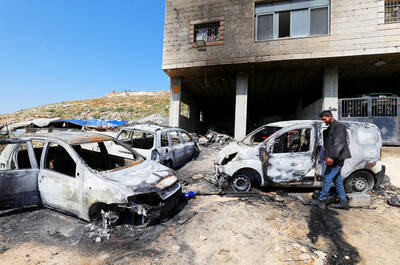
RAMPAGE: A Palestinian man was left dead after dozens of Israeli settlers searching for a missing 14-year-old boy stormed a village in the Israeli-occupied West Bank US President Joe Biden on Friday said he expected Iran to attack Israel “sooner, rather than later” and warned Tehran not to proceed. Asked by reporters about his message to Iran, Biden simply said: “Don’t,” underscoring Washington’s commitment to defend Israel. “We are devoted to the defense of Israel. We will support Israel. We will help defend Israel and Iran will not succeed,” he said. Biden said he would not divulge secure information, but said his expectation was that an attack could come “sooner, rather than later.” Israel braced on Friday for an attack by Iran or its proxies as warnings grew of
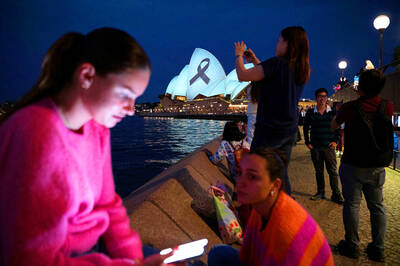
A prominent Christian leader has allegedly been stabbed at the altar during a Mass yesterday in southwest Sydney. Bishop Mar Mari Emmanuel was saying Mass at Christ The Good Shepherd Church in Wakeley just after 7pm when a man approached him at the altar and allegedly stabbed toward his head multiple times. A live stream of the Mass shows the congregation swarm forward toward Emmanuel before it was cut off. The church leader gained prominence during the COVID-19 pandemic, amassing a large online following, Officers attached to Fairfield City police area command attended a location on Welcome Street, Wakeley following reports a number


 RSS
RSS