


A growing wildfire sending massive billows of smoke into the sky north of Los Angeles nearly tripled in size, injuring three residents, destroying at least three homes, knocking out power to many more and spurring evacuations in a number of mountain communities.
Mandatory evacuations were extended on Saturday into neighborhoods in the canyons on the northwestern edge of Altadena, Glendale, Pasadena, La Crescenta and Big Tujunga Canyon, Forest Service spokesman Bruce Quintelier said.
The flames crept lower down the slopes of the San Gabriel Mountains despite winds blowing predominantly in the other direction, threatening more than 2,000 homes in the La Canada Flintridge area. Officials estimated that 1,000 homes had been evacuated.
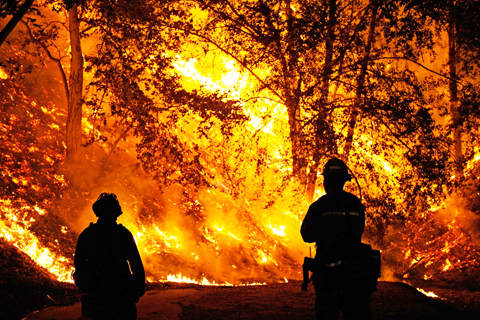
PHOTO: AFP
“Today what happened is what I call the perfect storm of fuels, weather, and topography coming together,” said Captain Mike Dietrich, the incident commander for the US Forest Service. “Essentially the fire burned at will; it went where it wanted to when it wanted to.”
At least three homes deep in the Angeles National Forest were destroyed, and firefighters were searching for others, Dietrich said.
The fire was the largest and most dangerous of several burning around southern and central California and in Yosemite National Park.
It made a run of 9km to 13km to the north and west in just four hours, Dietrich said, bringing new concerns for the community of Acton and the area around Santa Clarita, Dietrich.
Flames knocked out power to at least 164 residences in La Canada Flintridge on Saturday, according to Southern California Edison.
Repair crews were ordered to stay out of the area because of fire danger.
At least three people were burned and airlifted to local hospitals, Dietrich said. He had no further details on their injuries.
Air crews waged a fierce battle against the southeast corner of the fire, burning dangerously close to canyon homes. Spotter planes with tankers on their tails dove well below ridge lines to lay bright orange retardant then pulled up dramatically over neighborhoods, and giant sky crane helicopters swooped in to unleash showers on the biggest flareups.
The fire was burning in steep wooded hills next to NASA’s Jet Propulsion Laboratory in northern Pasadena.
A major goal was to keep the fire from spreading up Mount Wilson, where many of the region’s broadcast and communications antennas and the historic Mount Wilson Observatory are located, officials said.
“The Mount Wilson communications site is still actively threatened, and we don’t know what will happen tomorrow,” Dietrich said.
A second fire in the Angeles National Forest was burning several kilometers to the east in a canyon above the city of Azusa.
The 9km² blaze, which started on Tuesday afternoon, was 85 percent contained on Saturday. No homes were threatened.
A wildfire on the Palos Verdes Peninsula on the south Los Angeles County coast was 100 percent contained on Saturday afternoon, county fire officials said. As many as 1,500 people were forced to flee at the height of the fire on Thursday night. No injuries were reported.
Southeast of Los Angeles in Riverside County, a 9km² fire in a rural area of the San Bernardino National Forest was 10 percent contained, Forest Service spokeswoman Norma Bailey said.
To the north, in the state’s coastal midsection, a 24km² fire threatening Pinnacles National Monument kept 100 homes under evacuation orders near the Monterey County town of Soledad. The blaze was started by agricultural fireworks used to scare animals away from crops.
California Governor Arnold Schwarzenegger declared a state of emergency on Friday in Los Angeles and Monterey counties.
A state of emergency also was declared on Saturday for Mariposa County, where a nearly 14km² fire burned in Yosemite National Park. The blaze was 30 percent contained, park officials said. No structures were threatened.
Park officials closed a campground and a portion of Highway 120, anticipating that the fire would spread north toward Tioga Road, the highest elevation route through the Sierra. The number of firefighters was expected to double over the weekend to 1,000.
Guests and staff at the Yosemite View Lodge and about 100 residents from the town of El Portal were under evacuation orders, said Brad Aborn, chairman of Mariposa’s Board of Supervisors. He said the remainder of the town, an estimated 75 people, were evacuated on Saturday morning.

Republican US lawmakers on Friday criticized US President Joe Biden’s administration after sanctioned Chinese telecoms equipment giant Huawei unveiled a laptop this week powered by an Intel artificial intelligence (AI) chip. The US placed Huawei on a trade restriction list in 2019 for contravening Iran sanctions, part of a broader effort to hobble Beijing’s technological advances. Placement on the list means the company’s suppliers have to seek a special, difficult-to-obtain license before shipping to it. One such license, issued by then-US president Donald Trump’s administration, has allowed Intel to ship central processors to Huawei for use in laptops since 2020. China hardliners

A top Vietnamese property tycoon was on Thursday sentenced to death in one of the biggest corruption cases in history, with an estimated US$27 billion in damages. A panel of three hand-picked jurors and two judges rejected all defense arguments by Truong My Lan, chair of major developer Van Thinh Phat, who was found guilty of swindling cash from Saigon Commercial Bank (SCB) over a decade. “The defendant’s actions ... eroded people’s trust in the leadership of the [Communist] Party and state,” read the verdict at the trial in Ho Chi Minh City. After the five-week trial, 85 others were also sentenced on

‘DELUSIONAL’: Targeting the families of Hamas’ leaders would not push the group to change its position or to give up its demands for Palestinians, Ismail Haniyeh said Israeli aircraft on Wednesday killed three sons of Hamas’ top political leader in the Gaza Strip, striking high-stakes targets at a time when Israel is holding delicate ceasefire negotiations with the militant group. Hamas said four of the leader’s grandchildren were also killed. Ismail Haniyeh’s sons are among the highest-profile figures to be killed in the war so far. Israel said they were Hamas operatives, and Haniyeh accused Israel of acting in “the spirit of revenge and murder.” The deaths threatened to strain the internationally mediated ceasefire talks, which appeared to gain steam in recent days even as the sides remain far
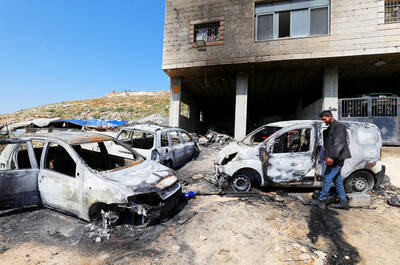
RAMPAGE: A Palestinian man was left dead after dozens of Israeli settlers searching for a missing 14-year-old boy stormed a village in the Israeli-occupied West Bank US President Joe Biden on Friday said he expected Iran to attack Israel “sooner, rather than later” and warned Tehran not to proceed. Asked by reporters about his message to Iran, Biden simply said: “Don’t,” underscoring Washington’s commitment to defend Israel. “We are devoted to the defense of Israel. We will support Israel. We will help defend Israel and Iran will not succeed,” he said. Biden said he would not divulge secure information, but said his expectation was that an attack could come “sooner, rather than later.” Israel braced on Friday for an attack by Iran or its proxies as warnings grew of


 RSS
RSS